






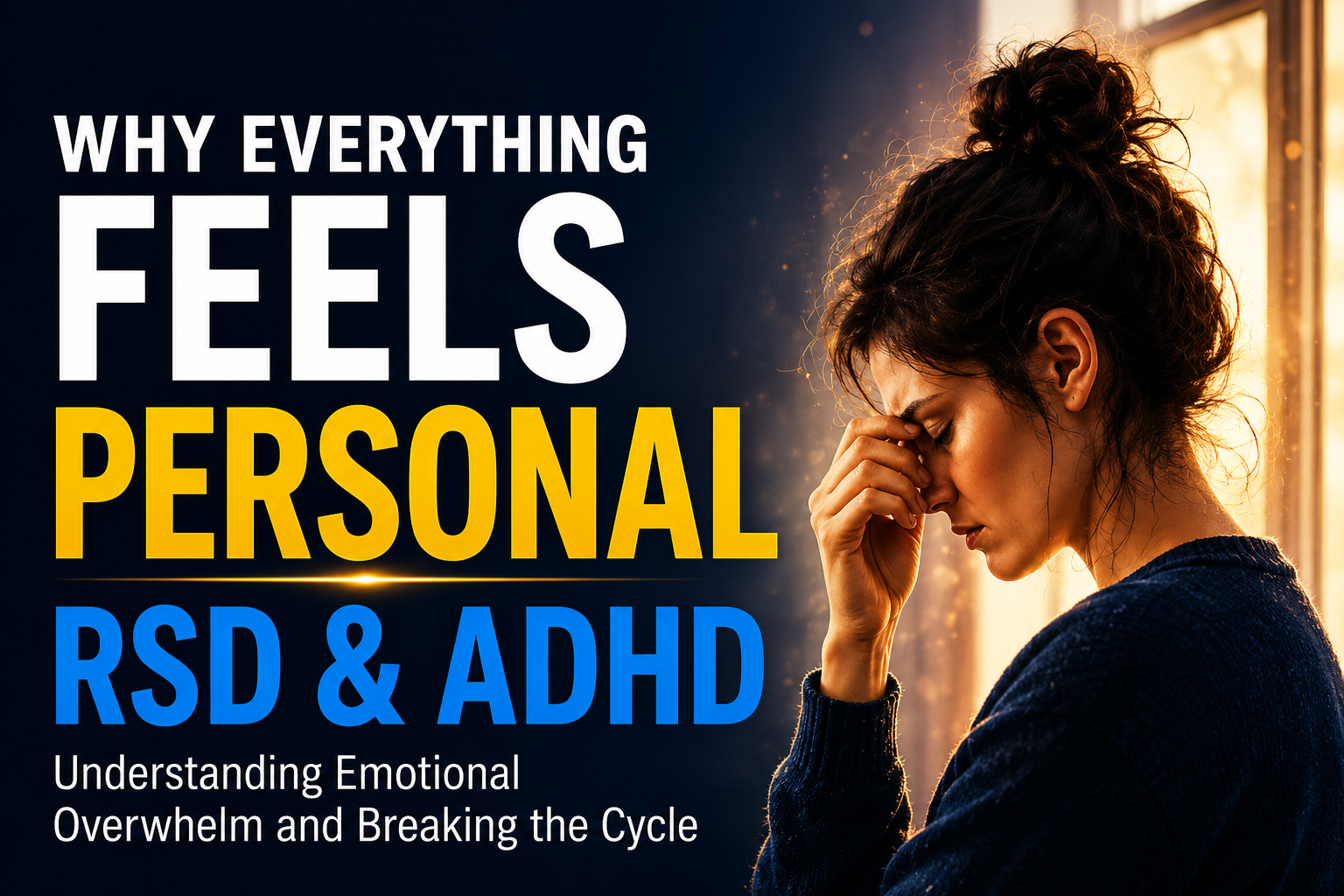
Understanding the Emotional Pattern Behind Overthinking, People-Pleasing, and Feeling Everything Too Deeply
There are people who move through criticism quickly, who can hear difficult feedback without emotionally collapsing, and who seem capable of separating what happened from what it means about them as a person. Then there are others who experience emotional reactions with an intensity that feels immediate, physical, and impossible to shut off once activated. A short message can suddenly feel loaded with hidden meaning. A delayed response can trigger anxiety. A small change in tone can spiral into hours of overthinking. Conversations replay repeatedly in the mind long after they end, not because the person wants to obsess, but because the emotional system never fully deactivated in the first place.
For many individuals, especially those with ADHD or heightened emotional sensitivity, this experience creates years of confusion and self-judgment because the reactions often feel disproportionate even to the person experiencing them. They know intellectually that someone’s comment should not hurt this much. They understand logically that a minor misunderstanding does not define their worth. Yet emotionally, the reaction feels absolute, consuming, and deeply personal in ways that are difficult to explain to people who do not experience the same internal intensity.
This is one of the reasons Rejection Sensitive Dysphoria, often referred to as RSD, has become an increasingly important conversation in psychology, emotional regulation, and neurodivergent mental health. While many people assume RSD simply means “being too sensitive,” the reality is far more complex and neurologically structured than that simplistic interpretation suggests.
At its core, RSD is not merely about emotional sensitivity itself. It is about the speed and intensity with which the brain interprets perceived rejection, criticism, disappointment, exclusion, or disapproval and immediately links that moment to identity, worth, belonging, and emotional safety. What makes the experience so overwhelming is not only the trigger itself, but the meaning the nervous system assigns to it almost instantaneously.
For many people living with this pattern, the emotional escalation happens so quickly that there is almost no separation between event and interpretation. A comment becomes proof of failure. A disagreement becomes evidence of abandonment. A mistake becomes confirmation of inadequacy. Even neutral situations can become emotionally loaded because the brain has already learned to scan constantly for signs of rejection, criticism, or disconnection.
Over time, this creates exhausting emotional loops that affect nearly every area of life. Relationships become emotionally fragile because reassurance is constantly needed to feel safe. Workplace feedback feels devastating rather than constructive. Social interactions become mentally exhausting because every conversation is analyzed afterward for hidden meaning, tone shifts, or perceived mistakes. Many people become chronic people-pleasers not because they lack boundaries, but because preventing rejection begins to feel psychologically necessary for emotional stability.
What makes this pattern particularly difficult is that most traditional advice fails completely for people experiencing RSD. Phrases like “don’t take it personally,” “just let it go,” or “stop overthinking” rarely help because the emotional system has already activated before conscious logic can intervene. The nervous system reacts first. Rational analysis comes later, often long after the emotional spiral has already taken hold.
This is why understanding the structure behind emotional reactions becomes so important.
When people finally begin recognizing the sequence behind these experiences, they often discover that their reactions are not random at all. There is usually a highly predictable pattern beneath the overwhelm itself. First comes the trigger, sometimes obvious and sometimes subtle. Then comes interpretation, where the brain rapidly assigns meaning to the event. That meaning becomes linked to identity, worth, or fear of disconnection. Once this happens, emotional escalation accelerates quickly through overthinking, rumination, shame, anxiety, defensiveness, withdrawal, or emotional collapse.
Without understanding this structure, people often spend years trying to control emotions after they have already intensified instead of learning how to interrupt the process earlier, before interpretation hardens into emotional certainty.
One of the most transformative aspects of understanding RSD is realizing that emotional intensity does not mean emotional weakness. In many cases, highly emotionally reactive individuals are also deeply empathetic, perceptive, intuitive, self-aware, and psychologically observant. They notice subtle shifts others miss. They process interpersonal dynamics deeply. They care intensely about relationships, connection, meaning, and emotional authenticity.
The problem is not emotional depth itself.
The problem occurs when every emotional experience becomes fused with identity and self-worth in ways that create chronic emotional instability and exhaustion.
This distinction matters enormously because healing does not require becoming emotionally numb, detached, or less caring. True emotional regulation is not about suppressing reactions or pretending not to feel deeply. It is about creating enough internal separation between what happens externally and what the mind immediately concludes internally.
People who begin understanding RSD often describe an unexpected sense of relief because, for the first time, their emotional patterns stop feeling irrational or shameful. Instead of viewing themselves as “too sensitive,” they begin recognizing that there is an actual neurological and psychological mechanism shaping these reactions beneath the surface.
And once a pattern can be understood clearly, it can also begin to change.
Learning how to slow emotional escalation, challenge automatic interpretation, regulate nervous system activation, and separate identity from external feedback creates a very different internal experience over time. Criticism no longer feels like emotional annihilation. Disagreement no longer automatically threatens connection. Emotional reactions become something that can be observed, understood, and managed rather than feared.
For many people, this process becomes far more than emotional regulation alone.
It becomes the beginning of finally feeling emotionally safe within themselves.


