




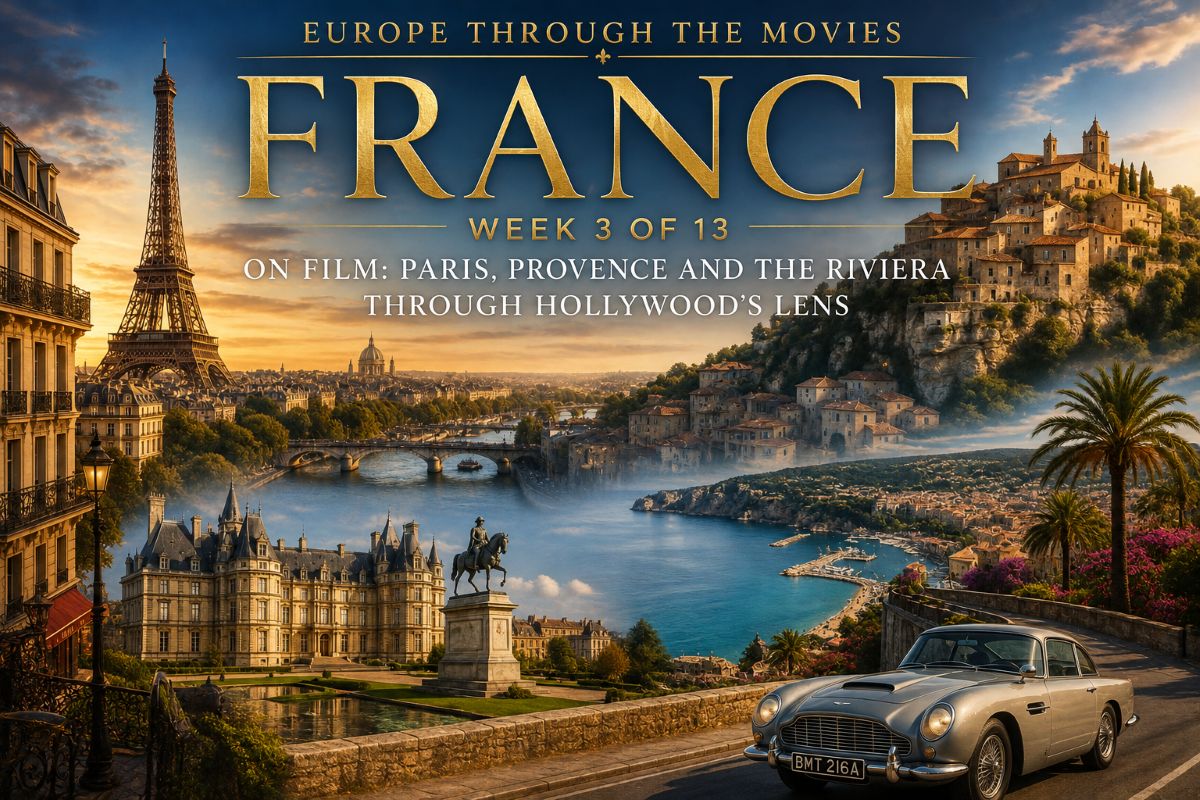
France occupies a singular position in the history of cinema because it is simultaneously one of the places where the medium was born and one of the landscapes filmmakers have spent more than a century turning into desire. The most iconic filming locations in France extend far beyond the instantly recognizable monuments of Paris, encompassing the Mediterranean glamour of the French Riviera, the sun-saturated villages and vineyards of Provence, the vertiginous roads above the Côte d’Azur, medieval towns, châteaux and landscapes whose identities seem almost pre-designed for the camera. Paris has been fractured and folded into impossible geometry in Inception, transformed into an arena for Ethan Hunt in Mission: Impossible – Fallout, romanticized, threatened, chased through and reinvented by generations of international filmmakers; the Riviera has supplied the dangerous elegance required by James Bond and the high-speed tension of Ronin; while Provence became an idealized landscape of reinvention in A Good Year. To visit famous movie locations in France is therefore not simply to locate where particular scenes were filmed, but to enter a country whose streets, architecture and landscapes have helped establish the visual grammar through which international audiences imagine Europe itself.
The deeper fascination of France film tourism lies in the fact that filmmakers rarely use the country as neutral scenery, because France arrives on screen already carrying an enormous accumulation of cultural meaning. Paris can signify romance, intellectual freedom, political power, artistic ambition, danger or sophisticated criminality depending upon where the camera is placed; the French Riviera filming locations around Nice, Cannes and the Mediterranean coast can communicate wealth and sensuality while simultaneously suggesting secrecy, risk and escape; Provence can slow narrative time until vineyards, stone farmhouses, village markets and summer light become arguments for another way of living. That symbolic density explains why productions as different as Inception, Mission: Impossible, Ronin, GoldenEye, To Catch a Thief and A Good Year can draw upon France without repeating one another. They are not merely photographing attractive places; they are selecting different psychological versions of France, using geography to tell audiences what kind of world they have entered before the story explicitly explains it.
Following these iconic French movie locations you can visit consequently becomes a journey through the ways cinema transforms geography into emotion, beginning in Paris, where Christopher Nolan made familiar streets physically impossible and Mission: Impossible converted monuments into the architecture of pursuit, before moving south toward Provence, where Ridley Scott discovered a radically different cinematic rhythm, and onward to Cannes, Nice and the Côte d’Azur, where Hitchcock, James Bond and generations of filmmakers recognized that beauty becomes dramatically more interesting when danger is allowed to enter it. Along the way, the distinction between film tourism and serious travel begins to dissolve, because understanding why directors chose these locations changes the way they are seen in reality: Paris becomes more than a collection of monuments, Provence more than picturesque countryside, and the Riviera more than an expensive coastline, revealing instead a country whose extraordinary cinematic power comes from the fact that its landscapes already contain stories before filmmakers arrive.


Unlock the Entire Empowering Entertainment Library
This article is only the beginning.
Become a member and enjoy unlimited access to every premium magazine article, expert interviews, in-depth features, practical guides, and a growing digital library of hundreds of books covering business, entrepreneurship, film production, personal growth, health, relationships, AI, ADHD, and much more.
One membership. Hundreds of resources. New content added every week.