







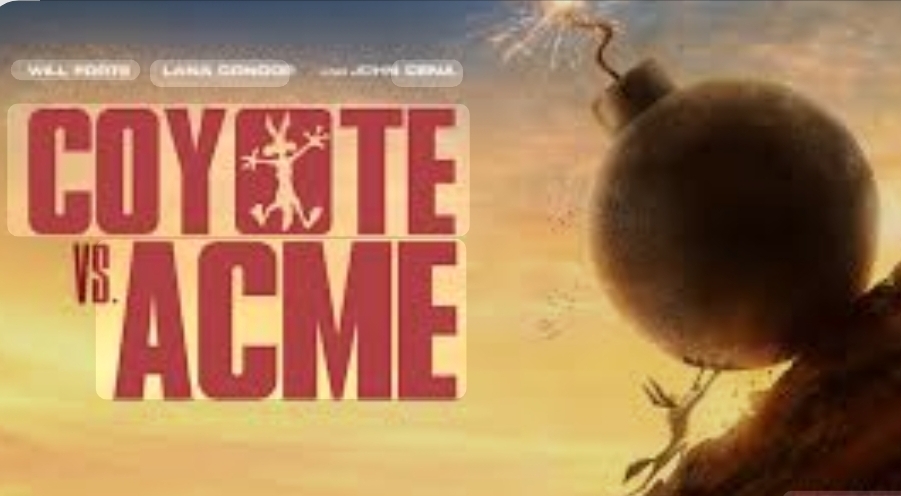
Dave Green made a film about one of popular culture’s most persistent characters, only to watch the film itself endure a remarkably similar ordeal. What emerged is more than the unlikely survival story of a Hollywood production; it is an accidental reflection on artistic legacy, corporate power, creative persistence and why Wile E. Coyote may have been the perfect character for this particular moment in cinema.
There is an exquisite irony at the heart of Dave Green’s Coyote vs. Acme that no screenwriter could reasonably have planned. Wile E. Coyote has spent generations purchasing increasingly elaborate products from the Acme Corporation, trusting that the next rocket, catapult, explosive device or mechanically improbable contraption will finally deliver the result promised on the box. It almost never does. The machinery malfunctions, physics turns against him, gravity waits until precisely the funniest possible moment to intervene, and the Coyote inevitably finds himself flattened against a canyon wall or standing beneath something extraordinarily heavy that is about to fall on his head. Yet the defining characteristic of Wile E. Coyote has never really been failure. It is his extraordinary willingness to continue after failure has provided him with every conceivable reason to stop.
That makes the journey of Coyote vs. Acme one of those rare moments when the history surrounding a film becomes inseparable from the film itself. Green completed a major studio picture based on one of Warner Bros.’ most recognizable characters, combining live action and animation around the wonderfully absurd premise that Wile E. Coyote finally decides to hold Acme legally responsible for the decades of defective products that have repeatedly injured him. Then the completed movie encountered its own institutional adversary. Warner Bros. announced in 2023 that the film would not be released, prompting an unusually intense reaction across the filmmaking and animation communities and transforming what might have been another studio comedy into a symbol of a much larger argument about the value of creative work in an increasingly financialized entertainment industry. After an extraordinary period in which its future remained uncertain, the film eventually escaped its apparent fate and found a new theatrical life through Ketchup Entertainment.
There is an obvious temptation to tell this merely as the story of “the movie that was saved,” but that description undersells what makes the episode fascinating. Coyote vs. Acme inadvertently became an extension of the mythology Green was attempting to place on screen. The protagonist is a character who has spent more than seventy years confronting a world that repeatedly destroys his plans without ever destroying his determination, while the film bearing his name became a completed creative work confronted by a corporate decision that could have removed it from public existence altogether. The parallel is almost unnervingly perfect: a movie about a small, battered figure challenging the enormous company whose decisions have caused his suffering became a movie whose own existence depended upon surviving the decisions of an enormous company.
DIRECTING AN ICON WITHOUT TURNING HIM INTO A RELIC
That remarkable production history could easily overwhelm discussion of the filmmaking itself, which would be unfortunate because Dave Green faced a creative challenge considerably more complicated than simply placing familiar cartoon characters inside a contemporary movie. Looney Tunes occupies an unusual position in popular culture. These characters are nostalgic without belonging exclusively to nostalgia, enormously valuable as intellectual property yet fundamentally anarchic in personality, instantly recognizable to audiences who may never have watched the original theatrical shorts in the environment for which they were created. Their longevity creates a paradox for any filmmaker entrusted with them: modernization is necessary if they are to continue living, but excessive modernization can remove precisely the qualities that made them worth preserving.
Green’s approach appears particularly interesting because it begins with respect for the characters rather than embarrassment about their age. He has spoken about the responsibility involved in temporarily inheriting cultural figures whose histories extend far beyond the careers of the people currently making films about them. That idea of stewardship is significant. There is a profound difference between approaching a legacy property as intellectual property available for reinvention and approaching it as a creative language that must first be understood before it can be extended. The former encourages filmmakers to ask how an old character can be made relevant to contemporary audiences; the latter begins with the more demanding question of why the character remained relevant long enough for another generation of filmmakers to inherit it.
Wile E. Coyote provides an especially fascinating answer because very little about him should have survived according to conventional theories of entertainment. His central objective barely changes, his plans almost always end identically, his dialogue is minimal in the classic Road Runner shorts, and audiences enter virtually every encounter knowing that he will fail. Yet repetition never destroyed the joke because the joke was never simply whether the Coyote would catch the Road Runner. The pleasure came from watching intelligence, arrogance, ingenuity, optimism and the laws of physics collide in increasingly inventive combinations. We knew the destination; artistry existed in the route taken to reach it.
THE SERIOUS ARCHITECTURE BEHIND ABSURDITY
One of the most intelligent aspects of Green’s conception is his decision not to treat animated characters as visitors entering an otherwise recognizable human reality. Instead, humans and cartoons simply occupy the same world, allowing the film to avoid spending valuable narrative energy explaining an absurdity that becomes considerably funnier when everyone accepts it. Wile E. Coyote does not require a metaphysical explanation for his existence; he requires legal representation. The more seriously the surrounding world treats that proposition, the more space the comedy has to operate.
That decision also reflects one of the fundamental principles underlying great screen comedy: absurdity frequently becomes stronger when the filmmaking surrounding it remains disciplined. The classic Looney Tunes cartoons understood this exceptionally well. Their universe could stretch, explode and temporarily suspend the laws of nature, but character motivation remained remarkably precise. Wile E. Coyote genuinely wants to catch the Road Runner, Daffy Duck genuinely believes he deserves recognition, and Bugs Bunny can transform an entire environment into chaos because someone has violated a boundary he considers important. Their objectives are treated with absolute conviction, and it is precisely that conviction that permits the audience to embrace the insanity surrounding them.
Green’s decision to photograph much of Coyote vs. Acme in real locations around Albuquerque therefore becomes more than an aesthetic choice. A tangible physical environment gives animated impossibility something against which to collide. Concrete, desert, courtrooms, roads, offices and ordinary human spaces provide resistance to the elasticity of a cartoon character, while the cartoon character introduces unpredictability into environments governed by recognizable physical rules. The relationship between those two realities becomes the visual joke, but it also allows Coyote to remain recognizably himself rather than becoming merely another computer-generated character occupying a digital environment.
DIRECTING A PERFORMANCE THAT DOES NOT YET EXIST
Hybrid filmmaking also requires a form of directorial imagination that audiences rarely have reason to consider. An animated character appearing perfectly integrated into a finished frame can make the process seem effortless, yet during principal photography that character may exist only as measurements, reference points, temporary stand-ins and an extraordinarily detailed shared understanding of what will eventually occupy an empty portion of the image. Human performers must establish emotional relationships with characters who are not physically present, background actors must direct their attention toward precise locations, camera movement must anticipate bodies that will not exist until much later, and physical comedy must preserve timing between live performers and animated ones whose final performances remain unfinished.
For a filmmaker working with Looney Tunes, that challenge becomes even more demanding because timing is not merely technical; timing is the language itself. The original cartoons were constructed with extraordinary control over anticipation, acceleration, impact and reaction. The difference between an ordinary gag and a memorable one can exist within fractions of a second. An object falling onto Wile E. Coyote is not inherently funny. What matters is when he realizes it is falling, how long the universe permits him to contemplate his situation, whether he looks at the audience before impact, and precisely how much time passes before gravity completes the joke. Recreating that rhythm inside live-action filmmaking requires far more than visual-effects competence. It requires understanding the grammar of animation deeply enough to translate it without sterilizing it.
This is where Green’s role deserves considerably more attention than the unusual industrial story surrounding the release. A director working with such recognizable characters must simultaneously protect memory and create surprise. The audience already knows what Coyote looks like, how he moves and what kind of catastrophe follows his elaborate plans, which means novelty cannot simply come from recognition. It has to emerge from context, performance, staging and the collision between an established character and circumstances he has never previously encountered. Putting Wile E. Coyote inside the American legal system is funny not because it abandons his mythology but because it extends that mythology to its logical conclusion: after decades of catastrophic product failure, perhaps litigation really is the one strategy he had not yet attempted.
WHEN A COMEDY BECAME AN ARGUMENT ABOUT CINEMA
The attempted shelving of Coyote vs. Acme also touched a nerve because it arrived during a period when Hollywood’s relationship with finished creative work was changing visibly. Streaming economics, consolidation, tax strategy, shifting distribution models and the pressure placed upon entertainment companies to extract measurable value from enormous libraries of intellectual property have altered the meaning of what it means for a film to be “finished.” For most of cinema history, completion implied an expectation of exhibition. A finished movie might fail commercially, receive poor distribution or disappear quickly, but the fundamental objective remained to place the work before an audience. The controversy surrounding Coyote vs. Acme exposed the uncomfortable possibility that under certain modern corporate calculations, a completed film could conceivably possess economic value precisely because audiences would not see it.
That distinction matters because filmmaking is not an abstract asset assembled entirely inside a balance sheet. A completed feature represents years of accumulated human decisions: performances given, sets constructed, images photographed, music composed, frames animated, scenes edited, problems solved and careers temporarily organized around the creation of something intended for public experience. None of this means that every film has an automatic right to commercial success, nor does it eliminate the economic realities facing studios financing expensive productions. It does, however, explain why the response to Coyote vs. Acme extended beyond ordinary disappointment over a cancelled release. For many people inside the creative community, the film came to represent a more unsettling question about whether the traditional relationship between making art and showing art was itself becoming negotiable.
The fact that this particular film became the center of that conversation only deepened the irony. Wile E. Coyote’s fictional grievance against Acme rests upon a simple imbalance of power: he is the endlessly hopeful customer, while Acme is the enormous institution manufacturing the tools upon which his ambitions depend. The legal premise turns decades of slapstick into a question of responsibility. Once the film itself became entangled in a corporate struggle over whether it would reach audiences, the satire acquired an accidental second dimension that could never have been designed during development.
WHY WILE E. COYOTE HAS ALWAYS BEEN MORE HUMAN THAN WE THINK
Perhaps the enduring genius of Wile E. Coyote is that underneath the explosives, cliffs and impossible machinery lies a surprisingly recognizable human impulse. He believes that the next attempt will be different. His evidence does not support that belief, his history actively contradicts it, and the universe appears to have developed a personal interest in proving him wrong, yet he continues constructing increasingly ambitious solutions to a problem he has never managed to solve. We laugh because his confidence is absurd, but somewhere beneath that laughter sits recognition. Entrepreneurs understand him. Artists understand him. Inventors, filmmakers and anyone who has pursued an objective long after rational evidence suggested abandoning it understand him rather well.
That persistence is fundamentally different from optimism. Optimism expects things to improve; Wile E. Coyote keeps moving even when experience provides almost no reason to expect improvement. In that sense, his endless pursuit has always contained something unexpectedly noble beneath the slapstick. Failure may temporarily change his physical dimensions, cover him in soot or send him thousands of feet toward the desert floor, but it never acquires the authority to tell him who he is. His identity remains attached to pursuit rather than outcome.
It is difficult not to see something of that spirit in the survival of Dave Green’s film. Coyote vs. Acme endured an experience that would ordinarily constitute the final chapter of a movie’s history. It was made, completed and then faced the possibility that completion would never lead to an audience. Yet filmmakers spoke about it, people who had seen it advocated for it, the creative community refused to allow the story to disappear quietly, and eventually another company saw enough value in the work to give it the theatrical future that had once seemed impossible.
DAVE GREEN’S FILM NOW CARRIES SOMETHING NO MARKETING CAMPAIGN COULD HAVE CREATED
Whatever audiences ultimately decide about Coyote vs. Acme as entertainment, they will now encounter a film carrying an extraordinary layer of meaning that did not exist when the cameras first rolled. Every story has a production history, but occasionally that history changes the way the finished work can be understood. Francis Ford Coppola’s battles making Apocalypse Now, Terry Gilliam’s famously impossible productions and the turbulent histories behind countless independent films have become part of their mythology because struggle alters the cultural object surrounding the images on screen. Coyote vs. Acme enters that tradition from an unusually contemporary direction: its greatest battle occurred after much of the traditional filmmaking battle had already been won.
For Green, that creates an unusual artistic legacy. He directed a movie about persistence without knowing that persistence would eventually become the defining story surrounding the movie itself. He took responsibility for characters created generations before him, attempted to preserve the visual and comedic intelligence that made them enduring, and built a contemporary cinematic environment in which an animated coyote could stand beside human actors without surrendering the qualities that made him an icon. Then, after the filmmaking was largely complete, circumstances supplied the picture with a metaphor no director could have staged.
There is something deeply appropriate about the fact that Wile E. Coyote should become the character attached to a story like this. Bugs Bunny probably would have outsmarted the corporation before lunch. Daffy Duck would have spent three acts demanding to know why somebody else received better billing. The Road Runner would simply have vanished over the horizon. Wile E. Coyote, however, would do what he has always done: absorb the catastrophe, study the wreckage and begin constructing another impossible machine.
That may ultimately be why Coyote vs. Acme deserves to be remembered as more than an unusual Hollywood rescue story. Its journey exposes some of the most complicated tensions inside contemporary filmmaking—the collision between creativity and corporate economics, the difficulty of protecting cultural legacy while allowing it to evolve, the invisible craftsmanship behind hybrid filmmaking, and the uncomfortable vulnerability of finished art inside institutions powerful enough to determine whether audiences will ever encounter it.
Yet its survival also provides a strangely beautiful counterargument to all of that machinery. A corporation can calculate the value of a film, a distributor can calculate the size of an audience, and an industry can calculate risk with extraordinary sophistication, but creative work sometimes develops a cultural momentum that proves considerably harder to quantify. People cared that this movie existed. They cared that artists had made it. They cared that it might disappear. Eventually, that persistence mattered.
Dave Green set out to direct Wile E. Coyote. Through one of the most extraordinary coincidences Hollywood could have produced, his film was eventually forced to demonstrate the very quality that has kept the Coyote alive for generations: the refusal to accept that catastrophe necessarily means the story is over.
Perhaps that is the most fitting ending imaginable for a character whose entire existence has been built around discovering that the bottom of a canyon is never quite the end of the road.


