




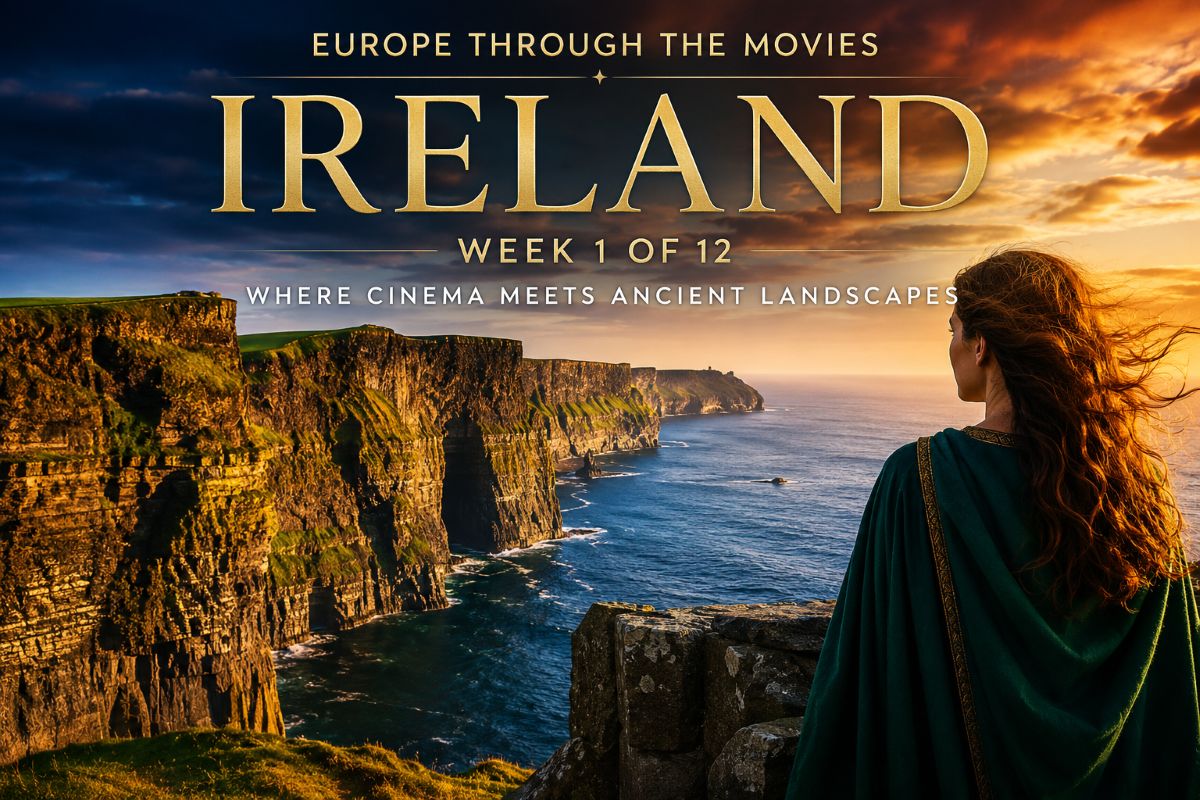
Ireland has always possessed the kind of landscape cinema normally has to invent: Atlantic cliffs rising almost vertically from violent water, green valleys enclosed by mountains, ruined monasteries standing where communities disappeared centuries ago, prehistoric stone structures occupying land that still feels astonishingly exposed, and coastlines so dramatically shaped by weather that they appear to belong as naturally to mythology as to geography. It is therefore unsurprising that some of the most iconic filming locations in Ireland have been transformed into worlds far removed from modern Ireland itself. Skellig Michael became Ahch-To, the remote refuge of Luke Skywalker in the Star Wars sequel trilogy; the Cliffs of Moher entered the wizarding world of Harry Potter and the Half-Blood Prince; the landscapes of County Wicklow have supported productions ranging from Braveheart to Vikings; while Ireland's western coastline, ancient ruins and mountain interiors have repeatedly offered filmmakers something increasingly difficult to manufacture convincingly: a sense that the world existed long before the characters entered it.
Yet the real fascination of Ireland film tourism begins when we stop treating these places as beautiful backgrounds and ask why filmmakers choose them in the first place, because Ireland's cinematic power is rooted in something more sophisticated than spectacular scenery. Its strongest locations contain what might be called narrative memory: Skellig Michael is not an artificially aged ruin but the surviving remains of a monastic community established more than a millennium ago on an almost impossibly remote Atlantic rock; the Cliffs of Moher do not merely look dangerous but physically expose the human body to immense vertical scale, wind and ocean; Wicklow's mountains and glacial valleys create genuine geographical isolation within relatively easy reach of Dublin; and places such as Dún Aonghasa on Inis Mór confront visitors with prehistoric architecture positioned against an Atlantic landscape whose scale makes human occupation appear both extraordinarily fragile and extraordinarily persistent. When cinema photographs such places, it inherits meanings created by geology, history and human survival before production design contributes anything at all.
Following the most famous movie locations in Ireland you can actually visit therefore becomes much more than a tour of recognizable frames, because the journey reveals how cinema converts real geography into emotional architecture. We will travel to Skellig Michael to understand why Star Wars needed an ancient Irish monastery rather than a digitally invented Jedi sanctuary, stand above the Atlantic at the Cliffs of Moher and examine why Harry Potter used geographical extremity to make supernatural danger feel physically credible, move through Wicklow to explore how Irish terrain has repeatedly become medieval Scotland, Norse territory and other imagined worlds, and continue west toward the Aran Islands, where Dún Aonghasa demonstrates that some real locations possess a visual authority no franchise could create for itself. Ireland is where this thirteen-week journey begins because it exposes the fundamental principle that will follow us across Europe: the most powerful filming locations do not simply give movies somewhere beautiful to happen; they give fictional worlds a past.


Unlock the Entire Empowering Entertainment Library
This article is only the beginning.
Become a member and enjoy unlimited access to every premium magazine article, expert interviews, in-depth features, practical guides, and a growing digital library of hundreds of books covering business, entrepreneurship, film production, personal growth, health, relationships, AI, ADHD, and much more.
One membership. Hundreds of resources. New content added every week.