





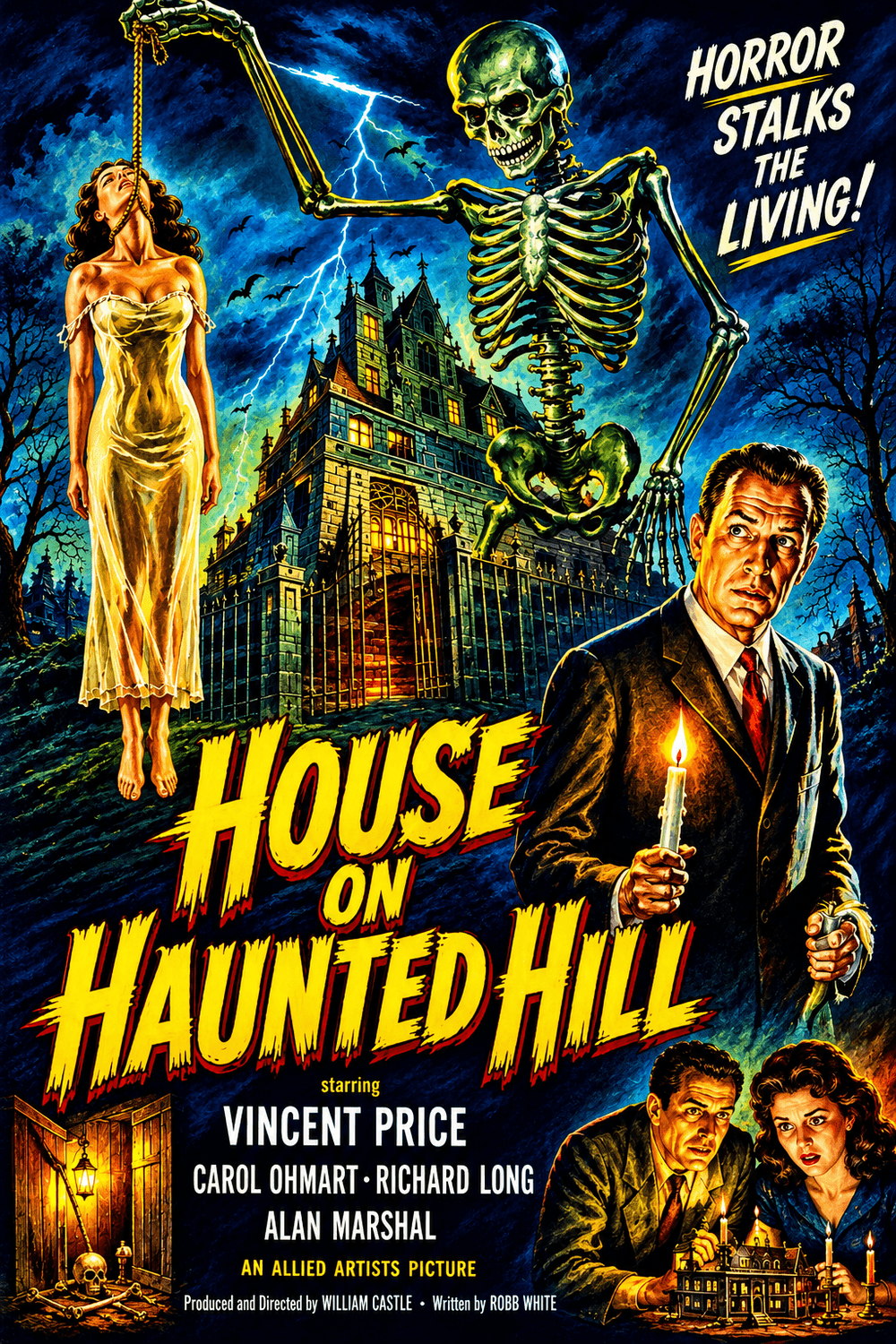
A Haunted House Built from Human Distrust
When House on Haunted Hill was released in 1959, it entered a long tradition of stories in which strangers are brought together inside an isolated mansion and forced to confront forces they cannot immediately understand. Yet William Castle’s film does something more psychologically sophisticated than simply placing frightened guests in a building filled with ghosts, secret rooms, severed heads, and unexplained noises. Beneath its carnival pleasures lies a story about manipulation, marital hatred, financial desperation, and the ease with which fear can make intelligent people surrender their judgment to whoever controls the environment around them.
https://youtu.be/g5AnMM_Mav8
Produced and directed by William Castle from a screenplay by Robb White, the film stars Vincent Price as wealthy eccentric Frederick Loren, Carol Ohmart as his wife Annabelle, and Elisha Cook Jr. as Watson Pritchard, the visibly terrified owner of the house. Frederick invites five strangers to spend an entire night inside the mansion and promises each of them $10,000 if they remain until morning. Once the doors are locked, however, the guests discover that the challenge is not simply to endure a frightening location. They have entered a carefully constructed psychological contest in which almost everyone possesses hidden motives and no one can be certain whether the danger comes from the dead, the living, or the interaction between them. (AFI Catalog)
The house is supposedly haunted by the victims of several brutal murders, but the film’s deepest source of unease is not the possibility that ghosts remain inside its walls. It is the certainty that the people gathered there are already capable of betrayal, deception, and violence without supernatural assistance. The building intensifies these tendencies by removing ordinary social protections, locking the guests together, and surrounding them with enough ambiguity that every fear can be interpreted as evidence.
Frederick Loren and the Performance of Control
Vincent Price’s Frederick Loren is introduced not merely as a wealthy man but as a director of human behavior. He has selected the guests, established the reward, arranged the timing, rented the house, and determined the conditions under which everyone will remain trapped until morning. Even before the doors close, he occupies the position of someone who has transformed other people’s financial vulnerability into entertainment.
Frederick’s power does not depend solely upon money. It depends upon his ability to remain emotionally composed while everyone around him becomes increasingly uncertain. He speaks with elegance, irony, and apparent amusement, rarely revealing whether he believes the house is haunted or whether the entire evening has been designed as an elaborate joke. His ambiguity forces others to study him for clues, which strengthens his position because the person who controls the meaning of an event often controls the people trying to survive it.
Price’s performance is particularly effective because Frederick never appears desperate to prove his authority. His control is expressed through stillness, timing, and verbal precision. He allows silence to create discomfort, watches others react before offering his own interpretation, and repeatedly presents danger as though it were another feature of the evening’s entertainment. This detachment makes him difficult to read and therefore difficult to challenge.
Yet Frederick’s composure should not be mistaken for moral stability. He has created a situation in which strangers are encouraged to endanger themselves for money, and he appears fully aware that financial need will pressure them to remain even after leaving would be the rational choice. His hospitality therefore contains a hidden form of coercion. The guests technically agree to the challenge, but their consent is shaped by economic circumstances Frederick has deliberately exploited.
Fear as a Financial Transaction
The promise of $10,000 gives the film a structure that resembles both a psychological experiment and a commercial spectacle. Each guest has been selected because the money matters, which means that fear is immediately placed into competition with need. The house may be dangerous, but leaving would mean surrendering a reward capable of changing their lives.
This arrangement transforms courage into something morally ambiguous. Remaining in the house may appear brave, yet it may also reflect desperation, pride, or an inability to walk away from money once it has become psychologically available. The guests are not simply asking whether the house is safe. They are calculating how much danger they are willing to accept in exchange for financial rescue.
Frederick understands this pressure because wealth has insulated him from the calculations governing everyone else. He can observe their fear as entertainment precisely because he does not need the reward he offers. The money gives him access to their behavior, allowing him to create circumstances in which strangers will tolerate confinement, uncertainty, and escalating danger because the promised outcome seems worth the risk.
The film therefore anticipates a recurring structure in modern entertainment, where people submit to extreme situations because the reward appears capable of justifying almost anything. The ethical imbalance lies in the fact that the person designing the challenge rarely shares the same vulnerability as those performing it. Frederick can treat the evening as theater because the guests experience it as opportunity.
Annabelle Loren and the Violence Beneath Elegance
The relationship between Frederick and Annabelle is the true center of the film because their marriage has moved far beyond resentment into strategic warfare. Their conversations are elegant in form but openly poisonous in meaning, with each remark designed to wound, provoke, or reveal knowledge the other would prefer to conceal. They do not communicate in order to understand one another. They communicate in order to gain advantage.
Carol Ohmart’s Annabelle is composed, glamorous, and emotionally unreadable, making her a powerful counterpart to Price’s theatrical sophistication. She presents herself to the guests as the endangered wife of a dangerous husband, encouraging them to interpret Frederick’s behavior through the possibility that he intends to murder her. Whether she appears frightened, seductive, fragile, or contemptuous depends upon what the moment requires.
The marriage therefore becomes a contest over narrative authority. Frederick suggests that Annabelle has repeatedly attempted to kill him, while Annabelle implies that Frederick has brought everyone to the house as part of a plan to kill her. Each offers a version of the relationship in which the other is the aggressor, and the guests must decide which account deserves belief.
This uncertainty exposes one of the most disturbing characteristics of psychologically abusive relationships: outsiders often encounter competing stories rather than visible proof. Both individuals may appear intelligent, charming, and credible, while every accusation can be interpreted as either warning or manipulation. The absence of certainty does not eliminate danger. It makes intervention more difficult because the observer fears becoming an instrument inside someone else’s conflict.
Frederick and Annabelle know one another too well to maintain ordinary marital illusions. Their intimacy has become weaponized, allowing each to predict the other’s weaknesses and anticipate the meaning hidden behind apparently casual remarks. The marriage is therefore not empty of connection. It contains a highly developed connection organized around hostility.
A Party Without Friendship
The five invited guests do not form a natural social group. They are strangers linked only by Frederick’s invitation and the financial reward, which means that trust must be created under the worst possible conditions. They enter the house already uncertain about the host, the building, one another, and the exact rules of the evening.
This lack of shared history makes the group especially vulnerable to manipulation. Trust ordinarily develops through repeated experience, allowing people to compare words with behavior over time. Inside the house, every judgment must be made quickly, often after frightening or contradictory events. A scream may indicate genuine danger, deliberate deception, panic, or an attempt to draw someone away from safety.
The guests repeatedly separate, investigate noises alone, and form temporary alliances based upon limited information. Their behavior may appear irrational, yet it reflects the difficulty of collective action among people who have no established reason to depend upon one another. Cooperation requires more than being trapped in the same location. It requires confidence that others are not using the crisis for private purposes.
The party therefore resembles a society created overnight without institutions. Frederick establishes the formal rules, but no trusted authority exists to interpret evidence, settle disputes, or protect the vulnerable. The guests must decide for themselves what is real while surrounded by people whose motives remain unclear.
The house does not merely frighten them. It turns uncertainty into a social force.
Watson Pritchard and the Authority of Belief
Watson Pritchard, played by Elisha Cook Jr., enters the story already convinced that the house is genuinely haunted. He knows its history, claims that members of his family died there, and interprets every unexplained event as further confirmation that the dead remain active. His fear appears excessive, but it also gives him a form of authority because he is the only guest who believes he understands the nature of the danger.
Pritchard’s certainty creates an interesting reversal. He is physically nervous and emotionally overwhelmed, yet intellectually he is the least confused because he possesses a complete explanation. The ghosts are real, the house is evil, and anyone who remains inside is in danger. Every new event fits comfortably into this interpretation.
The psychological advantage of such certainty is significant. Ambiguity often produces more distress than danger itself because the mind cannot determine what kind of response is required. Pritchard’s belief removes ambiguity by converting every phenomenon into evidence of haunting. His terror is intense, but it is organized.
The weakness of his position is that a complete explanation can become resistant to correction. Once every sound, disappearance, and visual disturbance is attributed to the supernatural, human manipulation becomes harder to detect. Belief provides emotional coherence while narrowing investigation.
Yet the film refuses to dismiss Pritchard completely. Even after several apparent supernatural events are exposed as human schemes, the conclusion preserves enough uncertainty to suggest that his warnings may not have been entirely foolish. This ambiguity allows the film to maintain two realities at once: human beings have manufactured much of the horror, but the house may still contain something beyond their control.
Nora Manning and the Destruction of Perception
Nora Manning becomes the principal target of psychological manipulation because she is isolated, financially vulnerable, and increasingly unable to trust her own senses. She encounters terrifying images that disappear before others can verify them, including an apparently severed head and the sudden appearance of a grotesque old woman. Each experience weakens her confidence while strengthening the possibility that others will regard her as unstable.
This process resembles gaslighting because the manipulation does not merely frighten Nora. It attacks her ability to establish reality. When she reports what she has seen and no evidence remains, she must choose between believing that the house contains supernatural forces or believing that her own perception has become unreliable.
The distinction is psychologically devastating because human beings depend upon shared confirmation to stabilize experience. An unexplained sight may be dismissed as error when others report nothing unusual, yet repeated private experiences create a widening gap between personal perception and social reality. Nora becomes increasingly desperate because she cannot persuade the group to inhabit the same world she is experiencing.
Her vulnerability is then used to direct her behavior. Fear narrows attention, increases suggestibility, and makes immediate relief more attractive than careful investigation. Once Nora believes she is surrounded by threats no one else can see, she becomes easier to guide toward the actions desired by the conspirators.
The film’s scares therefore serve a strategic function. They are not random attempts to unsettle the audience. They demonstrate how perception can be manipulated until a victim begins participating in the plan constructed against her.
The Personal Coffins and the Expectation of Death
Frederick’s decision to present each guest with a small coffin containing a handgun transforms the party from an eccentric challenge into an explicit rehearsal for violence. The coffins symbolize the possibility that everyone has already been assigned a death, while the weapons ensure that fear can become lethal before anyone has enough information to use them responsibly.
The gesture is theatrical, but its consequences are real. Frederick claims the guns are for protection, yet introducing firearms into a locked house filled with frightened strangers greatly increases the danger. A weapon may provide psychological reassurance, but it also converts misinterpretation into irreversible action.
The coffins reveal Frederick’s understanding of suggestion. By presenting death before anything has happened, he prepares the guests to interpret the night through mortality. Every noise becomes more threatening because the possibility of death has been physically placed into their hands.
The guns also alter the group’s relationships. Each guest knows that everyone else is armed, meaning that fear of the house becomes inseparable from fear of one another. The weapons promise equality because everyone receives one, but they produce greater instability because no one knows whose judgment will fail first.
This is a recurring pattern within systems organized around fear. Protective measures may create additional danger when they are introduced without trust, coordination, or reliable information. The guest who believes a ghost is approaching may fire at a person. The person who believes another guest is part of a conspiracy may act before asking questions. The weapon shortens the distance between suspicion and death.
The House as a Machine for Misinterpretation
The mansion’s architecture supports deception because it contains hidden passages, concealed rooms, staircases, doors, and spaces from which people can watch without being seen. It does not behave like the ancient Gothic castles of earlier horror, where history seems to have transformed stone into a supernatural presence. Instead, it resembles a modern machine designed to manufacture uncertainty.
Its severe exterior, based upon the Ennis House designed by Frank Lloyd Wright, gives the building an unusual visual identity. Rather than appearing decayed or medieval, it looks geometric, monumental, and emotionally cold. This modernity makes the house feel less like a relic of superstition and more like an engineered environment where terror can be produced through design.
The interior constantly disrupts spatial certainty. People disappear behind walls, sounds come from unidentified locations, and rooms appear to contain dangers that vanish as quickly as they arrive. The guests cannot construct a stable mental map, which prevents them from distinguishing accidental separation from deliberate isolation.
Control of architecture becomes control of information. The person who knows the hidden routes can create impossible appearances, move evidence, overhear conversations, and make ordinary actions resemble supernatural events. The house therefore does not need to be alive in order to behave like an adversary. Human intention can animate it.
This is why haunted-house stories remain so psychologically effective. A home is supposed to stabilize identity by providing privacy, familiarity, and predictable boundaries. When rooms, doors, and walls can no longer be trusted, the environment attacks the very assumptions through which safety is experienced.
The Acid Vat and the Material Reality of Death
The enormous vat of acid beneath the house introduces a form of danger more concrete than any ghost. Unlike the ambiguous apparitions and unexplained noises, the acid possesses an undeniable physical capacity to destroy the body completely. It dissolves not only life but evidence, transforming murder into disappearance.
The vat therefore represents the film’s movement from theatrical fear toward actual criminal intent. The guests may initially believe they are participating in an elaborate game, but the presence of a mechanism capable of erasing a corpse reveals that the house has previously contained real violence and can contain it again.
Its location beneath the floor strengthens its symbolic meaning. The elegant social gathering takes place above a substance capable of reducing human identity to nothing. Polite conversation, wealth, glamour, and entertainment remain on the surface, while annihilation waits below.
This vertical structure mirrors the marriage between Frederick and Annabelle. Their sophisticated public personas conceal a relationship organized around fantasies of murder. The acid vat is therefore not simply a convenient plot device. It is the physical expression of what lies beneath their elegance.
The possibility of disappearing without evidence also intensifies the guests’ vulnerability. A person may be killed, but murder ordinarily leaves a body that can provoke investigation, mourning, and accountability. The acid threatens to remove even that final testimony, allowing power to act without consequence.
Annabelle’s Scheme and the Manufacture of a Murderer
As the conspiracy becomes visible, the film reveals that Annabelle and Dr. David Trent have designed the evening to manipulate Nora into killing Frederick. Their plan depends upon creating enough fear and confusion that Nora will believe she is acting in self-defense. The perfect crime therefore requires more than concealing the killer. It requires transforming an innocent person into the apparent killer.
This strategy is especially cruel because it seeks to destroy Nora in two ways. She will either kill Frederick and carry the psychological and legal consequences, or fail and become another disposable witness. Her vulnerability has not merely made her easy to frighten. It has made her useful.
Annabelle’s plan demonstrates a sophisticated understanding of how responsibility can be transferred. Rather than committing the murder directly, she attempts to construct circumstances under which someone else will perform the decisive act. The conspirator becomes less visible because the victim appears to have chosen the action.
The distinction between choice and engineered behavior is central to the film. Nora would physically pull the trigger, but her decision would have been produced through fabricated evidence, emotional destabilization, and false belief. The conspiracy therefore attacks the moral meaning of action by separating the person who acts from the people who designed the conditions.
This pattern extends beyond criminal plots. Human beings frequently influence others while preserving the appearance of independent choice. The most effective manipulation does not always issue a direct command. It controls information, emotional pressure, available options, and timing until the desired action feels self-generated.
Frederick’s Counterplot and the Morality of Anticipation
Frederick eventually reveals that he understood Annabelle’s intentions and constructed his own counterplot. He replaces himself with a dummy, stages his apparent death, and uses a mechanical skeleton to frighten Annabelle toward the acid vat. Her scheme collapses because the man she believed she was manipulating had already anticipated her betrayal.
The reversal is satisfying at the level of suspense because the apparent victim regains control, yet it raises difficult moral questions. Frederick does not merely expose Annabelle and Trent. He engineers circumstances that lead to their deaths. His actions may be interpreted as self-defense, punishment, or premeditated revenge depending upon how much moral weight is assigned to his prior knowledge.
The film encourages the audience to enjoy Frederick’s triumph because Annabelle and Trent intended to murder him. Yet his pleasure in the counterplot complicates any simple claim to innocence. He does not respond like a frightened man narrowly surviving an attack. He behaves like a showman completing a performance.
This theatrical satisfaction reveals the similarity between the spouses. Annabelle uses deception to create murder, while Frederick uses deception to reverse it. Both understand people as pieces inside a design, and both are willing to exploit fear in order to achieve a lethal outcome.
The distinction between them lies partly in who initiated the conspiracy, but the film refuses to transform Frederick into a conventional hero. His intelligence protects him, yet the same intelligence allows him to control everyone in the house with disturbing precision.
Vincent Price and the Seduction of the Dangerous Host
Vincent Price’s performance is crucial because Frederick must remain attractive enough for the audience to follow even while his behavior becomes increasingly questionable. Price accomplishes this through wit, elegance, and a vocal rhythm that transforms threat into entertainment. His presence reassures the viewer while simultaneously warning that reassurance may be misplaced.
This combination became one of Price’s defining strengths. He could communicate menace without abandoning charm, allowing audiences to enjoy the company of characters they would never trust. Frederick’s sophistication therefore becomes part of the danger because charm lowers resistance.
Price also understands that the film’s tone depends upon balancing horror with amusement. Frederick appears aware that he is participating in a bizarre spectacle, and his dry reactions invite the audience to enjoy the artificiality without abandoning suspense. He becomes a bridge between the story and William Castle’s promotional style, functioning almost as an on-screen master of ceremonies.
The performance prevents the film’s theatricality from weakening its psychological tension. Frederick may appear amused, but his amusement suggests that fear is being produced deliberately. The audience is therefore encouraged to laugh while remaining aware that someone is always directing the laughter.
William Castle and Horror as a Live Event
William Castle became famous not only for making horror films but for transforming their exhibition into elaborate public events. For House on Haunted Hill, he created a promotional gimmick called “Emergo,” in which a large plastic skeleton traveled above theater audiences during a key moment in the film. TCM records that the device was designed to sail over moviegoers at the appropriate point, extending the movie’s spectacle beyond the screen and into the auditorium itself. (Turner Classic Movies)
The gimmick may appear crude compared with modern immersive technologies, yet its underlying principle remains remarkably contemporary. Castle understood that audiences do not purchase only a story. They purchase an experience shaped by anticipation, communal reaction, publicity, and the possibility that something unexpected will happen during the screening.
“Emergo” also blurred the boundary between fictional space and physical space. When the skeleton appeared on-screen, another skeleton entered the theater, creating the playful illusion that the film could escape its frame. The audience was no longer watching frightened guests inside a haunted house. They had temporarily become participants inside Castle’s attraction.
This approach reflects the film’s own structure. Frederick invites strangers to experience fear under controlled conditions, while Castle invites audiences to do the same. Both men create environments, promise danger, and maintain enough distance to enjoy the reactions they provoke.
The parallel gives the film an additional layer of self-awareness. Frederick Loren is not merely a character in a William Castle movie. He resembles William Castle within the movie: a charismatic host who gathers people together, warns them that they may be frightened, and then manipulates the conditions of their experience.
Fear as Entertainment and Fear as Evidence
The guests enter the house expecting fear to function as entertainment. They know the location has a murderous reputation, understand that Frederick has arranged a theatrical challenge, and accept that the night may contain staged surprises. This expectation initially protects them because frightening events can be dismissed as part of the game.
The same expectation also makes them vulnerable because genuine danger can hide inside performance. When everything may be a trick, people hesitate to respond decisively. A scream might be staged, a body might be fake, and an apparent threat might be another attempt to increase suspense.
The film repeatedly exploits this uncertainty. The audience knows William Castle is trying to frighten them, just as the guests know Frederick is trying to frighten them, yet neither group can be certain where the performance ends. Artificiality does not eliminate fear because a staged event can still produce an authentic emotional response.
This distinction explains why horror remains effective even when viewers understand its mechanisms. People know that actors are performing, sets are constructed, music is guiding emotion, and visual effects are designed to deceive perception. Yet the body reacts to suggestion before reason can fully neutralize it.
Fear can therefore be false in origin and real in consequence. Nora’s experiences may be manufactured, but her terror is genuine. The skeleton may be mechanical, but Annabelle’s panic produces a fatal result. The theater gimmick may be artificial, but the audience’s scream still belongs to them.
The Skeleton and the Image of Judgment
The mechanical skeleton controlled by Frederick is one of the film’s most memorable images because it functions simultaneously as trick, weapon, and symbol. Annabelle believes the figure emerging from the acid is Frederick’s ghostly remains, returning to punish her for murder. Her fear gives the artificial skeleton supernatural power.
The scene demonstrates that deception succeeds when it confirms what the victim already expects. Annabelle knows she intended Frederick’s death, and therefore the appearance of his skeleton activates guilt as well as fear. The machine does not need to be convincing under calm examination. It needs only to appear at the moment when her mind is prepared to believe it.
The skeleton becomes a form of judgment created from the victim’s own consciousness. Frederick supplies the image, but Annabelle’s guilt supplies its meaning. She retreats not from a collection of artificial bones but from the return of the person she believes she has killed.
This is one of the film’s strongest psychological ideas. People are often most vulnerable to illusions that give visible form to what they already fear internally. Guilt expects exposure, jealousy expects betrayal, and anxiety expects catastrophe. Once an external image matches the internal expectation, skepticism becomes difficult to maintain.
Frederick therefore defeats Annabelle not by overpowering her physically but by directing her imagination. The skeleton moves, yet guilt determines where she runs.
The Unresolved Presence of the Supernatural
Although much of the night’s horror is eventually explained through human conspiracy, the film does not entirely close the possibility that the house is genuinely haunted. Watson Pritchard’s final statements suggest that the dead remain present and that Frederick may eventually join them.
This unresolved element is essential because complete explanation would reduce the house to a stage and every ghost to machinery. By preserving uncertainty, the film allows human deception and supernatural possibility to coexist.
The distinction matters because the conspirators believe they understand the house well enough to use it. Hidden passages, acid vats, darkness, and local legends become tools inside their plans. Yet the possibility of real haunting suggests that no one possesses complete control.
Frederick may triumph over Annabelle, but he does not conquer the house. He survives one night and one conspiracy, yet Pritchard’s warning places his victory inside a larger history of death. The building has contained murder before and may continue to absorb those who enter it.
The house therefore exceeds every individual scheme. Human beings imagine they are using its reputation, but the reputation may be using them by drawing new violence into the same location. Whether ghosts are literally present becomes less important than the pattern through which the house repeatedly turns fear into death.
Why the Film Still Works
House on Haunted Hill remains effective because it understands that haunted-house horror depends less upon proving the existence of ghosts than upon destabilizing trust. The audience does not need certainty that the dead are active. It needs uncertainty about who is controlling events and whether any explanation can be safely accepted.
The film also benefits from its compact structure. At approximately seventy-five minutes, it moves quickly from invitation to confinement, from suspicion to violence, and from supernatural suggestion to criminal revelation. AFI records William Castle as producer and director, Robb White as screenwriter, and Vincent Price, Carol Ohmart, Richard Long, Carolyn Craig, Alan Marshal, and Elisha Cook Jr. among the principal cast, confirming the creative combination that gave the film its enduring identity. (AFI Catalog)
Its theatrical effects may now appear visibly artificial, yet this artificiality has become part of its appeal. The film does not ask to be mistaken for reality. It invites the audience into a carefully staged nightmare where theatrical pleasure and psychological danger reinforce one another.
The strongest moments endure because they are attached to recognizable fears: being trapped with strangers, losing confidence in one’s senses, discovering that a trusted person has constructed a false reality, and realizing that the apparent victim may be controlling the entire situation. These anxieties do not depend upon advanced effects. They depend upon the instability of human interpretation.
The Real Haunting Is the Marriage
The most disturbing force inside the house is ultimately not the ghost of a murdered resident but the hatred between Frederick and Annabelle. Their marriage has accumulated enough resentment that each can imagine the other’s death as both plausible and desirable. The haunted environment merely gives that hostility a stage.
Their relationship demonstrates what happens when intimacy survives after trust has disappeared. They retain knowledge of one another but use that knowledge strategically. They remain connected but organize the connection around suspicion. They continue speaking, yet every sentence contains concealed aggression.
The house reflects this marital condition because it also preserves structure after safety has vanished. It still has rooms, walls, doors, and the external appearance of shelter, but those features no longer guarantee protection. In the same way, Frederick and Annabelle retain the title and appearance of marriage while the relationship beneath has become lethal.
This parallel gives the film greater depth than its carnival reputation might suggest. A haunted house is frightening because something hostile occupies a place meant for safety. A poisoned marriage is frightening for the same reason. The form remains recognizable while its purpose has been reversed.
The Host Who Wins the Game
By morning, Frederick has survived the conspiracy, exposed the plot against him, and retained control of the narrative. The guests may receive their promised money, but they leave knowing they were never simply attending a party. They were witnesses, decoys, potential victims, and pieces inside a conflict they did not understand.
Frederick’s victory is therefore impressive but morally uneasy. He defeats people who intended to murder him, yet he does so by manipulating innocent guests, exploiting Nora’s terror, and transforming the house into a weapon. His survival does not prove that he is good. It proves that he is the superior strategist.
This refusal to provide a conventional hero is part of the film’s enduring charm. Frederick is charismatic enough to enjoy, intelligent enough to admire, and dangerous enough to distrust. He controls the final act because he understands that fear is not merely an emotion. It is a system that can be designed.
House on Haunted Hill leaves audiences with the uneasy recognition that the person who appears least frightened may not be the safest person in the room. He may simply be the person who arranged the fear.
The ghosts may exist, the house may be evil, and the dead may continue watching, but the most effective horrors of the night are created by living people who know how to manipulate money, guilt, desire, architecture, and perception. That is why the film remains more than an entertaining collection of skeletons and secret passages. Beneath its playful surface lies a serious warning about the theater of control: when someone determines the setting, the rules, the information, and the reward, everyone else may believe they are making choices while already performing the role that has been written for them.


