





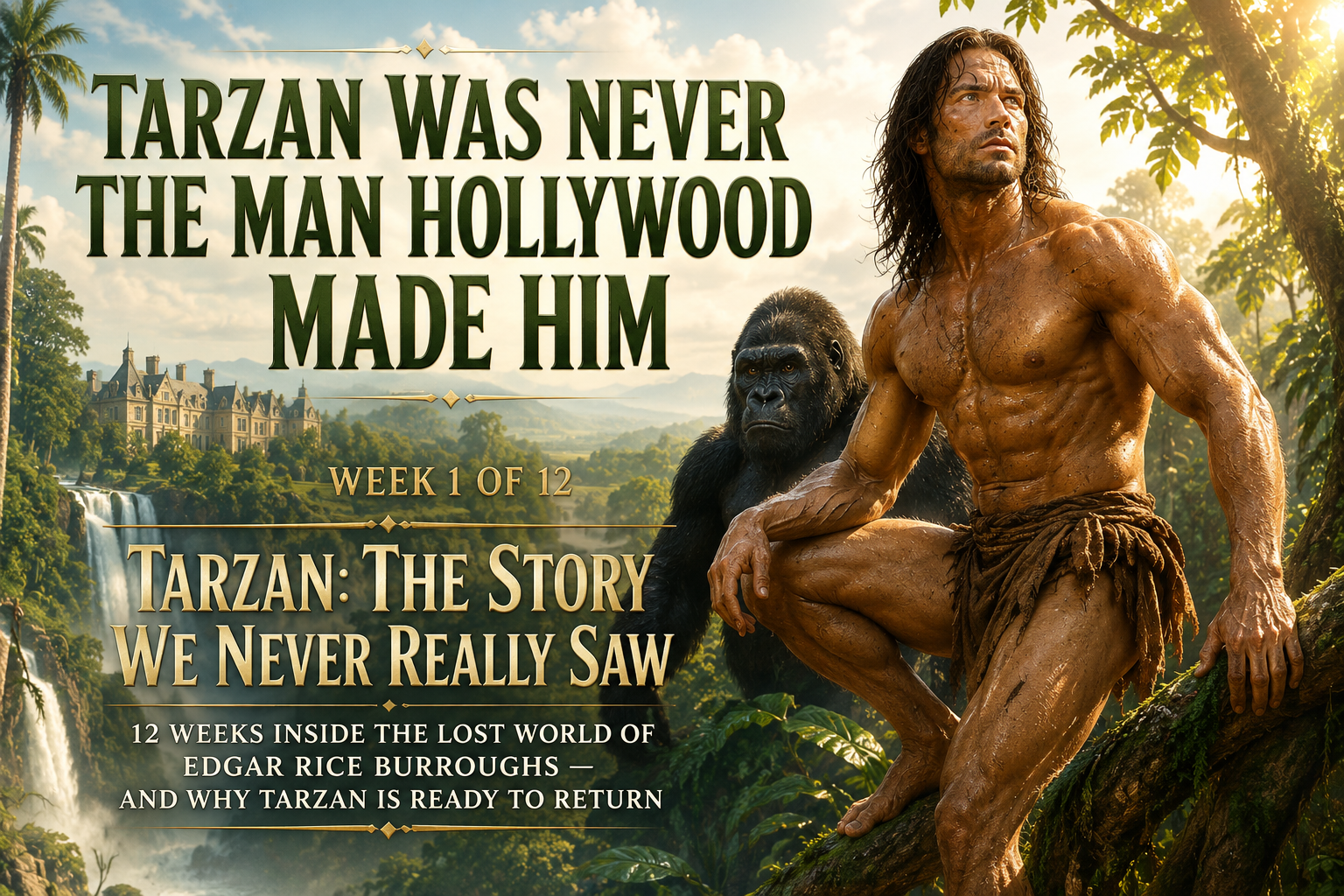
For more than a century, Tarzan has remained one of the most recognizable characters in world literature and cinema, yet the extraordinary paradox of his survival in popular culture is that recognition has gradually replaced understanding. Most audiences know the visual shorthand before they know the man: the jungle canopy, the loincloth, the animals, the vine, the cry, Jane somewhere nearby, and a hero whose relationship with civilization is often reduced to the comic simplicity of a supposedly primitive man learning the habits of the civilized world. That version became so culturally dominant that it obscured the far more complex figure Edgar Rice Burroughs introduced in Tarzan of the Apes in 1912, a character whose story was rooted not merely in physical survival but in identity, intelligence, self-education, aristocratic inheritance, emotional displacement and the tension between two worlds that each had legitimate claims upon him. The original Tarzan was not an empty savage waiting to be civilized, but John Clayton, heir to the Greystoke lineage, a child raised outside human society who constructed knowledge without teachers, developed language through astonishing self-directed effort, learned to survive by compensating for physical disadvantage with observation and strategy, and eventually encountered civilization from the unusual position of someone capable of understanding it without ever having been psychologically formed by it.
Watch classic Tarzan movies and TV series by joining the EE Vault. Click here for more information.
That distinction matters because the original Tarzan story by Edgar Rice Burroughs contains a remarkably sophisticated psychological conflict that many later adaptations either simplified or abandoned. Tarzan grows into a man whose physical identity, emotional loyalties and inherited social position never fully align, because the person called John Clayton by genealogy and Lord Greystoke by inheritance experiences himself first and most deeply as Tarzan, the name under which he learned fear, attachment, violence, intelligence, loss, competence and belonging. Civilization can eventually reveal his ancestry, teach him social convention and recognize his legal position, but it cannot retroactively become the author of the person he has already become, which is why Tarzan's relationship with civilization is far more interesting than the familiar narrative of a wild man being rescued from ignorance. He is capable of entering European society, acquiring languages, understanding manners and moving through aristocratic environments, yet he retains an outsider's ability to see the hypocrisies beneath those surfaces, and that psychological independence turns the character into something richer than a jungle hero: Tarzan becomes a living argument about whether identity is inherited, imposed, discovered or created through experience.
To recover the Tarzan Hollywood largely forgot, we therefore have to strip away a century of accumulated shorthand and return to the contradictions that made the character powerful before cinema turned him into an icon. We have to look at the abandoned child who learned to survive before he understood what a human being was, the reader who deciphered written language before entering human society, the aristocrat who possessed a title without needing it to establish his worth, the lover whose encounter with Jane Porter did not simply introduce romance but destabilized his entire understanding of belonging, and the outsider who could enter civilization without accepting its claim to moral superiority. Once those layers are restored, Tarzan stops looking like an exhausted relic waiting for another nostalgic remake and begins to look like something considerably more provocative: a psychologically divided, globally recognizable character whose most compelling dimensions remain unfamiliar to millions of people who believe they already know him, and whose true story may contain precisely the depth required for a major modern reinvention.


Unlock the Entire Empowering Entertainment Library
This article is only the beginning.
Become a member and enjoy unlimited access to every premium magazine article, expert interviews, in-depth features, practical guides, and a growing digital library of hundreds of books covering business, entrepreneurship, film production, personal growth, health, relationships, AI, ADHD, and much more.
One membership. Hundreds of resources. New content added every week.