






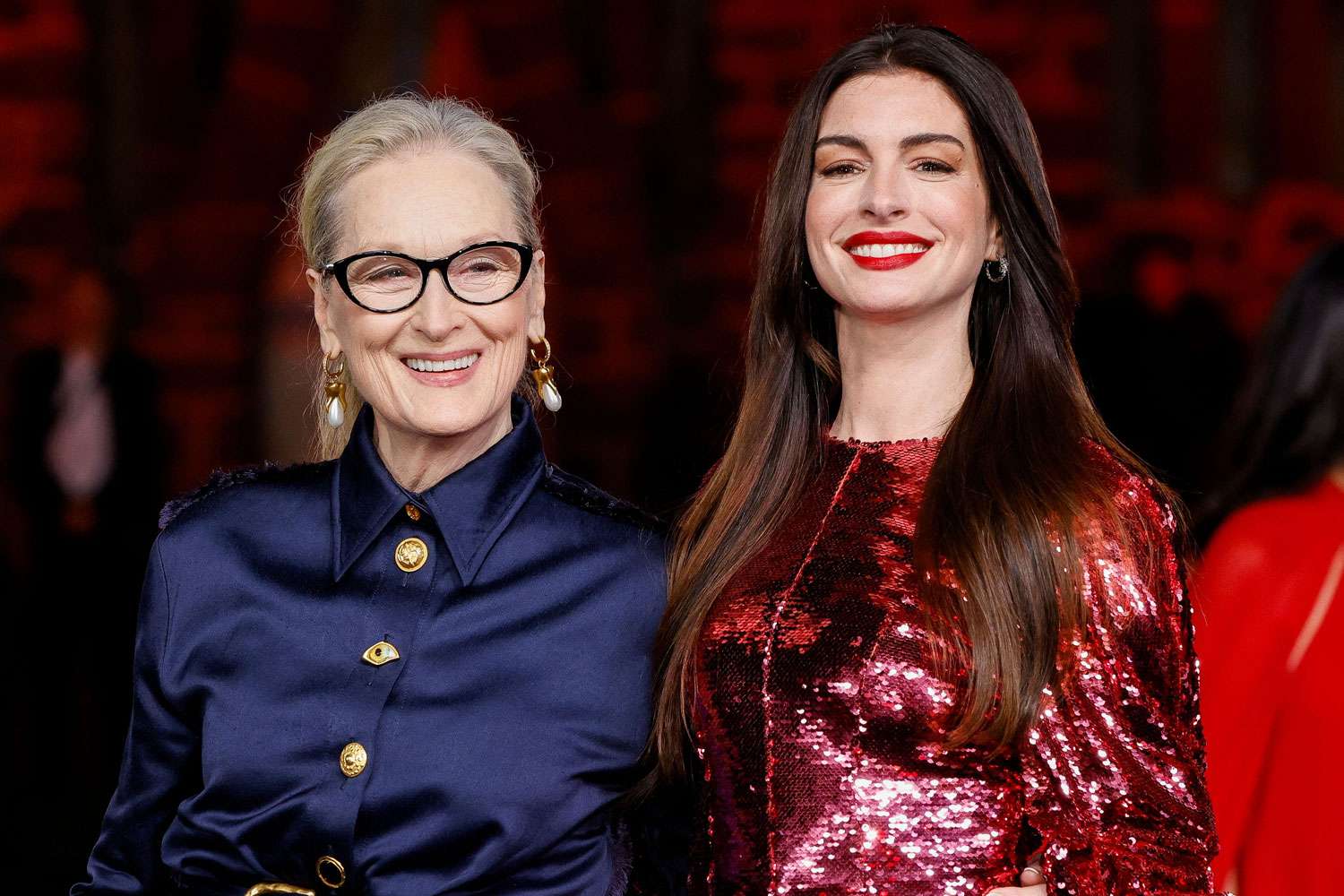
From Meryl Streep’s Witches to Anne Hathaway’s Renaissance, Hollywood Is Quietly Rewriting the Meaning of a Woman’s Age
There is a story Meryl Streep has told about turning 40 that, in retrospect, feels almost archaeological. She was already Meryl Streep: twice an Academy Award winner, one of the most acclaimed actresses of her generation, a performer whose talent was hardly waiting for validation. Yet around the time she crossed that seemingly innocuous numerical threshold, three separate scripts arrived offering her the role of a witch. Not one witch, which might have been coincidence or simply a good part, but three. The message was difficult to miss. Somewhere inside the machinery of Hollywood, a woman had turned 40 and an invisible lever had been pulled. The romantic heroine was apparently leaving the building. The crone was waiting in the wings.
What makes the story remarkable today is not simply how insulting it sounds. It is how strangely dated it feels. Forty has changed so dramatically in the cultural imagination that the old assumptions surrounding it can now seem as antiquated as the studio contracts and rigid star systems of another Hollywood era. The number itself has remained stubbornly identical, of course. Forty years are still 40 years. Biology has not renegotiated the calendar. But socially, aesthetically, professionally and psychologically, the experience of arriving at 40 has been transformed, particularly for women.
Look, by contrast, at Anne Hathaway. At 43, she occupies a position that would have been almost inconceivable under the Hollywood mathematics that greeted Streep several decades earlier. Hathaway is not being quietly transferred into the cinematic category reserved for mothers, eccentrics and witches. She has entered what looks remarkably like another peak. In The Idea of You, she played a 40-year-old single mother whose romance with a much younger pop star placed her desirability—not her disappearance—at the center of the story. Two years later, she returned as Andy Sachs in The Devil Wears Prada 2, nearly two decades after the original film helped turn her into a defining star of her generation. She remains a fixture of high fashion, major magazine covers and global celebrity culture.
The contrast is almost too perfect. At 40, Streep was being offered witches. In her 40s, Hathaway is being offered fantasies.
And somewhere between those two women lies one of the most fascinating cultural transformations of the past half-century.
The Age at Which a Woman Was Supposed to Disappear
For much of the 20th century, female aging operated according to a peculiar double standard. Men accumulated years and were permitted to translate them into authority. Their faces became distinguished; their gray hair became handsome; their experience made them credible. A male star could age into gravitas while continuing to command romantic storylines, enormous salaries and considerably younger leading ladies. His age became evidence that he had lived.
Women were often asked to perform the opposite trick. They were expected to accumulate experience without displaying evidence of having accumulated time.
Hollywood exaggerated this contradiction because Hollywood exaggerates almost everything. The camera became an unforgiving cultural microscope through which society’s discomfort with female aging could be projected at enormous scale. Actresses could spend their twenties playing daughters and romantic ingenues, their thirties navigating an increasingly narrow corridor of acceptable desirability, and then suddenly find themselves standing on the other side of an invisible line. Forty was not merely a birthday. It was a casting category.
The cruelty of that system was not limited to actresses. Hollywood simply made visible what ordinary women were absorbing everywhere else. Advertising told them to fight wrinkles. Fashion told them what was no longer appropriate. Employers quietly recalculated their potential. Dating culture assigned diminishing value to female youth while treating male maturity with considerably more generosity. Even the language surrounding aging revealed the anxiety. Women did not simply grow older; they were encouraged to “preserve” themselves, “fight” aging, “turn back” time and conceal the evidence that life had happened to them.
Forty became a psychological border checkpoint. On one side stood youth, possibility, desirability and reinvention. On the other stood something vaguely described as “middle age,” a phrase that often sounded less like a stage of life than an instruction to begin withdrawing from it.
That border is collapsing.
The Woman Turning 40 Today Is Not Her Mother at 40
Part of the shift is demographic, part economic, part technological and part cultural. A woman turning 40 today was born in the mid-1980s. Her adulthood has unfolded inside a social landscape radically different from that inhabited by a woman who turned 40 in 1980 or 1990. Marriage happens later. Motherhood happens later. Careers are less linear. Divorce no longer necessarily marks social exile. Women possess greater financial independence. Entrepreneurship has opened pathways that did not exist for previous generations, while technology has made it possible to build businesses, audiences, creative careers and entire professional identities from a laptop.
The old chronology of female adulthood has consequently fractured. There is no longer one universally accepted sequence in which education is followed by marriage, children, domestic stability and then gradual retreat from public ambition. One 40-year-old woman may have children approaching university while another is pregnant with her first child. One may be celebrating her twentieth wedding anniversary while another is dating after divorce, marrying for the first time or discovering that she prefers not to marry at all. One may have reached the pinnacle of a career she began at 22; another may have just abandoned the career she chose at 22 because she finally understands that she never wanted it.
That fragmentation has had an unexpectedly liberating effect. Once there is no single correct timetable, it becomes much harder to declare someone late.
And perhaps that is one of the most consequential changes in our understanding of age. Forty once carried the implication that most of life’s important beginnings should already have happened. Increasingly, 40 has become an age at which beginning again seems not only possible but ordinary.
The Visual Language of Middle Age Has Changed
There is also an obvious aesthetic dimension to this transformation, although it deserves more intelligent consideration than the tired declaration that “40 is the new 30.” People often do look different at 40 today. Smoking rates have changed. Knowledge about sun damage has changed. Fitness culture has changed. Nutrition, dermatology, dentistry, cosmetic medicine and skincare have changed beyond recognition. Clothes have changed, too, and perhaps most importantly, the social rules governing who is allowed to wear them have loosened.
The 40-year-old woman of previous generations was frequently expected to announce her transition into middle age through her appearance. There were appropriate hairstyles, appropriate hemlines, appropriate colors, appropriate swimsuits and an entire vocabulary of things that supposedly became inappropriate after a particular birthday. “Dressing your age” was presented as common sense when it was, in reality, an elaborate social code.
That code has weakened dramatically. Women in their 40s, 50s and beyond now participate in fashion rather than graduating from it. They wear bikinis, leather trousers, couture, miniskirts, sneakers and evening gowns without necessarily asking whether an imaginary committee has approved the garment for their decade. The effect is larger than fashion. Clothing has always helped society visualize age, and once the visual uniform of middle age disappears, our perception of middle age begins changing with it.
Anne Hathaway is an especially interesting example because her current cultural position is inseparable from fashion. The young actress once transformed onscreen from awkward Andy Sachs into a Chanel-boot-wearing fashion insider. Twenty years later, Hathaway herself has become a formidable fashion presence. Her 40s have not required a retreat into tasteful invisibility. They have coincided with another period of intense style attention and cultural visibility.
The irony is delicious. A film once centered partly on transforming a young woman into someone the fashion world considered worthy has returned two decades later with its female stars older, more powerful and still commanding the screen.
But “Looking Young” Cannot Be the Victory
There is, however, a dangerous temptation hiding inside this apparent progress. If our celebration of the modern 40-year-old woman amounts merely to marveling that she can still look 30, then very little has actually changed. We have not defeated ageism; we have simply improved the technology available for negotiating with it.
The endless celebrity headline declaring that a woman “hasn’t aged a day” is revealing. It is intended as praise, yet contained within it is the assumption that aging would have been unfortunate. We applaud the woman because time appears not to have touched her rather than because time has touched her and she remains beautiful, interesting, desirable and relevant anyway.
That distinction matters.
Forty does not need to become the new 30. Fifty does not need to become the new 40. Sixty should not be required to impersonate 45 in order to earn cultural permission to remain visible.
The genuine revolution would be allowing every age to possess its own value.
A 43-year-old woman should not need to look 29 to be considered attractive. She should be permitted to look 43 and expand our understanding of what 43 looks like. A 58-year-old woman should not need to become an exceptionally well-preserved version of youth. She should be allowed to redefine the visual vocabulary of 58.
Otherwise women remain trapped inside the same system, only with better lighting.
Experience Has Become Its Own Form of Glamour
Something else begins happening around 40 that youth-centric culture has historically undervalued: the accumulation of self-knowledge. The woman who enters her 40s may possess something her younger self desperately wanted but could not manufacture—perspective.
She has usually survived something by then. Perhaps several things. Careers that failed, marriages that ended, businesses that collapsed, friendships that disappeared, parents who aged, children who changed her, money she lost, opportunities she missed, mistakes she once believed would destroy her. Life has begun stripping away the illusion that everything can be controlled.
Paradoxically, this can create freedom.
The confidence associated with middle age is not necessarily the confidence of believing everything will work out. It is often the confidence of knowing that sometimes it won’t—and knowing you will probably survive anyway.
That produces a different kind of attractiveness. It is less dependent upon approval because it has lived long enough to discover how unreliable approval can be. It understands that beauty fluctuates, careers change, relationships end, reputations recover and catastrophes that once seemed permanent eventually become stories told over dinner.
Perhaps this is why the cultural fascination with women in their 40s and 50s increasingly feels different from the patronizing celebration of the “older woman who still looks amazing.” What is emerging instead is an appreciation for women who appear fully inhabited—women who seem to know themselves.
Experience, it turns out, can be glamorous.
Hollywood Is Finally Discovering the Commercial Value of Women Who Have Lived
Hollywood’s evolution remains imperfect, but its economics are beginning to catch up with its audience. The women who grew up watching Hathaway in The Princess Diaries and The Devil Wears Prada did not vanish when they turned 40. They became an enormously valuable audience with purchasing power, streaming subscriptions, disposable income and decades of cultural memory.
They also became tired of being treated as though their own lives had become supporting roles.
That helps explain why stories about adult female desire, reinvention, divorce, ambition and second acts have found increasingly receptive audiences. These women do not necessarily want stories telling them how to become young again. They want stories acknowledging that they never stopped being alive.
The Idea of You understood something about that appetite. Its central provocation was not simply that Solène falls for a younger man. It was that a 40-year-old mother was allowed to remain the erotic and emotional center of her own story. She was not there to dispense wisdom to the younger characters. She wasn’t the hero’s mother. She wasn’t an obstacle or a cautionary tale. Her longing mattered.
That may sound like a modest achievement until one considers how long popular culture treated female desire as though it came with an expiration date.
The Second Act May Be Longer Than the First
There is another reason our relationship with 40 is changing: the mathematics of adulthood have become impossible to ignore.
A woman reaching 40 today may have another 40 or 50 years ahead of her. Even 50 can plausibly mark the midpoint of an adult life rather than its epilogue. Yet culturally, we inherited a model of life in which enormous importance was assigned to the first two or three decades and everything afterward was described primarily in terms of maintenance and decline.
That model makes increasingly little sense.
A person can build a company in ten years. She can write ten books in ten years. She can become fluent in another language, change professions, move continents, create a body of work, fall in love, recover financially, build wealth, become an artist, become an executive or become someone she could not have imagined at 25.
She can do several of those things sequentially.
The question therefore changes. Instead of asking, “Is it too late?” the more rational question becomes, “What could happen if I gave the next decade the same imaginative importance I gave the first?”
The answer can be startling.
Ten years is an enormous amount of life when viewed forward and an astonishingly small amount when viewed backward.
That paradox may be one of middle age’s greatest gifts.
The Most Important Change May Be Happening Inside Women Themselves
Culture changes because laws change, industries change and technology changes. But it also changes when enough individuals quietly withdraw their cooperation from an old idea.
Women are increasingly refusing to disappear on schedule.
They are refusing to dress according to a decade. They are starting companies later, divorcing later, marrying later, creating later, dating later, becoming visible later. Some are allowing their hair to go gray; others are coloring it. Some embrace cosmetic procedures; others reject them. The important development is not that every woman has chosen the same relationship with aging. It is that the number of acceptable choices has multiplied.
There is no single correct way to be 40 anymore.
That may be far more revolutionary than insisting that 40 is young.
Because the old system was not merely cruel because it considered 40 old. It was cruel because it prescribed what a woman was permitted to become once she reached it.
The new possibility is not eternal youth.
It is freedom from the script.
From the Witch to the Woman Who Owns the Story
There is something almost cinematic about placing Meryl Streep and Anne Hathaway at opposite ends of this cultural evolution, particularly because their careers intersect through The Devil Wears Prada. Streep, the woman who once reached 40 and watched Hollywood send witches to her door, would eventually become Miranda Priestly, one of modern cinema’s most iconic portraits of female authority. Hathaway, who played the ambitious young assistant navigating Miranda’s world, has now crossed the very age threshold that once threatened to shrink actresses’ careers.
And instead of disappearing, she has returned.
Not as an elderly version of Andy Sachs. Not as a nostalgic cameo designed to remind audiences of her youth. She has returned as the grown woman that character inevitably became.
Perhaps that is the most compelling image of all.
Because 20 years ago, audiences watched Andy Sachs walk away from Runway and into the uncertain beginning of her adult life. For generations of women who watched her, the implicit promise was familiar: youth was where the interesting story happened.
Twenty years later, those women are older too.
And they are discovering something Hollywood should perhaps have understood all along.
The story didn’t end.
Meryl Streep’s three witches belonged to a culture that looked at a woman turning 40 and wondered what could possibly remain for her.
Anne Hathaway’s career belongs to a culture beginning, imperfectly but unmistakably, to ask a much more interesting question:
What happens next?
For millions of women entering their 40s, 50s and 60s, that may ultimately be the great liberation of this moment. Not pretending they are younger. Not defeating time. Not desperately preserving some earlier version of themselves.
Simply understanding that age does not close the narrative.
It deepens it.
And perhaps 40 was never the beginning of the end.
Perhaps we were simply telling women the wrong story.


