





Paul Greengrass’s historical epic succeeds because its leading man never allows us to see the performance beneath the pain.
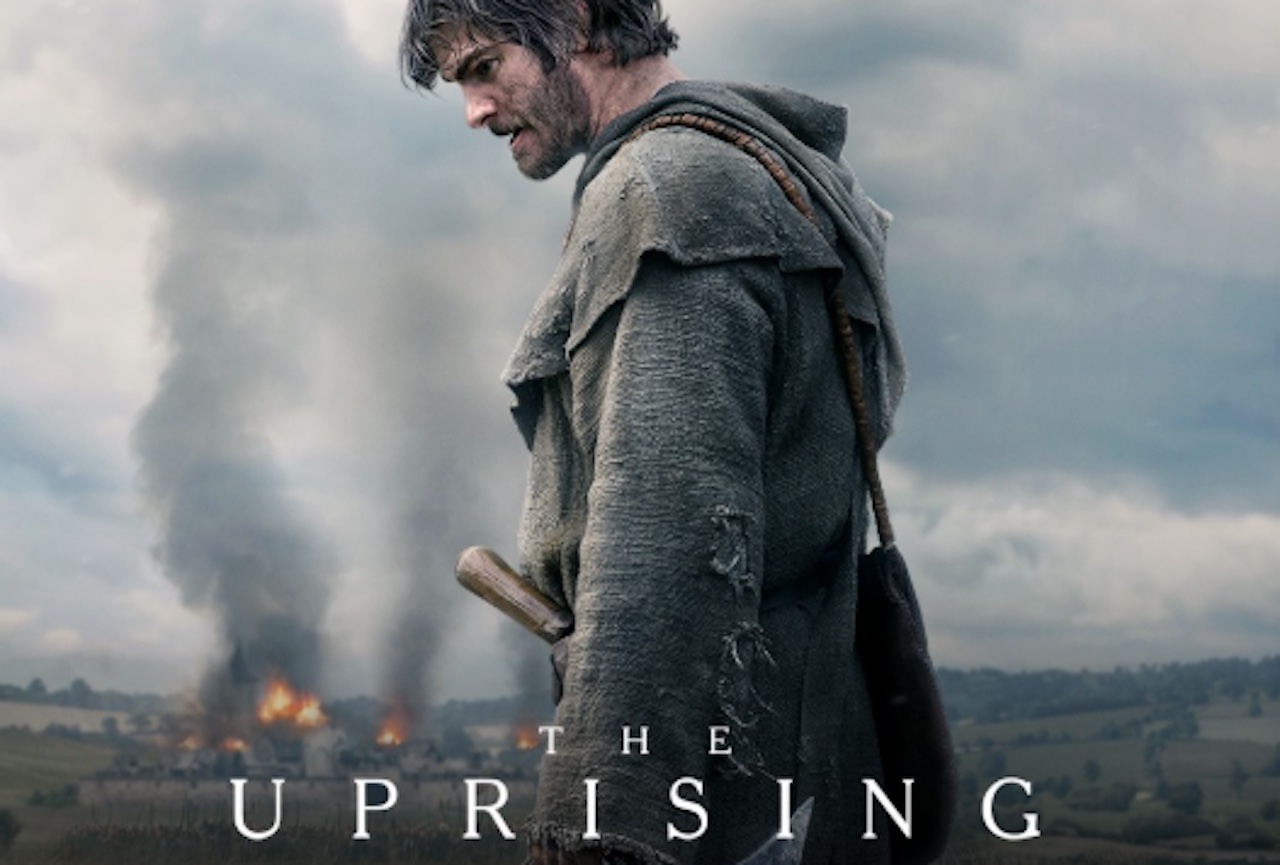
There are performances we admire for their technique, their eloquence or their visible transformation. Then there are performances that make us forget an actor is present at all. In Paul Greengrass’s The Uprising, Andrew Garfield achieves the latter. He does not seem to be demonstrating grief, desperation or moral awakening. He appears to be living through them, carrying each loss in his posture, his breathing and the increasingly haunted intensity of his gaze.
Set during the Peasants’ Revolt of 1381, the film introduces Garfield not as a celebrated historical figure but as a man known simply as Ploughman. His identity is inseparable from his labor. He belongs to the earth he works, to a social order that considers him useful but scarcely human, and to a population still devastated by the Black Death. England has lost an enormous portion of its people, yet those who remain are rewarded not with greater freedom but with oppressive taxation, controlled wages and increasingly brutal enforcement.
Greengrass, who both wrote and directed the film, does not treat this world as a picturesque medieval tableau. There is little romance in his England. Its fields feel depleted, its villages exhausted and its people physically worn down by grief, hunger and servitude. The director’s restless, handheld camerawork places the audience among them rather than safely observing them from a distance. The result is deliberately uncomfortable. We do not watch history from the polished end of a telescope; we feel as though we have been pushed into the crowd.
At the center of that crowd is Garfield, almost stripped of the qualities that ordinarily announce a movie star. His Ploughman is not introduced as a natural hero waiting for his moment. He is grieving the deaths of his wife and children, trying to survive within a system he still wants to believe possesses some form of justice. His radicalization does not arrive as a grand ideological revelation. It grows from accumulated humiliation, personal devastation and the gradual recognition that obedience will never protect him.
That evolution is where Garfield’s performance becomes extraordinary. He never seems to step outside the character to explain him to the audience. There is no visible effort to make Ploughman admirable, charismatic or conventionally heroic. Garfield allows him to remain frightened, wounded, hopeful, furious and, at times, almost spiritually emptied. Even when he says nothing, the character continues to think and feel. The performance does not stop when the dialogue does.
That distinction matters. Many actors can deliver an impassioned speech about injustice. Far fewer can make us believe that the words have been forming inside a man for years—through every harvest taken from him, every order he was forced to obey and every grave he had to dig. Garfield’s physical presence suggests that history has not merely happened around Ploughman; it has settled into his body.
The actor has described his relationship with performance as something deeper than impersonation, and that philosophy is evident here. Whether or not one formally labels his process “method acting,” the result feels immersive. Garfield seems to remain inside Ploughman’s emotional reality from beginning to end. There is no contemporary wink, no trace of vanity and no attempt to soften the character for easy audience approval. The mud, fear, exhaustion and violence do not appear to be elements surrounding the performance. They seem absorbed into it.
Greengrass surrounds him with an impressive ensemble. Jamie Bell brings dangerous conviction to the radical priest John Ball, while Cosmo Jarvis gives Wat Tyler the force of a man capable of turning collective suffering into organized resistance. Woody Norman’s young Richard II is particularly unsettling: a boy invested with nearly divine authority, protected by advisers who understand how effectively reverence can be manipulated. Yet Garfield remains the film’s emotional compass. As the Ploughman’s faith in the existing order disintegrates, ours follows it.
The film is also unmistakably concerned with the present. A society has survived mass death only to discover that wealth and power have become more concentrated. Laborers are indispensable when their work is required but disposable when they demand a fair share of what they produce. Political leaders speak of order while imposing conditions that make disorder inevitable. The parallels are never difficult to recognize.
Yet The Uprising avoids becoming merely a historical lecture because it understands that revolutions are not born from political language alone. They begin with the body: hunger, exhaustion, fear, violated dignity and the moment at which another demand becomes one demand too many. Greengrass films the rebellion from ground level, amid the confusion and violence, allowing its competing motives and moral contradictions to remain visible. This is not a sanitized procession of righteous heroes. It is a mass of human beings discovering both the power and the danger of their collective anger.
Some may question the film’s historical liberties, its narrative compression or its suggested connection to the mythology of Robin Hood. Those are legitimate discussions. But they should not obscure what the film accomplishes emotionally. The Uprising draws us into a brutal, unstable world and persuades us that its central character truly belongs there.
That achievement rests largely on Andrew Garfield. He gives us none of the reassuring distance of an actor illustrating suffering from the safety of the present. He appears weathered by Ploughman’s labor, hollowed out by his grief and transformed by every betrayal he witnesses. By the time resistance becomes inevitable, we do not simply understand why he rises.
We feel that remaining on his knees has become impossible.
The Uprising, written and directed by Paul Greengrass, stars Andrew Garfield, Jamie Bell, Cosmo Jarvis, Woody Norman, Katherine Waterston, Tom Hollander and Stephen Dillane. The film opened theatrically in September 2026. Film and cast information | Background on the film and its historical setting


