





There are festivals that exist to launch films, festivals that exist to create photographs, and festivals that exist because a city has decided that cinema is one of the languages through which it understands itself. Belgrade’s FEST belongs unmistakably to the third category.
For more than half a century, the Belgrade International Film Festival has been far more than an annual date on the European film calendar. It has been an act of cultural faith: a meeting place for filmmakers and audiences, an opening onto the world during periods when borders—literal, political and emotional—felt especially close, and a reminder that the cinema has the rare power to make a crowd of strangers experience the same silence at once.
This October, that history will become personal for producer, author and film strategist Slavica Bogdanov, who will serve as a jury member at the 53rd International Film Festival FEST in Belgrade. It is an invitation that carries particular resonance: not simply because FEST is one of the region’s most enduring film institutions, but because Belgrade itself has always understood film as something larger than entertainment. Here, cinema has been memory, argument, elegance, resistance, escape and, at its best, a serious conversation with the world.
A Brave New World
FEST was born in January 1971 under the slogan A Brave New World, opening at Belgrade’s Dom Sindikata with Robert Altman’s MASH. The title was not accidental. It expressed an ambitious idea: that Belgrade audiences should encounter the most vital films of their time, not years later and not in isolation, but as part of an international cultural exchange.
The first edition brought together work by filmmakers including Stanley Kubrick, Dennis Hopper, Luis Buñuel, Éric Rohmer and Yugoslav directors whose voices were already shaping the artistic identity of the region. In an era defined by political blocs and guarded cultural borders, FEST created a conspicuously open window. It offered audiences films that were provocative, formally adventurous and sometimes uncomfortable—exactly the qualities that make cinema matter.
Over time, FEST became one of those rare festivals whose importance cannot be measured only by premieres, red carpets or prize lists. It became part of the rhythm of the city. Generations of Belgraders came to know it as a yearly season of discovery: a chance to see what the world was making, to debate films long after the lights came up, and to feel that their own city was participating in a much larger artistic conversation.
The festival also became a remarkable point of contact between local audiences and international cinema. Over the decades, it welcomed filmmakers and stars including Francis Ford Coppola, Roman Polanski, Miloš Forman, Sam Peckinpah, Pier Paolo Pasolini, Jack Nicholson, Kirk Douglas, Robert De Niro and Dennis Hopper. Yet its character was never defined merely by famous names. FEST’s real distinction has been its public: audiences willing to show up for cinema that asks something of them.
That relationship between audience and screen is central to the festival’s mythology. Belgrade has never treated film as a passive luxury. It is discussed, argued over, revisited. A film can become the beginning of a late-night conversation, a political disagreement, an unexpected emotional reckoning or the first spark of a future filmmaker’s ambition. In that sense, FEST has helped shape not only a film culture but a city’s intellectual temperament.
A Festival That Endured
The history of FEST is inseparable from the history of the region around it. Its long life has included periods of great cultural confidence and periods of profound upheaval. During the difficult years of the 1990s, when conflict, isolation and economic hardship narrowed so much of public life, the festival faced interruptions and constraints. It did not emerge untouched. But it endured.
That endurance matters. Cultural institutions are often described too casually, as if their survival were automatic. It is not. A festival survives because audiences continue to care, because programmers and organizers continue to believe that the work is worth doing, and because artists continue to see value in bringing their films to a place where the response will be intelligent, passionate and direct.
FEST’s return and evolution in the decades that followed have reflected that resilience. It has continued to bring together international cinema, regional work and Serbian filmmaking, while creating space for both established masters and younger voices. The Belgrade Victor awards have become an important part of this legacy, honouring exceptional artistic contribution as well as the films that define each edition.
There is a special significance in the fact that the festival has never severed its relationship with serious cinema. In an age of endless content, when viewers can scroll past hundreds of films without watching any of them, a festival such as FEST restores attention to its proper scale. It says that a film deserves to be encountered in a theatre, in the company of other people, and with enough space afterward to let it remain with you.
The 53rd Edition: A Return to the Big Screen
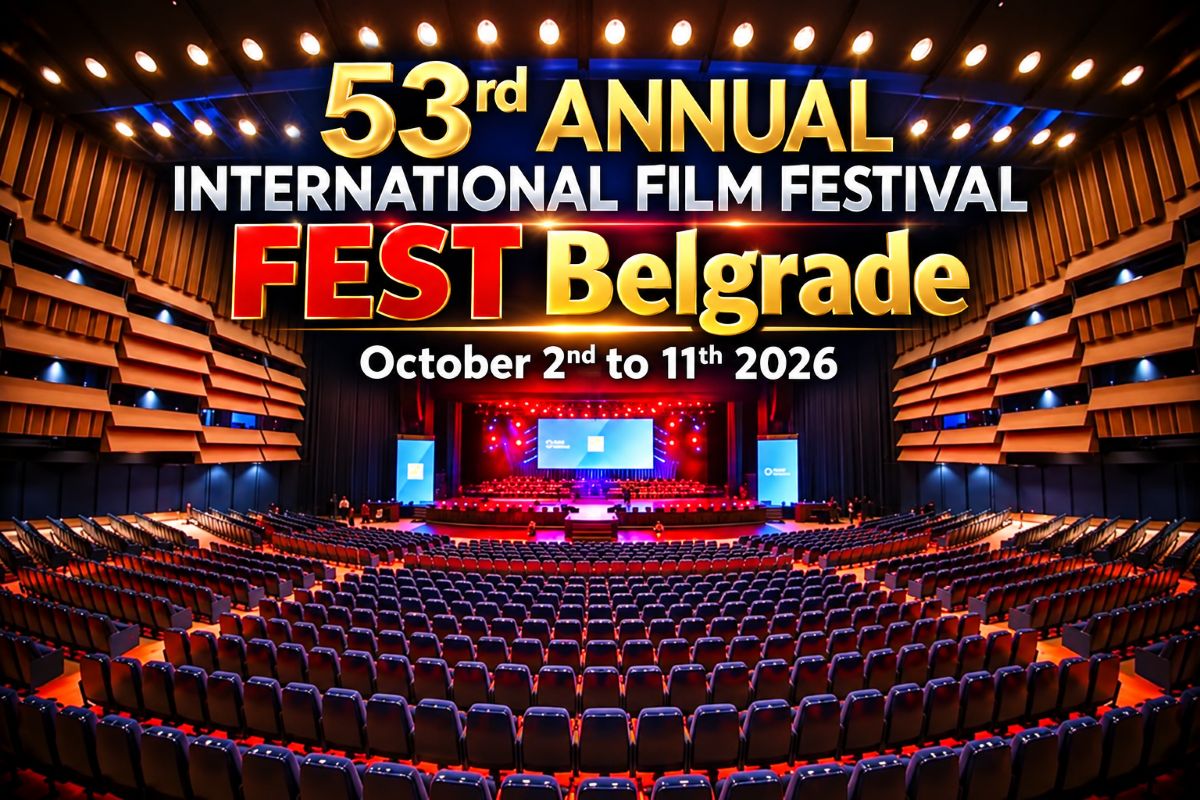
The 53rd International Film Festival FEST will take place from October 2 to 11, 2026, returning to the Sava Centre after six years, alongside cinemas and venues across Belgrade. Its opening film will be Lordan Zafranović’s Zlatni rez 42 (Djeca Kozare), a major new work from the acclaimed filmmaker whose career has long engaged with the hardest questions of history, violence and memory. Behind this return is a newly formed FEST Committee that includes acclaimed actor, director and producer Lazar Ristovski. His presence brings one of Serbian cinema’s most recognisable creative figures into the institutional life of the festival at a pivotal moment, as FEST reclaims its place on Belgrade’s cultural calendar.
It is a fitting opening for a festival with FEST’s own history. The choice signals an edition interested not in easy spectacle, but in cinema with moral weight—work that remembers, confronts and insists on being seen. Zafranović himself has described FEST as a great celebration of film, while also acknowledging the responsibility carried by those who create it. That balance between celebration and responsibility feels especially right for Belgrade.
For Slavica Bogdanov, joining the jury this year is both an honour and a natural extension of a career built across storytelling, production, publishing and the business of turning creative ambition into tangible work. A producer with experience financing and bringing a $4.5 million feature film to immediate worldwide distribution, she has spent years working where creative vision meets the realities of packaging, strategy, financing and audience.
Her path has never been limited to one medium. As an international bestselling author, producer and film strategist, Bogdanov has built a body of work around stories with commercial clarity and emotional reach. Her presence on the FEST jury brings that multidimensional perspective to the festival: an understanding not only of what a film is saying, but of what it takes to bring a film into existence and into the world.
To sit on a jury is to do more than choose winners. It is to watch carefully. It is to recognize craft without confusing polish for depth, to see ambition even when it arrives in an imperfect form, and to understand the difference between a film that simply occupies time and one that creates a lasting interior space in the viewer. The best juries protect the seriousness of the festival by treating each film as the result of years of work, risk and belief.
For Bogdanov, the invitation also marks a return to a city whose creative energy has always been inseparable from its complexity. Belgrade does not offer the polished neutrality of some festival capitals. It offers something more alive: a city of history, humour, intensity and contradiction, where culture is not a decorative accessory but part of the conversation people are already having.
More Than a Festival
Every great film festival ultimately asks the same question: what does cinema still mean now?
FEST’s answer, after more than fifty years, is clear. Cinema still means gathering. It still means taking a chance on an unfamiliar title because someone has selected it with care. It still means seeing a story from another country and discovering that its private wound resembles your own. It still means placing artists, producers, critics, audiences and emerging voices in the same rooms, where an unexpected conversation can become the beginning of a collaboration.
This is why Belgrade’s FEST remains important. It is not preserved by nostalgia; it is renewed by participation. Every filmmaker who arrives with a film, every audience member who buys a ticket, every jury member who takes the work seriously becomes part of its continuing story.
In October 2026, as the lights go down once again across Belgrade, the festival will offer its audience what it has offered for generations: not an escape from the world, but a deeper way of seeing it. And for Slavica Bogdanov, serving on the jury of the 53rd FEST will be an opportunity to take her place within that enduring conversation—one that began with a brave new world and continues, still, to imagine one.
Visit https://www.fest.rs/ for more information


