





When the Dead Stopped Being the Greatest Threat
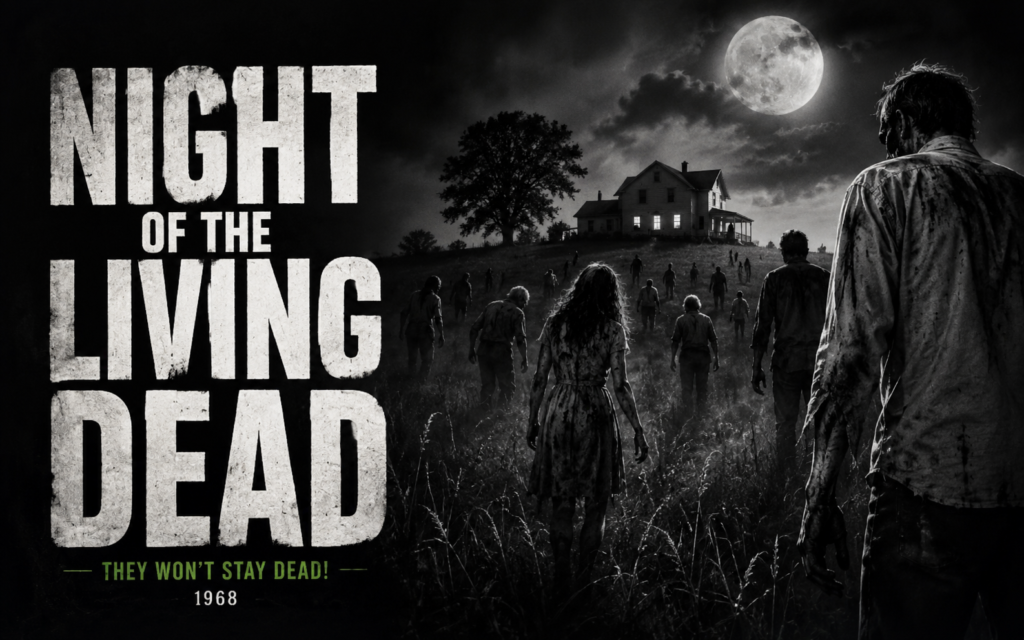
When Night of the Living Dead appeared in 1968, audiences were not simply watching another story about monsters attacking frightened human beings. They were witnessing the emergence of a radically different vision of horror, one in which civilization could collapse without warning, authority could become almost meaningless, and ordinary people could destroy one another long before the creatures outside succeeded in breaking through the door. Directed by George A. Romero and created far beyond the traditional machinery of Hollywood, the film transformed a modest rural farmhouse into a psychological laboratory where fear, pride, prejudice, mistrust, and the instinct for control were placed under unbearable pressure. The Library of Congress would later recognize the film as a work of major cultural, historical, and aesthetic significance, observing that Romero’s debut effectively helped create the modern zombie-film industry while introducing sociopolitical meaning into what initially appeared to be an exploitation picture. (The Library of Congress)
The film begins with an intrusion into the familiar rather than an entrance into an obviously supernatural world. Barbra and her brother Johnny are visiting their father’s grave when they encounter a strangely relentless man whose movements seem clumsy but whose violence is immediate. There is no elaborate explanation, no ceremonial awakening of an ancient evil, and no heroic figure prepared to restore order. The disruption arrives without permission, context, or moral logic, and this refusal to explain the danger becomes one of the film’s most important sources of terror. The dead do not return because someone deserves punishment, because a curse has been broken, or because a recognizable villain has devised a plan; they return into a world that is emotionally and politically unprepared to understand what is happening, making the crisis feel less like a fantasy and more like a catastrophe unfolding faster than human beings can interpret it.
A Farmhouse That Becomes a Model of Society
After escaping the cemetery, Barbra reaches an isolated farmhouse where she is soon joined by Ben, played by Duane Jones, whose intelligence, composure, and practical judgment immediately distinguish him from the paralysis surrounding him. Ben boards the windows, searches for supplies, assesses the danger, and attempts to transform the house from an accidental refuge into a defensible position. His behavior represents something larger than personal courage because he understands that survival depends upon the ability to recognize reality before fear distorts it. He does not waste valuable time pretending that the crisis will disappear, yet he also refuses to surrender to panic, placing him at the moral and strategic center of a group whose members repeatedly allow their emotional needs to compete with the demands of the situation.
The farmhouse initially appears to offer protection, but Romero gradually reveals that physical shelter cannot compensate for psychological fragmentation. The survivors are divided between the main floor and the cellar, between action and retreat, and between competing definitions of safety. Harry Cooper insists that everyone should hide below ground, while Ben believes the upper level provides greater mobility, visibility, and the possibility of escape. Their disagreement is not merely a practical debate over architecture because each man’s strategy expresses a deeper relationship to fear. Ben attempts to remain engaged with the world, collecting information and preserving options, whereas Harry seeks certainty through withdrawal, imagining that survival can be achieved by sealing himself inside a smaller and supposedly controllable space.
The conflict becomes increasingly destructive because neither the emergency nor the presence of the undead automatically produces cooperation. Instead, the crisis intensifies existing insecurities, transforming differences of judgment into contests of authority. Harry does not merely want his plan considered; he needs his status as head of his family to extend into leadership over the entire group. Ben, meanwhile, recognizes that following an unsound strategy out of politeness could kill everyone. The farmhouse therefore becomes a compressed representation of social breakdown, demonstrating that groups do not fail only because they lack information or resources, but because frightened individuals often defend their identity more fiercely than they defend their collective future.
WATCH THE FULL MOVIE

Ben and the Revolutionary Power of Competence
The casting of Duane Jones gave the film an extraordinary dimension within the cultural landscape of 1968. Ben is not introduced through a speech about race, nor is his authority granted to him by a white character who recognizes his worth. His leadership emerges through competence, decisiveness, and moral seriousness, qualities that the audience witnesses directly. MoMA has emphasized how remarkable it was for a 1968 American horror film to place an assertive, rational Black man at the center of civilization and order while chaos surrounded him, particularly because the film allows his intelligence to define him rather than reducing him to a symbolic supporting role. (The Museum of Modern Art)
This choice becomes even more powerful because the film does not construct Ben as invulnerable. He is capable, but he is also under pressure, increasingly angry, and sometimes forced to make decisions without enough time or information. His authority is not the effortless certainty of a traditional cinematic hero; it is the exhausting responsibility of the person who sees danger clearly while others resist what must be done. Every boarded window, improvised weapon, and attempt at coordination carries the additional burden of persuading people who may resent being directed by him, even when his actions repeatedly demonstrate superior judgment.
The film never turns its racial meaning into a simplified lesson, which is precisely why that meaning remains so unsettling. Ben’s position inside the farmhouse can be read through the broader realities of an America struggling with segregation, racial violence, political assassination, and profound mistrust of institutions, but the film does not pause to translate those conditions into explicit dialogue. Instead, it allows the audience to experience the tension through power, credibility, and vulnerability. Ben can become the most capable person in the room without becoming safe, because competence does not protect him from the assumptions and structures waiting beyond the farmhouse.
The Zombies as the End of Individuality
The creatures in Night of the Living Dead established many of the foundations of the modern cinematic zombie, although the film itself frequently refers to them simply as the dead or as ghouls. They are not glamorous supernatural aristocrats like traditional vampires, nor are they driven by an articulate intelligence capable of negotiation. They move slowly, gather instinctively, and consume human flesh without hatred, ambition, or pleasure in any recognizable human sense. Their horror lies partly in their emptiness because the individual who once occupied the body has disappeared, leaving behind appetite without identity.
Romero’s zombies become terrifying not because any single creature is overwhelmingly powerful, but because they accumulate. One can be pushed away, struck, or temporarily avoided, yet the growing mass eventually turns individual resistance into exhaustion. Their strength is repetition, and their threat resembles a social process more than a conventional monster attack. They surround the farmhouse gradually, testing the doors and windows until the distinction between outside danger and internal collapse becomes impossible to maintain. The survivors continue to think in terms of isolated decisions, but the dead operate through relentless collective pressure, making hesitation increasingly expensive.
There is also something deeply disturbing in the visual familiarity of the attackers. These are not creatures from a distant planet or figures dressed in ornate supernatural costumes; they wear ordinary clothing and carry the remnants of ordinary lives. Their faces are damaged, emptied, or expressionless, but they remain recognizably human enough to create unease about the fragile boundary between person and object. Death has not elevated them into mystical beings. It has reduced them to bodies governed by consumption, and this reduction gives the film a psychological force that later zombie stories would repeatedly adapt to anxieties about conformity, consumerism, contagion, social collapse, and the disappearance of individual moral responsibility.
Violence Without the Protection of Fantasy
The film’s black-and-white cinematography is often discussed as a limitation imposed by its independent production, yet aesthetically it gives the story an immediacy that polished color might have weakened. The images resemble documentary footage, crime-scene photography, and television reports, placing the extraordinary events within the visual language of ordinary reality. Rather than inviting the audience into a richly stylized Gothic world, Romero makes the farmhouse, cemetery, fields, and roads appear disturbingly accessible. The horror seems capable of occurring just beyond the range of the evening news.
The violence also rejects comforting distance. When the dead consume their victims, the act is not transformed into elegant suggestion or symbolic ritual; it is presented as physical, degrading, and stripped of meaning. The body is no longer treated as the protected center of human identity but as material that can be torn apart and consumed. The Library of Congress has specifically noted the film’s tight editing and unapologetically matter-of-fact treatment of violence and gore, qualities that helped distinguish it from the more restrained horror traditions preceding it. (The Library of Congress)
What makes the violence endure, however, is not simply that it was unusually explicit for its period. Its deeper power comes from the destruction of moral expectation. Courage does not guarantee survival, innocence does not create protection, and suffering does not automatically produce wisdom or solidarity. The film dismantles the reassuring structure through which audiences are often taught to interpret danger, leaving behind a universe where good decisions may still fail and where the arrival of supposed rescuers may create a new form of threat.
The Failure of Communication
Throughout the film, radio and television broadcasts offer fragments of information about the spreading crisis. Scientists, officials, and journalists attempt to identify causes, describe patterns, and advise the public, yet their explanations arrive after the survivors have already been forced to act. The broadcasts create the impression that institutions are functioning, but they cannot restore coherence inside the farmhouse because information alone does not resolve fear, resentment, or the struggle for dominance.
This distinction remains psychologically important because people often imagine that better information automatically creates better decisions. Night of the Living Dead demonstrates that facts must pass through personality before they become action. A frightened person may interpret evidence as a reason to hide, an angry person may use it to justify control, and an overconfident person may extract only the part that supports an existing belief. The survivors receive pieces of the same external reality, yet they cannot transform those pieces into a stable collective strategy because they are not united by trust.
The failed attempt to reach the truck and refuel it represents the consequences of action undertaken without sufficient coordination. The plan contains logic, and escape is necessary, but urgency compresses judgment until small errors become irreversible. Tom and Judy do not die because they lack courage; they die because courage cannot compensate for a system in which timing, communication, mechanical understanding, and emotional restraint must all function together. Their fate deepens the film’s central argument that survival is rarely determined by bravery alone, particularly when a crisis requires people to coordinate under conditions that amplify every weakness.
The Cellar and the Illusion of Perfect Safety
Harry Cooper’s insistence on the cellar appears cowardly from Ben’s perspective, yet the film complicates the disagreement by ultimately revealing that the cellar may have provided protection from the external attack. This does not make Harry a wise leader because his behavior remains selfish, antagonistic, and destructive, but it prevents the story from rewarding the audience with an easy division between the person who is always right and the person who is always wrong. Ben’s judgment is generally stronger, yet one of his most important conclusions may be mistaken.
This ambiguity gives the film intellectual weight because it separates moral character from perfect prediction. A person can behave courageously and still miscalculate, while an unpleasant person can identify a valid risk for the wrong reasons. The tragedy does not emerge from a single foolish choice that could have been avoided through obvious common sense; it emerges from a chain of imperfect decisions made by people who cannot know enough, trust enough, or cooperate long enough to test their assumptions properly.
The cellar therefore becomes more than a physical location. It symbolizes the human desire for an absolute refuge, a place where uncertainty can be sealed outside. Yet once Ben is finally forced below ground, he discovers that the space contains its own horror. The danger has already entered through the Cooper family’s injured daughter, demonstrating that no defensive structure can protect people from a threat they have carried inside with them. The house fails from both directions because the dead press inward while fear, secrecy, illness, and hostility spread outward from within.
The Ending That Refuses Heroic Closure
Ben survives the night, but survival does not deliver him into safety. At dawn, an armed posse moves through the countryside, shooting the remaining ghouls and restoring what appears to be organized human control. Hearing movement inside the farmhouse, Ben approaches a window, where he is mistaken for one of the dead and shot. His body is then carried outside and placed on a fire with the corpses of the creatures he fought throughout the night.
The ending is devastating because it eliminates the comforting distinction between rescue and destruction. The men outside possess weapons, vehicles, dogs, communication, and social legitimacy, yet their efficiency does not include careful recognition. Ben’s humanity, intelligence, and endurance are erased in an instant because he is seen only as a distant shape that fits the category of a target. The black-and-white still images accompanying the final sequence make his death resemble historical documentation rather than fictional spectacle, intensifying associations with racial violence, lynching imagery, and the bureaucratic disposal of bodies.
The film does not need to declare that Ben is killed because he is Black in order for race to shape the meaning of what the audience sees. His death occurs within a visual and historical context in which armed white men confidently identify, shoot, drag, and burn a Black man without discovering who he was. The absence of explicit racist dialogue does not neutralize the scene; it makes the event more disturbing by showing how violence can operate through routine assumptions rather than theatrical hatred. The system does not pause long enough to recognize the individual, and once Ben has been classified as dangerous, everything he did during the night becomes irrelevant.
Why the Film Still Feels Modern
Night of the Living Dead remains powerful because its deepest fears are not tied to a single decade. The film imagines a society confronted by a crisis that spreads faster than understanding, produces contradictory explanations, overwhelms local institutions, and transforms ordinary spaces into contested zones of survival. Within that environment, people struggle not only against the external threat but also against denial, territorial behavior, fractured trust, and the desire to preserve authority when circumstances demand cooperation.
Its influence on horror cinema is immense because it replaced the distant or aristocratic monster with the contaminated human body and replaced the heroic battle between good and evil with an unstable conflict among flawed people. MoMA acquired the film in 1980, and the Library of Congress added it to the National Film Registry in 1999, confirming its importance not merely as a successful horror film but as a landmark in American cinema. (The Museum of Modern Art)
Yet the film’s enduring importance cannot be measured only through the countless zombie films, television series, novels, games, and cultural images that followed it. Its greater achievement lies in recognizing that horror becomes most powerful when the monster exposes structures already present within society. The dead surrounding the farmhouse are frightening, but they are predictable; they move toward food, respond to stimulus, and continue advancing. The living are more dangerous because they can reason, communicate, and choose, yet repeatedly use those abilities to compete, conceal, dominate, and misjudge.
A Horror Classic That Became a Cultural Warning
Watching Night of the Living Dead today means encountering the foundation of modern zombie cinema, but it also means confronting a film that understands how quickly the protections of civilization can become illusions. Walls can be broken, authorities can misunderstand, families can turn against one another, and intelligence can be defeated by a single careless assumption. Romero’s achievement was not merely to place reanimated corpses outside a farmhouse; it was to show that the difference between order and collapse depends upon fragile human capacities that are often least available when they are most urgently required.
The film leaves the audience with no victorious hero, no restored moral balance, and no certainty that the people reclaiming the countryside are building a safer world. Ben’s body disappears into the fire, while the machinery of containment continues without reflection. The dead may eventually be destroyed, but the forces that produced the final injustice remain intact. That unresolved conclusion is why Night of the Living Dead continues to disturb viewers long after its shocks have become familiar, because beneath the imagery of cannibalistic corpses lies a far more enduring fear: when society stops seeing individuals clearly, the living may become indistinguishable from the monsters they believe they are eliminating.


