






The End of the World as a Daily Routine
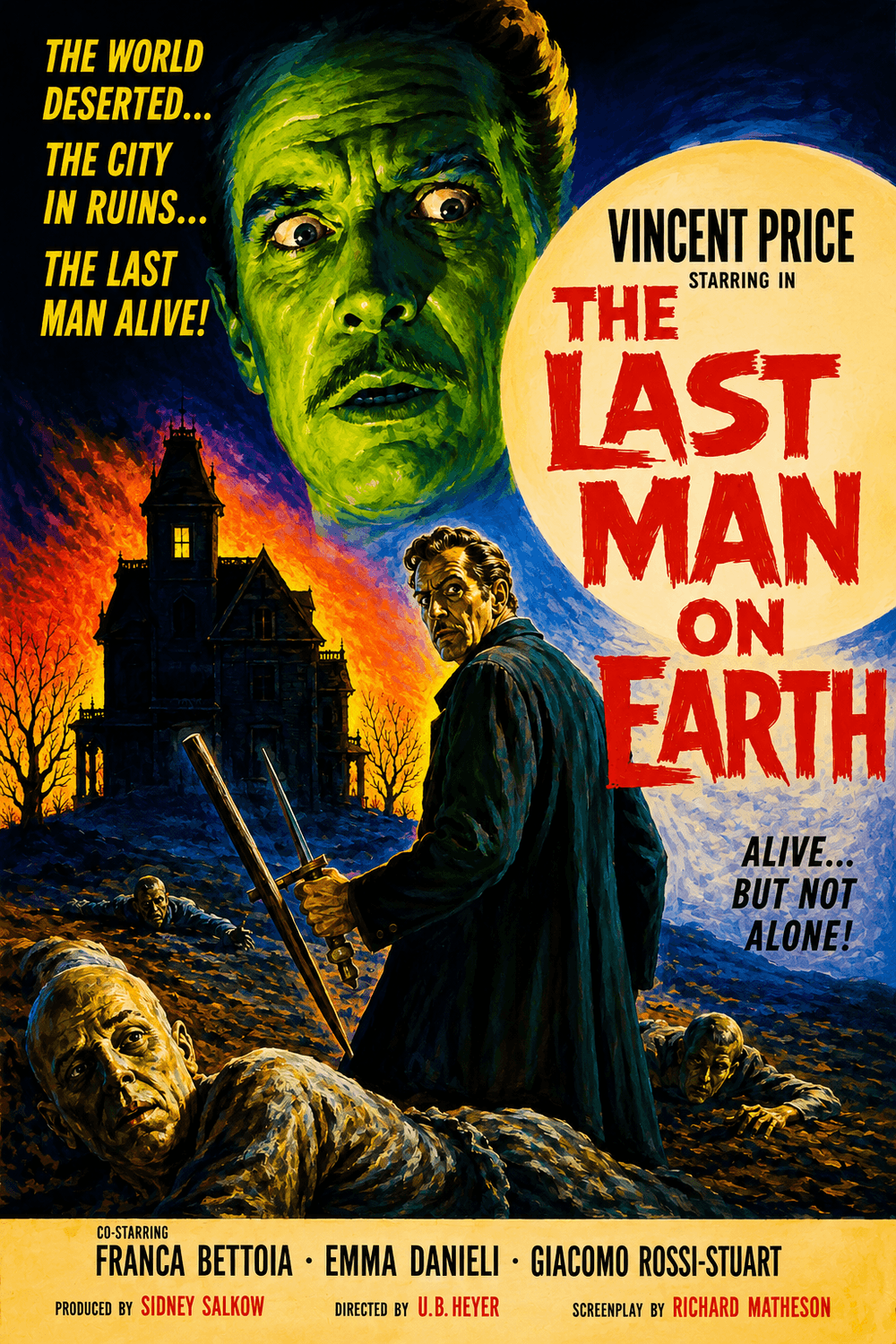
When The Last Man on Earth was released in 1964, cinematic apocalypse was often imagined through spectacle: cities destroyed by atomic weapons, extraterrestrial invasions, gigantic creatures, or scientific experiments escaping human control. This film pursued a more intimate and psychologically corrosive vision, reducing the end of civilization to the repetitive existence of one exhausted man who wakes each morning, checks his defenses, gathers his weapons, and ventures into a silent world to destroy the infected bodies of people who were once his neighbors. Directed by Ubaldo Ragona and Sidney Salkow, starring Vincent Price as Dr. Robert Morgan, and adapted from Richard Matheson’s influential 1954 novel I Am Legend, the film combines science fiction, vampire mythology, and post-apocalyptic horror while concentrating its deepest attention on loneliness, memory, and the instability of moral identity. (Wikipedia)

The premise appears simple: a global plague has killed most of humanity and transformed many of the dead into nocturnal, vampiric creatures who cannot tolerate sunlight, garlic, mirrors, or wooden stakes. Morgan believes himself to be the only immune survivor, and his life has become a rigid cycle of daytime hunting and nighttime defense. Yet the film’s importance does not rest primarily upon the mechanics of survival. Its true subject is what happens to human consciousness when routine continues after meaning has disappeared, when the gestures that once belonged to ordinary life remain but the social world that gave those gestures significance has vanished.
Morgan still wakes, dresses, eats, repairs his home, keeps records, and performs tasks, but these actions no longer participate in a shared civilization. There is no workplace to reach, no community to protect, no family waiting for him, and no future whose arrival can be confidently imagined. His discipline preserves his body while gradually exposing the emptiness around it, creating the unsettling possibility that survival may become a form of imprisonment when there is no longer anyone with whom life can be shared.
A World Emptied of Witnesses
The film’s deserted streets, abandoned buildings, overturned vehicles, and vacant public spaces produce a form of horror that depends upon absence rather than attack. The city has not been physically erased; much of its architecture remains intact. What has disappeared is the network of human relationships that once transformed those structures into homes, businesses, neighborhoods, and institutions. Without people, the city becomes a collection of abandoned surfaces, preserving the shape of civilization after its purpose has died.
This distinction gives the film’s emptiness unusual psychological force. Destruction can be understood as an event, but abandonment feels like a prolonged condition. A ruined building reveals that something happened, while an intact but silent building suggests that ordinary life stopped without receiving a proper conclusion. Morgan moves through spaces designed for crowds, commerce, conversation, and movement, yet encounters only evidence that those social functions have become obsolete.
Human identity depends more heavily upon witnesses than people often recognize. Individuals understand themselves partly through the responses of others: through names spoken aloud, responsibilities shared, memories confirmed, disagreements endured, and affection returned. Morgan can continue remembering who he was, but no living community remains to confirm that identity. He is a doctor without patients, a husband without a wife, a father without a daughter, and a citizen of a society that no longer exists.
His isolation therefore threatens more than his emotional well-being. It threatens the continuity of the self. When no one remains who remembers the same past, language, relationships, and social expectations, personal history becomes a private archive that cannot be verified. Morgan is physically alive, yet the person he once was belongs to a world whose disappearance has made that identity increasingly difficult to sustain.
Vincent Price Without Theatrical Protection
Vincent Price had become strongly associated with elaborate Gothic horror, particularly through films filled with haunted estates, aristocratic villains, elaborate dialogue, and richly theatrical performances. The Last Man on Earth uses his distinctive presence in a markedly different way. Robert Morgan is not introduced as an elegant master of ceremonies or a sophisticated figure controlling the fears of others. He is tired, unshaven, methodical, emotionally depleted, and burdened by a routine that appears to have continued long after hope stopped sustaining it.
Price’s performance becomes effective because he suppresses many of the qualities audiences expected from him. Morgan does not move through the film with flamboyant confidence. His voice often carries fatigue rather than authority, and his body expresses the accumulated weight of repetition. He has not become fearless; he has simply performed the same frightening tasks so often that terror has hardened into procedure.
This subdued approach gives the character credibility as a man whose grief has moved beyond visible crisis. Acute suffering often appears dramatic because the injured person remains close to the event that caused it, but prolonged suffering can become quieter and more mechanical. Morgan does not spend every moment openly mourning because mourning has become incorporated into the structure of his day. He functions because stopping would expose him to everything that his routine keeps temporarily contained.
Price’s recognizable elegance remains beneath the exhaustion, which makes Morgan’s decline more affecting. The audience can sense the educated, socially engaged professional he once was, even as the present world reduces him to scavenging, repairing barricades, disposing of bodies, and driving stakes into the infected. The performance communicates the erosion of civilization through a single man whose habits of reason and dignity remain visible but increasingly difficult to preserve.
The Plague and the Collapse of Certainty
The catastrophe begins as an epidemic that institutions attempt to understand through medicine, research, public communication, and emergency response. Morgan, trained as a scientist, initially believes the outbreak must have a material explanation, and his friend Ben Cortman argues that older legends about vampires may contain distorted observations of a real biological phenomenon. Their disagreement represents two competing ways of confronting the unknown: one insists that inherited superstition has no place in rational inquiry, while the other suggests that folklore may preserve evidence that science has not yet interpreted correctly.
The film does not ultimately reject science. The plague has biological properties, and Morgan’s immunity appears connected to an earlier encounter with an infected bat. Yet the story does expose the danger of intellectual rigidity. Morgan’s commitment to rational explanation becomes limiting when it prevents him from considering evidence associated with ideas he regards as primitive or absurd. The problem is not that science fails, but that a scientist may fail when professional identity becomes attached to dismissing possibilities before examining them.
This theme acquires additional force because pandemics destabilize the ordinary relationship between knowledge and action. During a rapidly spreading crisis, people must make decisions before certainty becomes available. Authorities may possess more information than individuals, yet their information remains incomplete, delayed, or contradictory. Families must decide whether to trust official instructions, personal observations, medical judgment, or inherited belief while the consequences of error continue escalating.
The Last Man on Earth understands that uncertainty is not merely an intellectual discomfort. It becomes a moral pressure because every interpretation produces action. To underestimate the danger may expose others to infection, while overreacting may destroy trust, freedom, and human connection. The plague therefore attacks society not only through disease but through the widening gap between what people need to know and what can actually be established in time.
The Family Before the Fall
The film’s extended flashback provides the emotional center of Morgan’s story by revealing the family life that existed before his isolation. His wife Virginia and daughter Kathy transform him from an abstract survivor into a man whose present routine has been constructed upon irreversible loss. The flashback also changes the meaning of the deserted home. What initially appears to be a defensive structure becomes the remains of a domestic world where affection, argument, responsibility, and ordinary expectation once existed.
Kathy’s illness is particularly devastating because the plague enters the family through the vulnerability every parent fears but cannot fully control. Morgan’s scientific training does not grant him the power to protect his daughter, and his role as a father comes into conflict with the procedures imposed by public authorities. The state requires infected bodies to be removed and burned, treating them as sources of contamination rather than as members of grieving families.
This policy may be epidemiologically understandable, yet emotionally it becomes unbearable. To the authorities, Kathy’s body represents risk; to Morgan, it remains inseparable from the child he loves. The conflict exposes how emergency systems often require abstraction in order to function. Officials must think in categories, numbers, transmission patterns, and containment measures, while individuals experience the same crisis through names, faces, promises, and attachments.
Morgan’s secret burial of his daughter becomes an act of resistance against that abstraction. He cannot accept that her body should disappear anonymously into a mass fire, because such treatment feels like the erasure of her personhood. Yet the burial also creates the conditions for a more terrifying confrontation when she returns, transformed by the infection, and comes back to the home that once represented safety.
The scene embodies the collapse of emotional categories. Morgan’s daughter is simultaneously someone he loves and something that threatens him. Memory demands recognition, while survival demands rejection. The plague does not merely kill the people closest to him; it weaponizes their familiar bodies, forcing him to defend himself against the physical form of his own attachment.
The Door Between Love and Survival
The repeated nighttime assault on Morgan’s house is one of the film’s strongest symbolic structures. The infected gather outside, calling his name and demanding that he come out, while he remains barricaded within a home transformed into a fortress. The door separates life from death, safety from exposure, and present necessity from the relationships that existed before the plague.
Ben Cortman, once Morgan’s colleague and friend, becomes the most persistent voice outside. His repetition of Morgan’s name is disturbing because it preserves a fragment of social recognition within a creature Morgan considers no longer human. Ben does not attack as an anonymous monster. He attacks as someone who remembers enough to identify the person inside.
This partial continuity complicates Morgan’s daily killings. The infected appear diminished, violent, and incapable of ordinary life, yet they are not entirely empty. They speak, organize themselves to some degree, recognize places, and retain traces of previous relationships. Every stake Morgan drives into a sleeping body may therefore be destroying something more psychologically complex than a mindless corpse.
The house protects Morgan by enabling him to maintain categorical clarity. Inside, he is the living human being; outside, they are the monsters. The barricades do not merely stop physical entry. They protect the interpretation upon which his actions depend. As long as the infected remain beyond the threshold, he can avoid confronting the possibility that the division between human and monster is less absolute than his survival routine requires.
Repetition as Psychological Anesthesia
Morgan’s days follow a nearly identical structure. He checks his calendar, gathers supplies, hunts the infected while they sleep, disposes of bodies, repairs damaged defenses, and prepares for another night. This repetition preserves order in a world where social time has collapsed. Without appointments, institutions, seasons of collective activity, or meaningful future plans, the calendar risks becoming a record of endurance rather than progression.
Routine ordinarily provides stability because it organizes life around recurring responsibilities and anticipated outcomes. In Morgan’s world, however, routine becomes psychological anesthesia. Each task occupies attention and prevents memory from overwhelming him, but the repetition cannot produce a fundamentally different future. He is maintaining a life that no longer grows.
The distinction between discipline and compulsion becomes increasingly difficult to preserve. Morgan must perform these tasks to survive, yet survival also allows the tasks to continue. He kills the infected because they threaten him, and they threaten him partly because he kills them. The cycle reinforces itself until each side’s actions appear to justify the other’s.
This circularity is one of the film’s most sophisticated observations about prolonged conflict. Once violence becomes routine, individuals can lose access to the moment when alternatives might have existed. Every new act is interpreted through the history created by previous acts, making retaliation feel like defense and defense appear indistinguishable from aggression.
Morgan’s routine therefore protects him from immediate death while preventing him from recognizing how thoroughly the world has changed. He continues behaving as though he were preserving the last fragment of the old order, but the old order may no longer be the standard by which humanity can be defined.
Ruth and the Return of Uncertainty
Morgan’s discovery of Ruth appears at first to offer the possibility he has been unconsciously seeking: another living human being. Her presence disrupts the emotional and intellectual certainty of his routine because she cannot be immediately classified as either healthy or infected. Morgan’s desperation for companionship competes with his suspicion, creating a situation in which hope itself becomes dangerous.
The encounter demonstrates how isolation damages the ability to trust. Morgan longs for another person, yet years of survival have trained him to interpret every unexpected presence as a potential threat. He attempts to test Ruth, observe her reactions, and force reality into a category he understands, but her condition resists the simple division upon which his world has been built.
Ruth belongs to a community of infected people who have developed a treatment that suppresses the disease and allows them to retain intelligence, social organization, and a substantial degree of normal functioning. They are neither fully healthy according to Morgan’s standard nor equivalent to the nocturnal creatures surrounding his home. They represent an emerging population adapting biologically and socially to conditions that Morgan has interpreted only as catastrophe.
Her existence transforms the film’s central question. Morgan is no longer merely asking whether another human being has survived. He must confront who possesses the authority to define human survival. Is humanity limited to those whose bodies remain unchanged, or can it include people who have been altered but continue thinking, choosing, loving, organizing, and imagining a future?
Morgan’s tragedy lies partly in the fact that he encounters this question too late. His routines have become moral convictions, and his loneliness has intensified his certainty that he alone represents legitimate humanity. Ruth’s presence offers evidence that the world contains distinctions he has not understood, but understanding would require him to reinterpret years of killing.
The Monster Who Believes He Is the Hero
The most radical idea inherited from Matheson’s novel is the reversal through which the apparent survivor becomes the legendary monster of a new society. Morgan has spent years entering homes during daylight, locating helpless infected people, driving stakes through their hearts, and burning their bodies. From his perspective, these actions are necessary acts of extermination directed against creatures who destroyed civilization. From the perspective of the emerging infected community, he is an unpredictable killer who arrives while they are vulnerable and destroys members of their population.
The facts of his behavior remain the same, yet their moral meaning changes according to the observer. This does not automatically make Morgan evil or invalidate the suffering he endured. It reveals that moral identity cannot be established solely through intention. A person may believe he is defending humanity while becoming a source of terror to those whose humanity he refuses to recognize.
The film therefore destabilizes the traditional relationship between protagonist and monster. Audiences have followed Morgan’s experience, entered his memories, witnessed his grief, and understood the practical logic of his actions. That intimacy encourages identification, but identification does not guarantee moral innocence. By remaining close to Morgan, the film demonstrates how easily viewers accept a person’s definitions when they experience danger through his perspective.
This is one of horror cinema’s most important ethical mechanisms. A monster is often created not only through physical difference but through narrative distance. The audience fears the creature whose interior life remains inaccessible and sympathizes with the figure whose suffering has been explained. Once the perspective changes, the moral categories can change with it.
Morgan’s greatest failure is not simply that he killed infected people before understanding their condition. It is that he gradually lost the capacity to imagine that anything outside his categories might possess a meaningful interior life. Isolation narrowed his world until his own consciousness became the only evidence of humanity he trusted.
Science, Immunity, and the Burden of Exception
Morgan’s immunity separates him biologically from the infected population, but the film refuses to treat that difference as a simple blessing. Immunity preserves his life while condemning him to separation, survivor’s guilt, and the burden of becoming an exception without a community. What protects his body isolates his identity.
The immune survivor occupies an unstable moral position because biological difference can easily become a claim to superiority. Morgan considers himself normal because his body resembles the human body that existed before the plague, while the infected appear abnormal because they represent change. Yet normality is partly determined by population and context. When almost everyone has changed, the unchanged individual may become the anomaly.
This reversal challenges the assumption that the past possesses permanent authority over the future. Morgan’s immunity allows him to preserve an earlier biological condition, but preservation is not the same as adaptation. The infected community, despite its altered bodies and compromised health, has created medicine, organization, rules, and a collective future. Morgan has preserved himself, but he has not created a society.
His scientific knowledge also becomes tragically incomplete. He understands enough to diagnose aspects of the plague, identify weaknesses in the infected, and eventually use his blood to help Ruth, yet he has spent years applying knowledge primarily to destruction. The same biological difference that made him an efficient killer may also contain the basis of treatment.
This contrast reveals that knowledge has no fixed moral direction. Scientific understanding can be used to classify, cure, contain, or eliminate, depending upon the assumptions and objectives of the person applying it. Morgan’s tragedy is not a lack of intelligence but the narrowing of intelligence under grief, fear, and isolation.
The New Society and the Violence of Transition
The organized infected community represents the beginning of a new social order, yet the film does not present that order as peaceful or morally pure. Its members intend to eliminate both the fully transformed nocturnal creatures and Morgan, whom they regard as a dangerous remnant of the old world. Their emergence therefore confirms that social reconstruction does not automatically end violence. It reorganizes violence around new categories of legitimacy.
Every society creates boundaries between those it protects and those it regards as threatening. During periods of stability, those boundaries may appear natural or invisible. During transformation, they become explicit because the emerging order must define who belongs, who can be treated, who must be controlled, and who may be killed.
Morgan has spent years making these decisions alone, but the new community now claims collective authority to make them against him. The reversal is brutal because he experiences the same reduction he imposed upon others. His history, grief, motives, and individuality become secondary to the category he occupies: dangerous immune outsider.
The new society’s fear of Morgan is understandable because his actions have made him lethal to its members. Yet its decision to kill him also demonstrates how quickly self-protection can become dehumanization. The infected are building a future, but they remain vulnerable to reproducing the same certainty that allowed Morgan to deny their complexity.
The film therefore offers no morally uncomplicated replacement for the lost civilization. The old human world failed, Morgan’s solitary campaign became destructive, and the emerging infected order begins by eliminating those who do not fit within it. History moves forward, but moral progress is not guaranteed.
The Church and the Final Judgment
Morgan’s final flight leads him into a church, a location filled with symbolic associations of sanctuary, judgment, sacrifice, and redemption. Yet the church cannot protect him from the new order pursuing him. The sacred space becomes the setting in which the last representative of the previous humanity is condemned and killed.
His death is not merely the defeat of an individual. It marks the extinction of the identity around which he built his survival. Morgan dies believing that those surrounding him are monsters, while they regard his death as the removal of a monster who terrorized their community. Neither side can fully recognize itself within the other’s description.
His final denunciation of them expresses both truth and blindness. They have hunted and killed him, confirming their capacity for cruelty, but he remains unable to understand why they fear him. He recognizes the violence directed toward him without fully accepting the meaning of the violence he directed toward them.
The scene transforms legend from a story about heroic survival into a story about historical perspective. Morgan becomes legendary not because he preserved the values of the old civilization, but because he becomes the terrifying figure whose actions helped define the fears of the new one. The last man of one world becomes the monster remembered by another.
From Vampire Story to Modern Zombie Cinema
Although the infected in The Last Man on Earth possess traditional vampiric weaknesses, their behavior helped establish imagery that would become central to modern zombie cinema. They gather outside a barricaded home, move with diminished coordination, overwhelm through numbers, and transform familiar human bodies into a persistent collective threat. The film’s vision of plague-driven social collapse predates the modern zombie cycle and occupies an important position between traditional vampire mythology and the apocalyptic undead films that followed.
George A. Romero’s Night of the Living Dead, released four years later, would transform the genre by removing much of the explicit vampire mythology and intensifying the social breakdown, cannibalism, and siege structure. Yet The Last Man on Earth had already brought together several essential components: global infection, deserted cities, the fortified survivor, shambling nocturnal attackers, the return of familiar people as threats, and the moral ambiguity of extermination.
The film was the first screen adaptation of Matheson’s I Am Legend, preceding The Omega Man in 1971 and I Am Legend in 2007. Although each version substantially reinterprets the material, the 1964 production remains distinctive for preserving the story’s bleak psychological reversal more clearly than the later, more action-oriented adaptations. (Wikipedia)
Its limited production resources contribute to this effectiveness. The empty Roman locations, sparse streets, and stark black-and-white photography create an atmosphere of exhaustion rather than spectacle. The world does not appear dramatically destroyed so much as abandoned, which keeps the focus on the emotional consequences of surviving after collective meaning has disappeared.
Black-and-White Desolation
The film’s monochrome cinematography gives its urban spaces an austere, nearly documentary quality. Daylight scenes are not reassuring because sunlight merely reveals the scale of abandonment. Roads stretch through vacant landscapes, buildings stand without occupants, and Morgan’s vehicle moves through a city that no longer responds to his presence.
The contrast between day and night structures both the film’s visual language and its moral uncertainty. Daylight belongs to Morgan, allowing him to move freely while the infected remain helpless. Darkness belongs to them, forcing him behind barricades while they surround his home. Each side possesses a period of dominance and a period of vulnerability.
This alternating structure complicates the usual symbolism of light and darkness. Daylight traditionally represents safety, truth, and moral clarity, yet Morgan uses it to enter the hiding places of incapacitated beings and kill them. Night traditionally represents danger, but it is also the time when the infected awaken, communicate, gather, and seek revenge against the person destroying them.
The film therefore prevents light from functioning as a guarantee of goodness. Visibility can support knowledge, but it can also support surveillance and violence. Darkness can conceal danger, but it can also shelter those who would otherwise be defenseless. The moral character of each space depends upon whose experience the audience is willing to consider.
Grief as a Closed System
Morgan’s prolonged isolation can be understood as grief that has become structurally complete. He has lost his family, colleagues, social identity, and future, yet no community remains to help him transform those losses into a new relationship with life. His grief therefore circles around itself, reinforced by the same objects, rooms, memories, and routines.
Healthy mourning does not require forgetting, but it usually depends upon movement between memory and continued participation in the world. Morgan has memory without participation. Every day confirms that the past is irretrievable, while the future appears to contain only another repetition of the present.
His campaign against the infected provides grief with an external target. Rather than remaining entirely helpless before what the plague took from him, he can act against the bodies associated with it. Killing them becomes a way of converting sorrow into purpose, even when that purpose prevents him from questioning whether the infected have changed.
This mechanism extends beyond the film’s supernatural premise. Human beings often endure unbearable loss by locating an enemy who can be blamed, pursued, punished, or eliminated. Such action may restore a temporary sense of control, but it can also imprison grief inside conflict. As long as the enemy remains, the mourner retains a reason not to confront the deeper emptiness that victory cannot repair.
Morgan’s tragedy is that the activity keeping him alive also prevents him from discovering a life beyond vengeance. He survives the plague but remains psychologically organized around it, allowing the catastrophe to define every action until the distinction between resistance and captivity disappears.
Why the Film Remains Disturbing
The Last Man on Earth endures because it recognizes that apocalypse is not only the destruction of institutions or populations. It is the destruction of shared meaning. Food, shelter, medicine, and weapons may preserve biological existence, but human life also depends upon recognition, reciprocity, memory, and belonging.
The film asks whether survival remains a victory when the survivor can no longer participate in a moral community. Morgan is disciplined, intelligent, resourceful, and courageous, yet those qualities are insufficient to protect him from the psychological consequences of absolute isolation. His reasoning becomes narrower, his routines become more rigid, and his enemies become less human in his imagination because no one remains to challenge his interpretation.
Its central reversal also remains profoundly relevant. Individuals and societies frequently define themselves as good by identifying another group as dangerous, diseased, irrational, or monstrous. Once that classification becomes absolute, violence can be experienced as responsibility rather than cruelty. The film exposes the instability of that process by shifting perspective until the man who believed himself to be humanity’s defender becomes the creature others fear.
The horror lies not in discovering that Morgan was secretly evil. He was not. It lies in recognizing that suffering, intelligence, and good intentions do not prevent a person from becoming destructive when perspective contracts around survival. A human being can remain emotionally understandable while becoming morally terrifying to those whose experience he cannot see.
The Last Human or the First Legend
The title The Last Man on Earth initially appears to describe Morgan’s physical condition, but by the conclusion it has become a philosophical question. He may be the last biologically unchanged human, yet the emerging infected community possesses relationships, medicine, collective organization, and a vision of the future. They have begun constructing the social qualities through which humanity has traditionally understood itself, while Morgan exists outside every community.
This does not mean the new society is morally superior. Its willingness to kill him reveals its own fear and rigidity. Yet it does mean that humanity cannot be defined by biology alone. A body may remain unchanged while the person becomes incapable of relationship, just as an altered body may contain intelligence, loyalty, affection, and social purpose.
Morgan’s final status as a legend completes this reversal. Legends are created when one generation transforms the incomprehensible figures of an earlier world into symbols. To the new society, Morgan will not be remembered primarily as a grieving father or isolated scientist. He will become the daylight killer who entered homes, destroyed sleeping people, and seemed immune to the conditions governing everyone else.
He believed the infected were supernatural monsters because they violated the rules of his world. They believe he is a monster because he violates the rules of theirs. The film’s deepest insight is that monstrosity is often produced at the boundary between incompatible definitions of normality.
The Last Man on Earth therefore leaves audiences with a question more unsettling than whether civilization can survive a plague. It asks whether people can recognize humanity after its familiar appearance has changed. Morgan survives longer than almost anyone, yet survival alone does not make him the future. He becomes the final guardian of a vanished definition of humanity, fighting so relentlessly to preserve the past that he cannot recognize the new world forming around him.


