




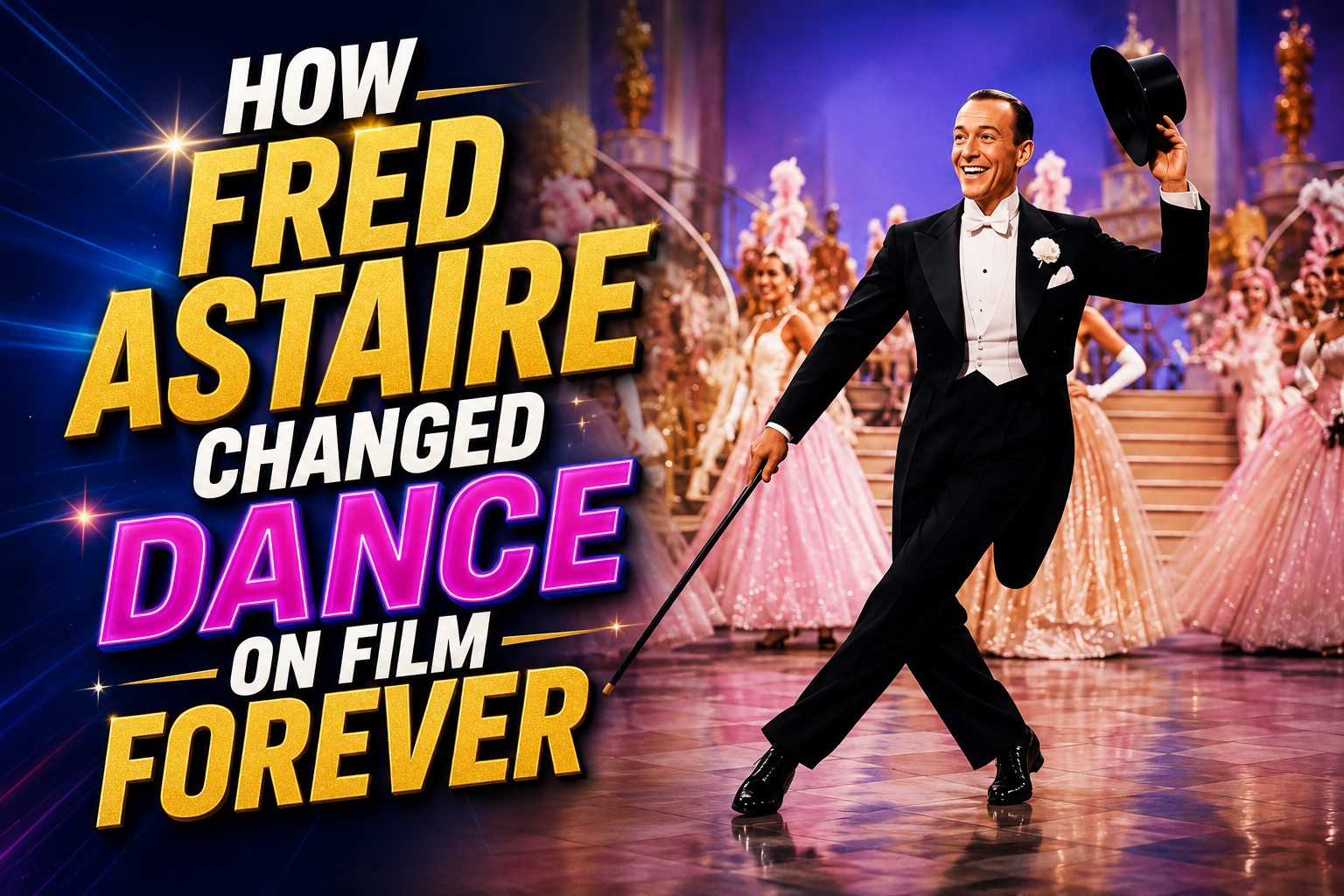
Fred Astaire’s place in film history cannot be explained simply by saying that he was an extraordinary dancer. Hollywood had extraordinary dancers before him and would produce many after him, but Astaire altered something more fundamental: the relationship between dance and the camera. He understood that cinema could either reveal physical mastery or obscure it, that editing could intensify movement while simultaneously destroying its continuity, and that the greatest contribution a filmmaker could sometimes make was to create the conditions in which audiences were permitted to witness what a performer could actually do. The elegance for which Astaire became famous therefore concealed something far more radical—a coherent philosophy of filmmaking that helped transform dance from photographed entertainment into cinematic storytelling.
Before Tom Holland attempts to recreate that extraordinary physical language for a new generation, watching Astaire himself offers the clearest way to understand why the challenge extends far beyond learning recognizable choreography. You can watch Fred Astaire’s original movies and explore other classics inside the EE Vault with a 7-day free trial at https://www.empoweringentertainmentpublishing.com/classic-movies, where the difference between knowing Astaire as an icon and actually watching him becomes immediately apparent: the camera frequently remains far enough away to expose the complete body, long enough to preserve the continuity of movement, and quiet enough to allow performance rather than editing to become the spectacle.
Before Astaire, Cinema Had to Decide What to Do With Dance
The arrival of synchronized sound created enormous opportunities for Hollywood because music, singing and dance could suddenly become central components of mainstream cinema, yet the transition from stage performance to film introduced a problem that was not merely technological. Theatre gives spectators a relatively stable relationship with space: the audience sees performers within a continuous physical environment and decides where to direct attention. Cinema possesses radically different powers. A director can move the camera, alter distance, isolate a face or foot, change perspective, interrupt time through editing and assemble a performance from material recorded across multiple takes. Those possibilities make cinema more flexible than theatre, but they also create the danger that dance will cease to exist as coherent physical performance and become a collection of visually impressive fragments.
The problem is deeper than whether a particular editing style looks attractive. Dance communicates through relationships that require space and duration to remain intelligible. The position of the feet matters in relation to the torso; the position of one dancer matters in relation to another; a turn derives meaning from the movement that enters it and the movement that emerges from it; balance becomes impressive because the spectator witnesses how it is acquired, displaced and recovered. Once choreography is fragmented aggressively, the audience may continue to receive an impression of energy while losing access to the physical logic that produced it. Cinema can therefore make dance appear more spectacular while paradoxically allowing us to see less of the dancing itself.
Astaire’s importance begins with his understanding of that contradiction. He did not reject cinema’s powers or attempt merely to reproduce the theatrical experience in front of a stationary camera. Instead, he developed an approach in which filmmaking served the intelligibility of choreography. The camera could move, environments could become fantastical, and cinematic illusion could expand the possibilities of the number, but the dancer remained physically legible. What mattered was not preserving theatre inside cinema but discovering how cinema could become more cinematic without sacrificing the integrity of movement.
The Revolutionary Importance of Seeing the Whole Body
Astaire’s preference for allowing audiences to see the dancer’s full figure has sometimes been reduced to a stylistic signature, yet it represented a much deeper understanding of how physical performance communicates. A dancer does not exist as a collection of independently expressive body parts. Footwork derives its force from what the rest of the body is doing; posture changes the meaning of rhythm; arms create counterpoint and line; the relationship between upper-body calm and lower-body complexity can generate the very impression of effortlessness that made Astaire so distinctive. To isolate the feet may reveal technical speed, but it can simultaneously conceal the extraordinary coordination required to make that speed coexist with apparent serenity everywhere else.
Full-body framing also preserves something essential about credibility. When the audience sees enough of the performer to understand the physical action continuously, the image functions as evidence. We do not merely infer that the dancer completed the movement because editing has connected its beginning and end; we witness the transition itself. This creates a particular form of cinematic pleasure in which admiration comes not from being told that something difficult has happened but from being given sufficient visual information to comprehend its difficulty. Astaire’s dancing becomes astonishing precisely because the filmmaking frequently refuses to exaggerate it.
That restraint changes the relationship between performer and spectator. The camera does not insist that we admire Astaire by continually selecting impressive details; instead, it creates a space within which our attention can discover the accomplishment. The distinction is subtle but important. Manipulation can produce immediate excitement, while observation produces conviction. Astaire’s cinema trusts that if the physical achievement is strong enough, visibility itself will generate spectacle.
Why Continuity Was More Important Than Showing Off
Astaire’s preference for relatively sustained takes follows naturally from the same philosophy. A dance is not simply a sequence of positions but a continuous negotiation with gravity, momentum, rhythm and space, which means that the transitions between recognizable movements are often where mastery becomes most visible. Editing can remove those transitions and leave behind only successful endpoints, creating an impression of performance without requiring the spectator to witness the physical chain connecting them. Astaire’s approach preserved more of that chain, allowing duration to become part of the evidence.
This did not mean that every number needed to unfold in a single unbroken shot, nor did Astaire subscribe to a simplistic rule that editing itself was somehow dishonest. The more sophisticated principle was that cuts should not destroy choreographic meaning. Editing could reorganize perspective or accommodate a change in scale, but it should not become a substitute for the dancer’s ability to sustain movement. The distinction matters because a rigid prohibition against cutting would merely replace one formula with another, whereas Astaire’s actual contribution lay in understanding what the audience needed to see in order for dance to remain coherent.
The result created an unusual equilibrium between cinema and performance. The film retained its power to guide attention while refusing to manufacture every moment of excitement editorially. Astaire remained accountable to the frame, and the frame remained accountable to the choreography. Neither existed merely to display the other. This reciprocity helped establish a visual language in which dance could become genuinely cinematic without becoming dependent upon cinematic concealment.
The Camera Became a Partner Rather Than a Competitor
To describe Astaire’s approach as simply “keeping the camera still” would fundamentally misunderstand his innovation. Some of his most memorable sequences depend upon camera movement, elaborate production design and technical effects that could never exist on a conventional stage. What distinguishes the approach is not the absence of cinematic technique but the hierarchy governing it. The camera participates in the choreography without competing against the dancer for dominance, moving when movement clarifies or expands what the body is doing and remaining restrained when additional intervention would contribute nothing.
This creates a fascinating relationship between choreography and cinematography because both become concerned with space. The dancer moves through an environment while the camera determines how that environment is perceived, and the strongest sequences coordinate those systems so precisely that the spectator experiences them as a single visual idea. A tracking movement can preserve the dancer’s momentum, a widening frame can reveal a new spatial relationship, and a carefully designed set can provide surfaces, levels and obstacles that become active components of choreography. Cinema is not merely recording movement; it is constructing the conditions through which movement acquires additional meaning.
Astaire’s sophistication lies in recognizing that cinematic invention becomes most powerful when it does not constantly announce itself. The audience may remember the dance without consciously remembering the camera movement that made the dance legible, which is itself a sign of successful integration. Just as Astaire concealed technical difficulty within apparent ease, the filmmaking surrounding him often concealed its own intelligence by making the relationship between performer and camera appear inevitable.
When the Environment Itself Began to Dance
One of the clearest demonstrations of Astaire’s willingness to embrace cinematic invention appears in Royal Wedding and the celebrated “You’re All the World to Me” sequence, in which he appears to dance across the walls and ceiling of a room. The effect was achieved through a rotating set constructed so that the room moved while the camera remained fixed in relation to it, creating the illusion that gravity itself had shifted. It is an ingenious piece of filmmaking, but its historical interest lies not simply in the mechanism. The sequence reveals precisely how Astaire believed technology should interact with performance.
A less disciplined version of the idea could have allowed the technical trick to become the entire attraction, reducing the performer to an object transported through an ingenious machine. Astaire instead integrates the altered environment into choreography. His body must continually negotiate the changing relationship with gravity, furniture and architectural surfaces, and the illusion works because he performs within the mechanism rather than allowing the mechanism to perform for him. Technology expands the physical world available to the dancer without removing the dancer’s responsibility for making that world believable.
This distinction is particularly relevant today because it complicates the simplistic assumption that Astaire’s commitment to visible physical performance made him hostile to special effects. His philosophy was not anti-technology; it was concerned with the purpose technology served. A cinematic effect could be extraordinary when it opened possibilities for human performance, while becoming less meaningful when it existed primarily to disguise the absence of performance. Royal Wedding therefore anticipates a debate that has become increasingly important in contemporary cinema: whether technological sophistication should replace physical achievement or create environments in which physical achievement can become even more astonishing.
Astaire Understood That Dance Could Carry Story
The revolution Astaire helped create was not confined to cinematography because his approach to filming dance was inseparable from his understanding of what dance could accomplish dramatically. A musical number need not suspend the story while performers entertained the audience; movement itself could become narrative. Attraction, hesitation, rivalry, seduction, disappointment and reconciliation could unfold through changes in rhythm and spatial relationship, allowing choreography to express psychological developments that conventional dialogue might render less subtly.
This becomes especially visible in his work with Ginger Rogers, where partnered dancing repeatedly functions as emotional negotiation. Two characters may begin physically or psychologically separated, testing one another through movement before gradually discovering a shared rhythm. The audience understands the progression without requiring explanatory dialogue because synchronization itself becomes meaningful. The dancers are not merely executing the same choreography at the same time; their increasing physical coherence represents an evolving relationship.
Astaire’s visual philosophy was essential to making this dramatic language comprehensible. If the camera constantly separated the performers, the audience would lose access to the spatial information through which the relationship develops. By preserving both bodies within a coherent environment, the filmmaking allows distance, approach, resistance and synchronization to become emotionally legible. Technique and storytelling therefore reinforce one another: the camera shows the dance clearly because the dance itself is carrying narrative information.
Effortlessness Was a Cinematic Achievement as Well as a Physical One
Astaire’s famous effortlessness is often treated as a personal quality, but cinema played an essential role in allowing that quality to reach audiences. His extraordinary discipline created the performance, while the filmmaking protected the continuity through which the performance could be understood. The apparent ease therefore emerged from a collaboration between preparation and presentation. Astaire rehearsed until complexity became fluid, and the camera allowed the resulting fluidity to remain visible rather than fragmenting it into a series of disconnected accomplishments.
This helps explain why his films can feel remarkably calm even during technically demanding sequences. The image is not anxious. It does not continually seek another angle or another visual stimulus because the movement already contains sufficient complexity. That calmness creates space for the audience to notice details that faster visual construction might erase: the relaxed upper body above intricate footwork, the slight delay before a musical accent, the way a partner is guided without appearing controlled, or the transformation of an ordinary walk into rhythmic expression.
The elegance associated with Astaire therefore exists partly in the absence of unnecessary cinematic insistence. The film does not repeatedly tell us that we are watching greatness. It allows greatness to accumulate through observation, creating an experience in which the viewer’s admiration feels discovered rather than commanded. That confidence may be one of the most enduring aspects of Astaire’s influence because it demonstrates that visual restraint can intensify rather than diminish spectacle.
Why His Philosophy Feels More Relevant in the Digital Age
The extraordinary technological capabilities of contemporary cinema have transformed what audiences understand an image to represent. Bodies can be digitally altered, faces replaced, environments constructed, performances assembled from multiple sources and physical events created that never existed continuously before any camera. These possibilities have produced remarkable art, but they have also changed the relationship between seeing and believing. Spectators increasingly understand that visual evidence alone cannot tell them how much of a performance physically occurred.
Astaire’s films now exist within that changed cultural environment, and the result is paradoxical: a filmmaking philosophy developed nearly a century ago can feel newly radical. When the camera remains on a performer long enough for the audience to comprehend a difficult physical sequence, continuity itself becomes valuable because it restores a relationship between image and accomplishment. The viewer is not simply impressed by what appears on screen but by the knowledge that a human being had to possess sufficient control to make the image possible.
This does not require rejecting digital cinema or pretending that practical performance is inherently superior to technological creation. The more useful insight is that different forms of spectacle produce different kinds of emotional response. Digital possibility can create wonder through impossibility, while sustained physical performance creates wonder through credibility. Astaire understood the second form with extraordinary precision, and contemporary filmmakers continue rediscovering its power whenever audiences respond intensely to choreography, stunt work or action presented with enough clarity to make human accomplishment visible.
The Challenge Tom Holland Is Really Inheriting
This is why Tom Holland’s preparation for Fred Astaire cannot ultimately be evaluated only by asking whether he learns the steps. Holland possesses genuine dance experience, exceptional physical control and the athletic background required to approach demanding choreography, but Astaire’s standard extends beyond competence. If the forthcoming film intends to reproduce something of his artistic philosophy rather than merely his appearance, Holland must become capable of sustaining performance under a camera that does not continually rescue him.
The distinction changes the nature of preparation. Choreography assembled through short fragments can be learned as a succession of manageable units, while sustained full-body performance requires the entire sequence to become deeply internalized. Technical concentration must eventually recede enough for acting to return. Holland must remain emotionally present, musically responsive and physically relaxed while executing material complicated enough to demand enormous cognitive attention during the learning process. Only when the choreography ceases to look like information being remembered can the Astaire illusion begin.
The way the eventual film photographs Holland will therefore reveal almost as much as Holland’s dancing itself. If the sequences rely heavily upon fragmented coverage, concealed bodies and rapid editing, the filmmakers may successfully reproduce the iconography of Astaire while avoiding the standard he established. If they allow Holland’s full body to remain visible through extended movement, they will accept a much more dangerous artistic challenge—and potentially create something far closer to the philosophy of the man they are portraying.
The Revolution Was Never About Nostalgia
Fred Astaire’s importance does not depend upon believing that old Hollywood was inherently superior to contemporary cinema or that every modern musical should imitate the visual conventions of the 1930s. Artistic influence becomes sterile when it is reduced to replication. The enduring value of Astaire’s work lies instead in the questions it forces filmmakers to ask: What information does an audience need in order to understand physical performance? When does editing clarify movement, and when does it obscure it? When should the camera intervene, and when does confidence require allowing the performer to hold the frame?
Those questions extend far beyond dance. Martial arts, action filmmaking, stunt performance and even intimate physical acting depend upon similar relationships between body, space and camera. Whenever filmmakers allow audiences to understand how a performer moves through an environment rather than merely presenting the consequences of movement, they participate in a visual tradition that Astaire helped clarify. His legacy is therefore not a collection of rigid technical commandments but an argument for coherence.
The most remarkable aspect of that argument is how unobtrusively it entered popular culture. Astaire did not present himself as a cinematic theorist delivering manifestos about the future of film. He appeared in enormously entertaining musicals filled with romance, comedy and unforgettable songs, and inside those seemingly light entertainments he helped establish ideas about physical authenticity, visual continuity and the integrity of performance that remain relevant generations later. The revolution arrived wearing evening clothes.
The Camera Did Not Make Fred Astaire Great—It Allowed Us to See Why He Was
The distinction may be the most important way to understand Astaire’s contribution to film. Cinema possesses enormous power to manufacture charisma, excitement and apparent physical ability, yet Astaire sought a relationship with the medium in which the camera became a witness to mastery rather than its principal manufacturer. His dancing was extraordinary before the image was edited; the filmmaking mattered because it preserved enough of that extraordinary reality for audiences to recognize it.
That principle transformed screen dance because it placed responsibility simultaneously upon performer and filmmaker. The dancer had to produce something worthy of sustained observation, while the director and editor had to possess enough confidence not to destroy it through unnecessary intervention. When those conditions aligned, choreography became more than spectacle. It became evidence of human possibility translated into cinematic form.
The most fascinating part of Astaire’s revolution begins once we move beyond the famous rules about full-body framing and longer takes, because his influence ultimately reaches into questions modern cinema is still struggling to answer: when does technology deepen performance, when does it begin replacing it, why do audiences respond so powerfully when they can verify physical accomplishment for themselves, and what will Tom Holland’s first uninterrupted Astaire dance reveal about whether the new film truly understands the artist it is recreating? Unlock the rest of this feature with an Empowering Entertainment Magazine subscription, which also includes the EE Vault—giving you the opportunity not only to read the deeper history of cinema, but to watch classic movies, explore books and games, and experience the entertainment that made that history worth preserving.
JOIN FOR FREE
Sign up to Hundreds of resources. New content added every week.
PLUS access to our MOVIE CHANNEL
One free account. Unlimited articles and movies. No credit card required.

Already a member? LOGIN HERE
