

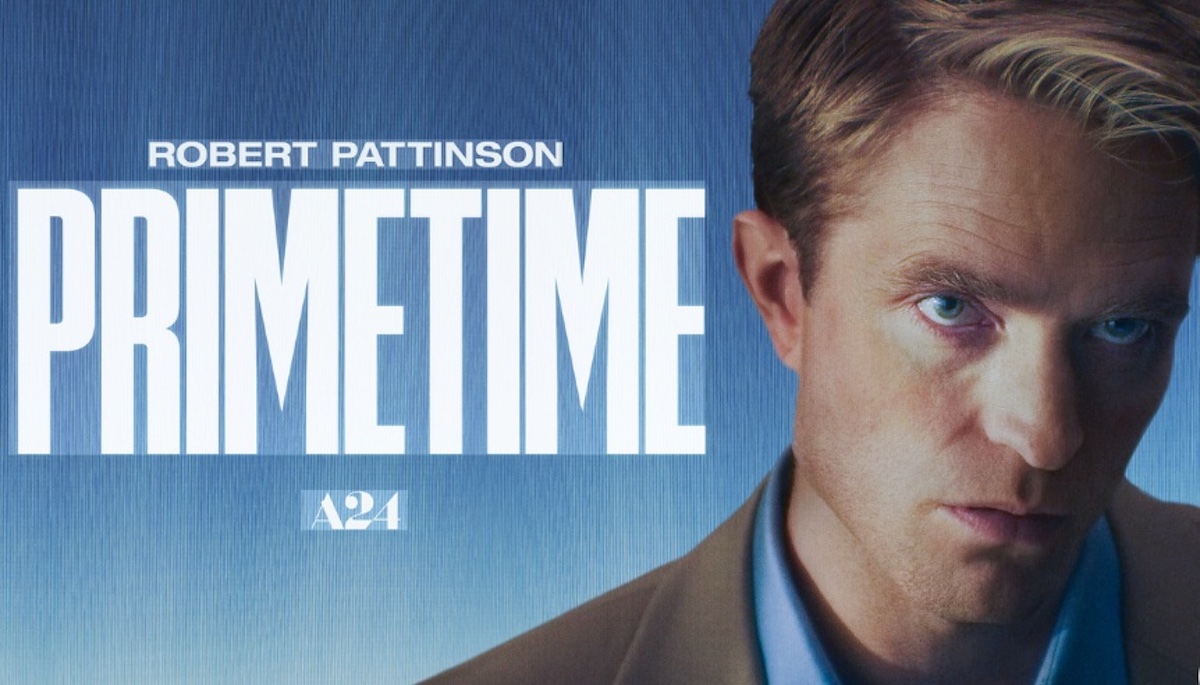
Few television images from the early 2000s remain as indelible—or as culturally uncomfortable—as a man sitting in a suburban living room, suddenly realizing that the friendly encounter he believed he had arranged was in fact a sting operation. Then came the calm voice, the fixed gaze, and the question that became a national catchphrase: “Why don’t you have a seat?” With Primetime, director Lance Oppenheim returns audiences to the charged world behind To Catch a Predator, not as a nostalgia exercise, but as a sharply stylized examination of the moment journalism, law enforcement, public humiliation, and ratings became inseparable.
Opening September 25, the A24 film stars Robert Pattinson in a fictionalized role inspired by Chris Hansen, the Dateline NBC correspondent whose confrontations with men accused of seeking sex with minors made him one of the most recognizable faces on American television. The premise is set in 2006, at the height of the program’s reach and influence: a period when hidden-camera investigations were not simply news segments, but national events, repeated endlessly on cable television, discussed in workplaces, and dissected online long before social media turned public condemnation into a permanent spectator sport. Entertainment Weekly
Yet Primetime appears less interested in recreating the procedural mechanics of the show than in exploring the psychological machinery surrounding it. Pattinson’s television host is positioned at the center of an environment where moral certainty is also performance, where a devastating story can become a ratings triumph, and where the camera’s presence changes every decision made in the room. The film asks an unsettling question that has only become more relevant in the years since: when a public good is delivered through spectacle, can the spectacle ever remain morally clean?
That tension is precisely what makes the material so fertile for cinema. To Catch a Predator was framed as an investigation designed to expose men attempting to exploit children, a purpose that carried undeniable public force. At the same time, its format depended on suspense, confrontation, surprise, and the unmistakable electricity of televised disgrace. The audience was invited to feel both alarm and satisfaction—to witness wrongdoing exposed in real time and to participate emotionally in a swift form of public judgment. Primetime seems prepared to examine what happens when those impulses become part of the product itself.
Pattinson is an inspired and provocative choice for such a role. Few contemporary actors are more willing to undermine the familiar shapes of leading-man charisma. Across his recent work, he has repeatedly shown an appetite for characters who are volatile, obsessive, vain, isolated, or quietly unraveling beneath the surface of self-control. In Primetime, that quality may be especially potent: the figure at the center is not merely reporting a story, but becoming one. His composure, authority, and apparent certainty are all being tested by the same medium that has elevated him.
The supporting cast deepens the film’s promise of something more than a conventional true-crime drama. Merritt Wever, Skyler Gisondo, Phoebe Bridgers, and Sean Bridgers join Pattinson in a project that has already generated discussion for its unnerving atmosphere and its refusal to treat its real-world inspiration as simple heroism. Oppenheim, known for documentaries that approach American life through its strange, fragile, and often revealing edges, makes his narrative-feature debut with a subject that sits perfectly within his fascination with performance and identity. A24’s official trailer
The history behind the film also gives it an unavoidable gravity. The original series became increasingly controversial after a 2006 Texas investigation involving assistant district attorney Bill Conradt, who died by suicide as police attempted to execute a search warrant while an NBC camera crew was present. The event became a flashpoint in the larger debate around the show: where does the responsibility of journalists end, where does law enforcement begin, and what changes when an investigation is designed for broadcast at the same time it is unfolding? Chris Hansen has publicly objected to Primetime and said he was not consulted, while defending the original program’s journalistic purpose and its collaboration with police. People
That conflict may be the very reason Primetime has arrived at the right moment. Contemporary audiences live inside an economy of exposure. Viral accusations, edited clips, body-camera footage, public callouts, true-crime franchises, and online campaigns now transform private catastrophe into immediate collective consumption. The technology has changed, but the appetite has not. If the original program made viewers feel as though they were witnessing justice from the safety of their living rooms, today’s culture has multiplied that living room into a vast, restless arena in which everyone can watch, comment, condemn, and share.
The most compelling possibility of Primetime lies in its willingness to hold several truths at once. The protection of children matters. Accountability matters. Journalism matters. But so do restraint, due process, human consequence, and the ethical burden carried by anyone who turns real suffering into entertainment. A film that confronts those contradictions without smoothing them into an easy answer could become one of the season’s most provocative releases—not because it revisits a famous television format, but because it exposes the uneasy bargain beneath so much of modern media.
Primetime is not simply looking backward at 2006. It is looking directly at the culture that followed.
