




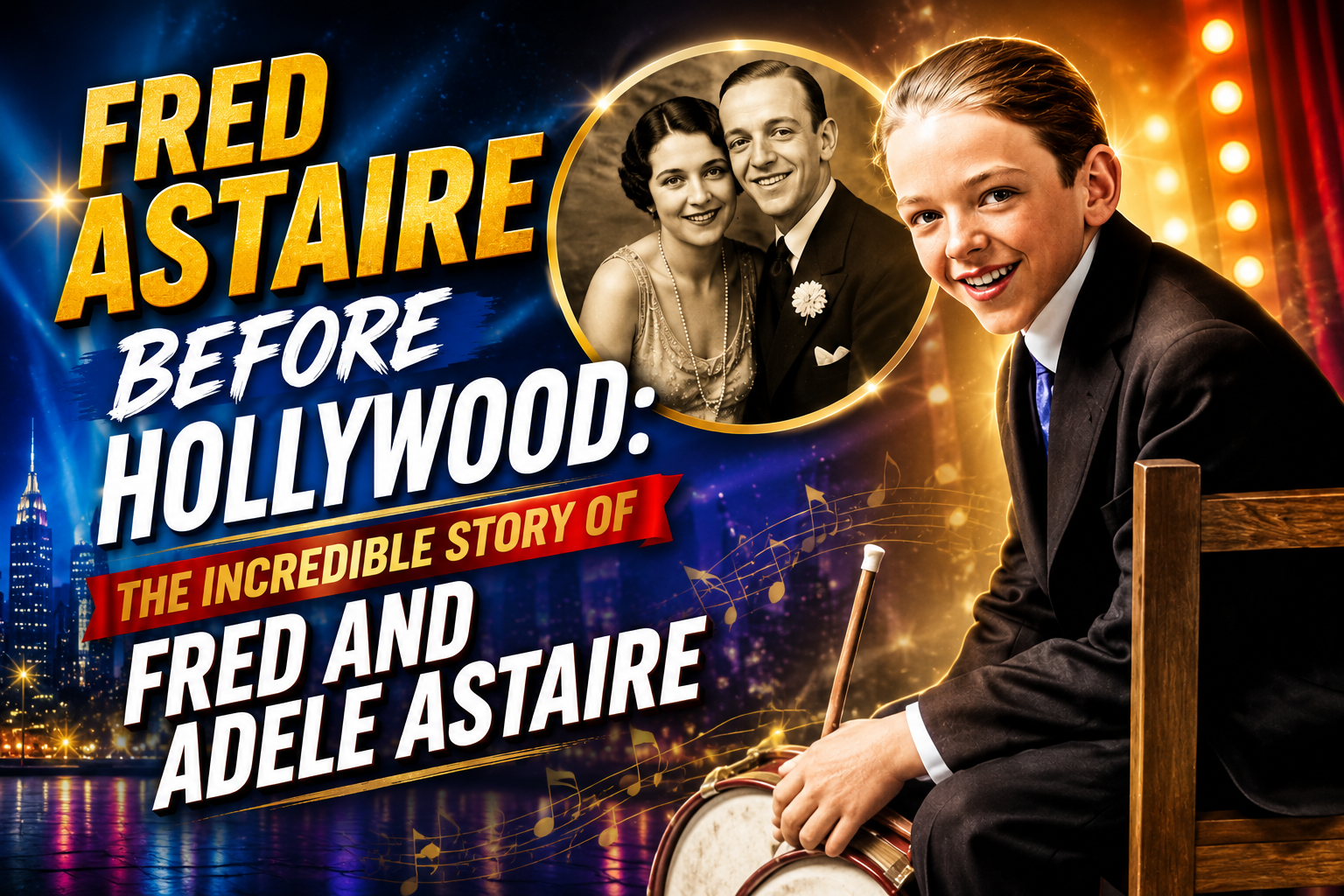
Long before Fred Astaire became synonymous with Hollywood elegance, before Ginger Rogers, before the immaculate evening clothes, impossible-looking routines and sophisticated musical comedies that transformed him into one of the defining performers of twentieth-century cinema, there was another Astaire partnership at the center of his life. Fred and his older sister Adele spent decades developing an act that carried them from childhood training through American vaudeville and eventually to major success on Broadway and the London stage. To contemporary audiences who know Fred primarily through the movies, Adele can appear almost like a forgotten prologue to the famous story. Historically, however, she was something much more important: a gifted and celebrated performer whose charisma helped shape her brother, whose partnership provided much of his earliest artistic education, and whose eventual departure from the stage forced Fred to confront the terrifying possibility that the professional identity he had spent most of his life building might have disappeared with her.
That history becomes especially important as Tom Holland prepares to portray Astaire, because the Hollywood icon cannot be understood properly without the decades of preparation that preceded Hollywood. The mature Astaire looks so natural on screen that it is easy to mistake refinement for instinct and effortlessness for something he simply possessed. You can watch Fred Astaire’s classic movies and explore other golden-age films inside the EE Vault with a 7-day free trial at https://www.empoweringentertainmentpublishing.com/classic-movies, and those performances become considerably richer once we understand that the man gliding through them had already spent most of his life rehearsing, touring, collaborating, failing, adjusting and learning how to make extreme preparation disappear beneath apparent ease.
Before Fred Astaire Became an Individual Star, He Was Half of an Act
Fred Astaire was born Frederick Austerlitz in Omaha, Nebraska, in 1899, into a family whose future would soon become entangled with the performing ambitions of its children. His sister Adele, eighteen months older, displayed enough natural aptitude that the family began taking the possibility of professional performance seriously, and Fred became part of the developing act. Their mother eventually took the children to New York, where they received training and began constructing the stage partnership that would occupy an extraordinary portion of Fred’s formative life. Even the transformation of the family name from Austerlitz to Astaire reflected the extent to which performance was becoming not merely something the children did but an identity through which they would be presented to the world.
Beginning so young matters because Fred did not first encounter discipline as an adult who had decided to become a professional dancer. Rehearsal, correction, repetition, musical structure and the awareness of an audience entered his life while his physical and psychological habits were still forming. A child trained under those conditions does not merely acquire steps; he develops an understanding that the public performance is the final visible layer of a much larger invisible process. What appears spontaneous onstage may have been repeated hundreds of times, and what appears relaxed may depend upon a degree of preparation that makes relaxation possible. The central paradox of Astaire’s later artistry—the enormous labor required to create the illusion that nothing is difficult—was therefore being embedded long before Hollywood gave him the medium through which it would become immortal.
Yet Fred’s early education was never solitary, and that distinction is crucial. From childhood onward he learned performance in relation to another body, another personality and another source of audience attention. He had to understand not only his own rhythm but Adele’s, not only how to occupy a stage but how to share one, and not only how to execute material correctly but how to preserve the impression of a relationship while doing so. Partnership was therefore not an additional skill Fred acquired after mastering individual performance. It was part of the architecture through which he learned performance in the first place.
Adele Astaire Was Far More Than Fred’s First Dance Partner
Popular history inevitably privileges the material that survives most visibly, and cinema has preserved Fred Astaire’s later partnerships in a way that the live theatre could never preserve Fred and Adele. As a result, Ginger Rogers occupies an enormous place in cultural memory while Adele is often known primarily to specialists, theatre historians and serious Astaire admirers. That imbalance can create a profoundly misleading impression of the siblings’ original relationship because Adele was not simply the capable sister who accompanied a future genius until his real career could begin. During significant portions of their shared stage career, she was an extraordinary attraction in her own right, celebrated for a natural charm and theatrical personality that audiences and critics found irresistible.
This changes the psychological meaning of Fred’s development. We often imagine great artists as unmistakably exceptional from the beginning, dominating every environment until institutions eventually catch up with what everyone around them already knows. Fred’s story is more interesting because the sibling beside him could be the more immediately magnetic presence. Adele possessed qualities that did not depend upon the kind of technical perfectionism for which Fred would later become famous, and her spontaneity could make the act feel alive in ways that pure precision never could. Fred therefore developed inside a partnership where excellence could not simply mean attracting more attention than the person standing next to him.
That circumstance may have been one of the greatest gifts of his early career. Fred had to create authority through qualities different from Adele’s, refining control, rhythm, precision and musical intelligence rather than attempting to become a second version of his sister. Their differences created artistic contrast, and contrast allowed individuality to develop inside collaboration. The performer later remembered as uniquely Fred Astaire was therefore shaped partly by years spent beside someone who demonstrated, night after night, that there were other ways of commanding a room.
Vaudeville Built the Discipline Behind the Effortlessness
The vaudeville circuit provided an unforgiving education because it stripped performance of many protections later available in cinema. There was no editing room capable of rescuing a weak transition, no alternate camera angle to conceal an uncertain movement and no post-production process through which an inconsistent performance could be reconstructed from fragments recorded across multiple attempts. Performers stood before an audience and discovered immediately whether their material worked. The experience could be exhilarating when the connection happened and brutal when it did not, but either way it trained artists to understand audience attention as something that had to be earned continuously.
For Fred and Adele, repetition under those circumstances developed more than endurance. Performing similar material again and again allowed them to refine the minute elements through which entertainment becomes persuasive: the length of a pause, the relationship between movement and music, the timing of a reaction, the difference between merely executing a routine and making that routine appear newly alive for an audience seeing it for the first time. Repetition therefore became a method of discovering freedom rather than simply enforcing uniformity. Once technique had been absorbed deeply enough, attention could move away from remembering the material and toward communicating through it.
This principle would eventually become central to Fred’s mature filmmaking philosophy. His insistence that audiences should be able to see dancing clearly makes greater sense when understood through the biography of someone formed in live performance. Fred knew from experience that sustained physical execution had meaning because he had spent years performing under conditions in which continuity could not be manufactured after the fact. Hollywood would give him extraordinary new possibilities, but his instincts about what a spectator should be allowed to witness had been shaped long before he stood before a movie camera.
Broadway and London Turned the Sibling Act Into a Major Theatrical Success
Fred and Adele eventually moved far beyond the precarious novelty of a childhood act. Their success on Broadway and in London established them as sophisticated adult performers capable of carrying significant theatrical productions, and this period is essential because it destroys the convenient idea that Fred’s pre-Hollywood years were merely an apprenticeship awaiting the arrival of his “real” career. By the time cinema became his defining medium, he had already experienced major professional success and had developed within theatrical cultures on both sides of the Atlantic.
Their London years were particularly significant because they placed the Astaires within a social and theatrical environment whose codes of sophistication would later seem remarkably compatible with Fred’s Hollywood persona. The cosmopolitan ease audiences associated with him was not created entirely by costume designers placing a tuxedo on an American dancer. Fred had spent years moving through international theatrical worlds, encountering different expectations of manners, style, comedy and social performance. Elegance gradually became more than wardrobe; it became part of an accumulated cultural vocabulary.
Success also raised the stakes of the partnership itself. Fred and Adele were no longer two young performers who could easily abandon an unsuccessful experiment. Their names had become professionally intertwined, their reputation depended upon the act, and their individual identities had been formed within a structure that audiences understood collectively. The stronger the partnership became, the more psychologically dangerous its eventual dissolution would be, because Fred had never needed to discover whether the public wanted Fred Astaire without Adele Astaire.
Partnership Taught Fred Something Technical Mastery Alone Could Never Teach
Dance partnerships are often described through synchronization, but synchronization is only the most visible layer of a much more complex relationship. Two performers may execute identical timing without creating the impression that they are communicating. Great partnership requires responsiveness: awareness of another person’s weight, rhythm, emotional intention and spatial choices, combined with enough technical security to adjust without making the adjustment visible. Fred spent his earliest professional life developing precisely that form of intelligence.
Adele’s strong personality made this education particularly valuable because she could not simply be treated as a neutral extension of Fred’s choreography. Her presence demanded response. The audience’s relationship with her was different from its relationship with him, which meant the act had to accommodate two distinct centers of energy. Fred learned that allowing another performer to command attention did not diminish his own authority; properly managed, it could enlarge the entire performance. This is one reason his later screen partnerships possess such unusual generosity. He does not appear threatened by the strength of the person opposite him because collaboration had never required him to erase the other performer.
When Ginger Rogers eventually entered Fred’s cinematic life, he therefore brought decades of partnership experience into the relationship. The famous Astaire-Rogers chemistry was new, but the collaborative intelligence Fred applied to it was not. He already understood how contrast could become attraction, how resistance could create dramatic tension and how shared rhythm could communicate an emotional development that dialogue might explain less elegantly. Adele had been the first great laboratory in which those instincts were formed.
Then Adele Walked Away From the Stage—and Fred Lost the Identity He Knew
In 1932, Adele married Lord Charles Cavendish and retired from professional performance, bringing one of the most important partnerships in Fred’s life to an end. From the vantage point of history, the event can look almost conveniently timed: Adele exits, Fred moves toward Hollywood, Ginger Rogers appears and the legend begins. Lived experience is rarely so orderly. For Fred, Adele’s departure meant losing the person beside whom he had spent most of his professional life and confronting the question of whether an identity created as half of a celebrated act could survive independently.
The distinction between losing a collaborator and losing a structure of identity is profound. Fred had rehearsed with Adele, toured with her, experienced success with her and learned how audiences perceived him in relation to her. Their professional history was also family history, making separation more psychologically complex than an ordinary business partnership ending. The next stage of his career therefore required more than finding another dancer. He had to discover what remained when the framework through which he had always understood himself professionally disappeared.
This is one of the richest dramatic territories available to any serious Fred Astaire biopic because it introduces vulnerability into a story too easily flattened into inevitable greatness. The Fred Astaire we remember did not know in 1932 that future generations would consider him one of the greatest dancers in film history. He knew that an enormously successful partnership had ended and that he now had to establish himself independently at an age when many entertainers might have feared their defining opportunity had already passed. The uncertainty is essential because without it, reinvention becomes destiny rather than courage.
Hollywood Did Not Discover an Unformed Talent
Fred’s eventual move into motion pictures is sometimes absorbed into the familiar Hollywood mythology of discovery, but the reality is more interesting. Cinema did not encounter an inexperienced performer waiting to be molded. It encountered an artist whose discipline, musical intelligence and understanding of live audiences had been developed across decades, and whose challenge was now to translate those qualities into a medium with fundamentally different possibilities.
This distinction explains much about the authority Fred eventually exercised over the presentation of dance on film. He arrived knowing what coherent movement looked and felt like because the stage had demanded it from him continuously. When he resisted cinematic techniques that fragmented the dancer unnecessarily, he was not protecting some abstract theory learned inside a studio. He was protecting an understanding of performance formed through thousands of hours in environments where the body had to sustain the illusion without editorial assistance.
Hollywood supplied cameras, sets, editing, sophisticated production machinery and eventually the conditions in which Fred could rethink what dance might become on screen. What it did not supply was the foundation. The artist capable of using those resources had been constructed long before cinema made him famous.
Fred’s Reinvention Was More Radical Than His Later Image Makes It Seem
Because the Hollywood persona eventually became so coherent, it is easy to imagine Fred moving naturally toward an identity that had somehow always been waiting for him. Yet reinvention rarely works that way. A successful shared identity had to be dismantled before an independent one could become convincing, and Fred had to preserve the skills developed within partnership without appearing permanently defined by its absence.
His age makes this transformation particularly revealing. Fred was already in his thirties when the Hollywood career that would define his global image began, which challenges the assumption that major artistic identity must be established in youth. He arrived with history rather than novelty, and that history became an advantage because maturity had given him something raw talent could not provide quickly: a deeply internalized understanding of craft.
The Fred Astaire who eventually seemed incapable of uncertainty had therefore passed through a period in which professional certainty had been removed. His later control becomes more interesting when understood not simply as temperament but as something strengthened through the experience of surviving instability. Reinvention did not erase the Adele years. It converted everything they had taught him into a new form.
Why Adele Is Essential to Understanding the Tom Holland Film
As Tom Holland prepares to portray Fred Astaire, the treatment of Adele may become one of the clearest indicators of how deeply the film intends to investigate its subject. A superficial biopic could use the sibling partnership as an efficient opening chapter before moving rapidly toward the Hollywood images audiences already recognize. A more ambitious film would understand that the Adele years contain the psychological and artistic foundations necessary to make those later images meaningful.
Through Adele, the film can show Fred before mastery became mythology. It can dramatize a young performer learning beside someone whose charisma sometimes surpassed his own, a brother negotiating family and professional dependence simultaneously, and an artist discovering technical identity through contrast. Most importantly, it can show the rupture that forced Fred to stop being half of an established success and become responsible for constructing a future alone.
For Holland, this material also offers something more dramatically substantial than impersonation. Recreating famous dances may demonstrate physical transformation, but portraying the years before the icon existed allows him to investigate how identity itself is formed. The younger Fred does not yet know which characteristics history will remember, and that uncertainty gives an actor room to create a human being rather than merely reproduce a legend.
The Fred Astaire We Remember Was Built in a World We Can No Longer See
One reason Adele has receded from popular consciousness is painfully simple: much of the world in which she and Fred became famous belonged to live performance and therefore vanished when the curtain came down. Cinema preserved Fred’s later work with a permanence theatre could not provide, creating an imbalance in cultural memory. We can still watch Astaire and Rogers move together, replay individual sequences and study them frame by frame, while the electricity of Fred and Adele’s stage partnership survives largely through photographs, reviews, accounts and historical reconstruction.
That difference demonstrates how profoundly media preservation shapes our understanding of artistic importance. What survives becomes easier to treat as central, while what disappeared can gradually resemble background even when it was foundational to the people who lived it. Adele’s diminished place in contemporary popular memory therefore tells us less about her importance to Fred than about the unequal ways different forms of performance survive.
Recovering her role changes the architecture of Astaire’s story. The famous Hollywood years cease to look like an isolated explosion of genius and instead become the continuation of a much older artistic education. The man on screen carries the invisible history of the child performer, the sibling partnership, the vaudeville circuits, Broadway, London and the destabilizing moment when the structure supporting all of it suddenly ended.
Fred Astaire’s rise becomes considerably more surprising once Adele is restored to her proper place in the story, because the years before Hollywood reveal a performer who was shaped by another star, defined by partnership and then forced to reinvent himself when that partnership disappeared. Beyond the paywall, we go deeper into the fascinating imbalance between Adele’s contemporary fame and her later disappearance from cultural memory, how sibling competition may have sharpened Fred’s perfectionism, why the end of their act created the psychological conditions for his Hollywood transformation, and why Tom Holland’s portrayal could fundamentally change the way a new generation understands both Astaires. Subscribe to Empowering Entertainment Magazine to unlock the complete feature, and your subscription also includes the EE Vault, where classic movies, books, games and more connect entertainment history with the stories still shaping popular culture today.
JOIN FOR FREE
Sign up to Hundreds of resources. New content added every week.
PLUS access to our MOVIE CHANNEL
One free account. Unlimited articles and movies. No credit card required.

Already a member? LOGIN HERE
