




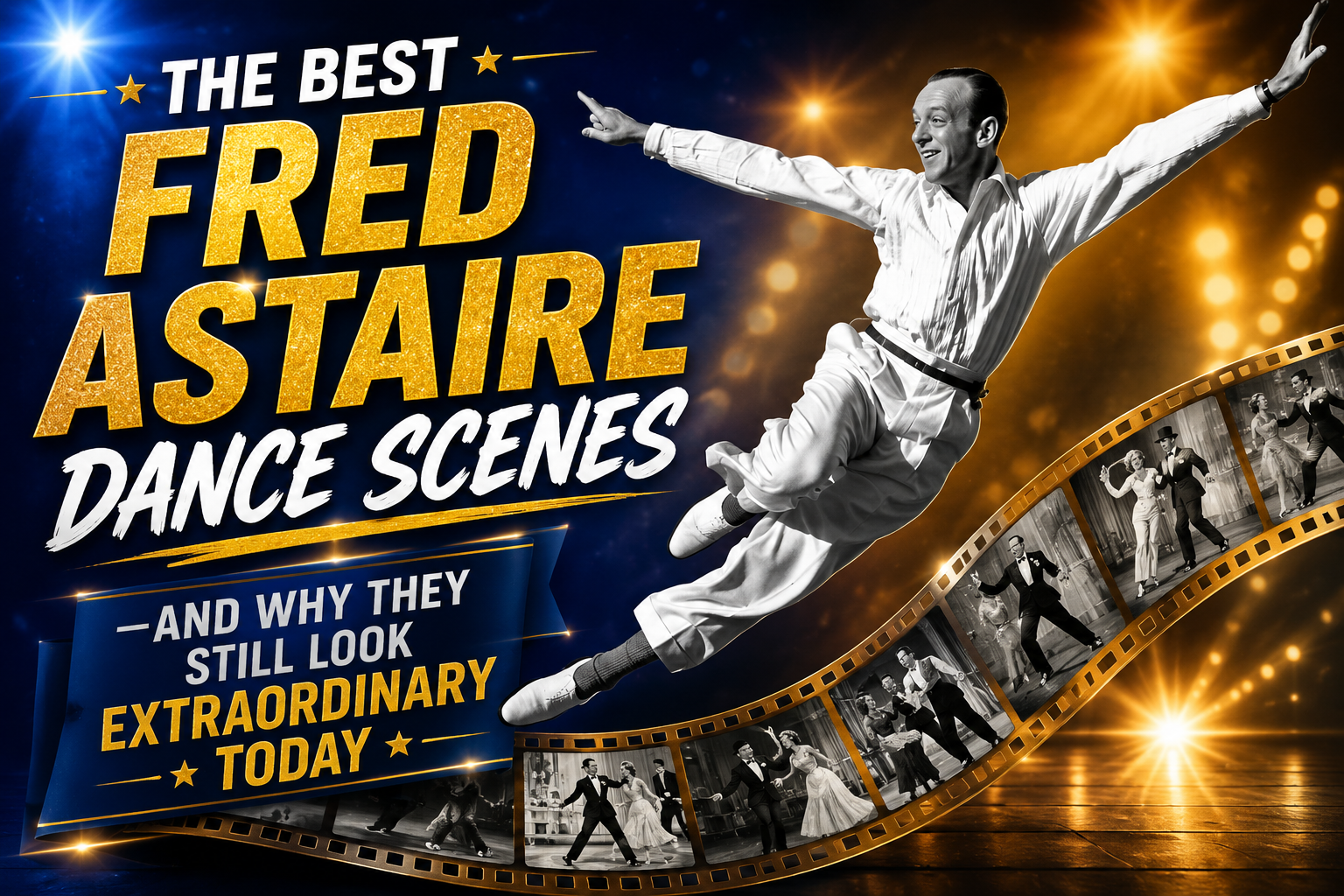
Nearly a century after Fred Astaire began transforming dance on film, the most remarkable thing about his greatest sequences is not that they remain historically important. Historical importance can survive long after entertainment value has faded; an artist can be essential to understanding the development of a medium without continuing to produce the visceral pleasure that originally made the work successful. Astaire presents a different phenomenon. Watch the finest sequences today and the distance between contemporary audiences and 1930s or 1940s Hollywood can suddenly become surprisingly small. The clothes belong to another era, the musical arrangements come from another cultural vocabulary and the filmmaking lacks almost every form of technological acceleration modern viewers have been trained to expect, yet once Astaire begins moving, the images can feel startlingly immediate. The reason is not nostalgia. It is that the fundamental source of the spectacle remains visible: an extraordinary human being doing something extraordinarily difficult with such precision that difficulty itself seems to disappear.
That quality is particularly worth rediscovering as Tom Holland prepares to portray Astaire, because no description of his technique can substitute for watching the originals and discovering how differently individual routines express the same underlying artistic philosophy. You can watch Fred Astaire’s classic movies and explore other golden-age films inside the EE Vault with a 7-day free trial at https://www.empoweringentertainmentpublishing.com/classic-movies, where Astaire’s work offers something increasingly unusual in an era of infinitely manipulable images: enough visual continuity to study the performer rather than merely accept the spectacle. His greatest numbers are not interchangeable demonstrations of virtuosity. Some turn courtship into movement, some transform ordinary objects into instruments, some make architectural space appear to defy gravity, and some strip dance down so completely that rhythm, personality and a nearly empty environment become sufficient to hold the screen.
“Cheek to Cheek”: When Romantic Chemistry Becomes Choreography
Few images are more deeply associated with Fred Astaire and Ginger Rogers than their dance to Irving Berlin’s “Cheek to Cheek” in Top Hat. The sequence possesses all the visual ingredients that have helped define Hollywood glamour in cultural memory: formal evening dress, an elegant setting, Rogers in a famously feathered gown and two stars moving with an ease that makes sophistication appear almost natural. Yet concentrating only on the glamour misses what gives the number its emotional durability. Astaire and Rogers are not merely dancing beautifully beside one another; choreography becomes a language through which intimacy is negotiated.
The sequence demonstrates one of Astaire’s most important contributions to the movie musical: dance can develop a relationship rather than interrupt it. The bodies move through changing degrees of proximity, separation and synchronization, allowing attraction to acquire physical structure. Astaire’s control is impressive, but the number would lose much of its emotional power if Rogers existed merely as an elegant object being guided through his virtuosity. She answers him physically, and the partnership creates the sense that intimacy is being discovered rather than imposed. Their technical synchronization becomes emotionally meaningful because it represents two distinct people gradually occupying the same rhythm.
The filmmaking protects that relationship by allowing the audience to understand both bodies in space. We are not repeatedly separated from the partnership through frantic changes of perspective, which means that approach, retreat, rotation and physical alignment remain legible. The camera gives us enough time to perceive chemistry as movement. What survives today is therefore not simply a beautiful old dance but an exceptionally clear example of cinema using choreography to express something dialogue could only describe.
“Puttin’ on the Ritz”: One Performer, Multiple Astaires and the Architecture of Persona
Astaire’s “Puttin’ on the Ritz” sequence in Blue Skies offers a different kind of pleasure because it transforms his famous sophistication into something more playful and self-aware. The number eventually multiplies Astaire through visual effects, surrounding him with copies of himself and turning the screen into an elaborate celebration of the persona audiences already recognized. Yet the technical device does not diminish the physical performance at its center. Instead, it reveals how successfully Astaire’s identity had become a form of visual shorthand: the tailoring, posture, rhythm and movement were sufficiently distinctive that multiplying the figure intensified rather than diluted the effect.
What makes the sequence especially interesting today is its relationship with technology. Astaire is sometimes remembered through an oversimplified opposition between authentic dancing and cinematic effects, as though his commitment to visible performance implied resistance to technological invention. His films repeatedly demonstrate something more sophisticated. He was perfectly capable of participating in elaborate cinematic illusion when the illusion expanded what performance could mean. The important question was whether technology served the dancer or made the dancer irrelevant.
“Puttin’ on the Ritz” retains its vitality because the multiplication of Astaire does not ask us to forget the performer at the center of the construction. The effect amplifies personality. Contemporary visual-effects cinema can create armies of impossible bodies, but this older sequence remains engaging because the technological trick has a conceptual relationship with the star himself: Astaire has become so unmistakably Astaire that the film can turn his screen identity into choreography.
“Pick Yourself Up”: The Joy of Watching Partnership Become Equality
In Swing Time, “Pick Yourself Up” offers one of the clearest demonstrations of why Astaire and Rogers cannot be understood through the simplistic idea of a male virtuoso accompanied by a female partner. The number is dramatically structured around revelation. Rogers’s character initially has reason to underestimate the dancing ability of Astaire’s character, and the routine transforms that misunderstanding into delight as his competence becomes impossible to conceal. Yet the sequence quickly develops beyond a demonstration of his superiority because Rogers meets him with enough authority to make the dance a shared event.
The pleasure comes partly from watching performance change the relationship between the characters. Knowledge has shifted, and with it the balance of power. Dance becomes evidence: Astaire’s character reveals something about himself that conversation had not established, while Rogers responds not through passive admiration but through her own movement. The choreography allows competence to generate attraction because each performer discovers something worth answering in the other.
This dramatic construction helps explain why the number remains so enjoyable without requiring modern audiences to possess any technical knowledge of dance. We understand the emotional stakes before we understand the steps. The virtuosity is impressive, but the sequence has narrative momentum because movement changes what the characters know about one another. Astaire’s larger legacy lies partly in this integration of technique and storytelling: the dance matters because something is different when it ends.
“Never Gonna Dance”: When Virtuosity Becomes Emotional Desperation
The climactic “Never Gonna Dance” sequence in Swing Time demonstrates another dimension of the Astaire-Rogers partnership because technical beauty is placed in the service of emotional intensity rather than uncomplicated pleasure. The number develops through an increasingly demanding physical and emotional structure, using movement to express a relationship that has reached a point where ordinary language is inadequate. What begins within the conventions of musical romance acquires a sense of urgency precisely because the performers’ extraordinary control is carrying emotions that threaten to exceed control.
This is where Astaire’s reputation for elegance can become misleading if elegance is interpreted as emotional detachment. His restraint does not eliminate feeling; it gives feeling architecture. The disciplined body allows emotional changes to become visible through shifts in rhythm, distance and intensity without requiring theatrical excess. Rogers is equally essential because the sequence depends upon two performers sustaining the same dramatic escalation. Their technical command permits the choreography to become more emotionally dangerous without collapsing into disorder.
For a contemporary actor such as Tom Holland, this kind of sequence may ultimately present a greater challenge than an isolated display of difficult footwork. It is possible to train until choreography can be completed accurately; it is much harder to reach the point where technical execution remains secure while emotional life appears to be driving the movement. Astaire’s greatest dances repeatedly demonstrate that virtuosity is not the destination. It is the foundation that makes dramatic freedom possible.
“Bojangles of Harlem”: A Brilliant Performance Inside a History That Requires Context
Any serious discussion of Astaire’s most famous screen dances must confront “Bojangles of Harlem” from Swing Time, because the sequence demonstrates both his extraordinary technical imagination and the racial history embedded within American entertainment. Astaire created the number as a tribute associated with Bill “Bojangles” Robinson, one of the most important Black tap dancers of the era, yet the performance includes Astaire appearing in blackface. That fact cannot responsibly be detached from the number’s historical evaluation, nor should admiration for Astaire’s dancing require pretending that the imagery has not acquired a profoundly different meaning for contemporary audiences.
The sequence is artistically fascinating in part because of its use of projected shadows, which become extensions and opponents of Astaire’s movement. He appears to dance against multiplied silhouettes, creating a sophisticated relationship between live performance and cinematic illusion. Rhythm becomes both physical and graphic, while the screen itself seems to participate in the choreography. The conceptual ambition anticipates the same fascination with technology and bodily performance visible elsewhere in Astaire’s work, and the technical accomplishment remains important to the history of dance on film.
Yet historical sophistication requires holding artistic achievement and cultural context together rather than using one to erase the other. Astaire worked within an entertainment culture deeply shaped by racial appropriation, segregation and unequal access to recognition, while tap itself carries histories that cannot be understood without Black American artistry. Watching the number today therefore asks more from us than uncomplicated celebration. It asks us to recognize the technical brilliance visible on screen while understanding that Hollywood’s systems of representation allowed white performers access to forms of prestige and preservation that many of the artists who shaped those traditions did not receive equally. Serious film history becomes richer, not poorer, when admiration is capable of containing complexity.
“Steppin’ Out With My Baby”: How Color and Movement Became Part of the Same Idea
By the time Astaire performed “Steppin’ Out With My Baby” in Easter Parade, the visual possibilities of the Hollywood musical had expanded considerably, and the sequence demonstrates how readily his approach could inhabit a more elaborate cinematic environment without sacrificing clarity. The number uses the possibilities of color, staging and photographic manipulation while preserving Astaire as the organizing center of the image. Once again, technology does not replace performance; it creates another layer through which performance can be perceived.
This matters because Astaire’s longevity depended partly upon his refusal to confuse artistic principles with a single visual formula. A performer who had simply repeated the aesthetics of his earliest films would eventually have become a historical artifact inside his own career. Instead, Astaire could work within changing production styles because the deeper principles remained portable. The body should remain intelligible, rhythm should govern the relationship between movement and image, and cinematic invention should enlarge the expressive possibilities of choreography rather than conceal its weaknesses.
The result is a sequence that feels simultaneously anchored in classical Hollywood and remarkably conscious of cinema as a manipulable visual medium. Astaire never needed realism in the narrow sense. His films could become highly artificial because the physical credibility of the performer gave the artificial environment something solid around which to organize itself. The more fantastical the world became, the more valuable his visible control could become.
“You’re All the World to Me”: Dancing on the Ceiling Without Making the Human Performer Disappear
The ceiling dance from Royal Wedding remains one of Astaire’s most immediately astonishing sequences because its central image is understandable within seconds: the ordinary laws of gravity appear to have stopped applying. Astaire dances across a room, continues onto the walls and eventually appears upside down on the ceiling, transforming architecture into a partner. Even viewers unfamiliar with the technical history behind the effect can recognize that they are watching an ingenious interaction between performer, set and camera.
The illusion was created through a rotating room constructed around a camera whose relationship to the set remained fixed. As the room rotated, furniture was secured in place while Astaire adapted his body to the changing orientation, creating the impression that he had escaped gravity rather than that the environment itself was moving. What makes the sequence extraordinary is that the mechanical ingenuity does not reduce Astaire’s responsibility. He still has to perform within the rotating environment, controlling his body as the physical world around him changes. The effect and the dancer depend upon one another.
This is perhaps one of the clearest examples of why describing Astaire as a purist opposed to cinematic trickery fundamentally misses the sophistication of his approach. He embraced an enormous illusion because the illusion created a new physical problem for the performer to solve. Technology did not eliminate human accomplishment; it made a different form of human accomplishment possible. In an era when digital technology can make almost any impossible image plausible, that distinction has become newly relevant. The sequence remains astonishing because we are watching illusion and physical reality cooperate rather than compete.
“Sunday Jumps”: Why a Hat Rack Can Become a Dance Partner
One of Astaire’s most revealing talents was his ability to animate ordinary objects through rhythm. In “Sunday Jumps” from Royal Wedding, a hat rack becomes his partner, demonstrating how little external spectacle he actually required when the underlying concept was strong enough. The object possesses no expression, psychology or independent performance, yet Astaire creates a relationship with it through timing, distance and response, encouraging the audience to perceive personality where none literally exists.
The achievement illuminates something fundamental about great physical performance. Astaire does not need the hat rack genuinely to move like a human partner because he controls the audience’s perception of causality. A gesture toward the object, a movement around it or a carefully timed reaction can make the rack appear to participate in an exchange. The performer supplies both sides of the relationship through his own precision, turning choreography into a form of imaginative storytelling.
This capacity to make ordinary environments responsive is one reason Astaire’s work resists becoming merely decorative. His dancing repeatedly reorganizes the world around him. Floors become instruments, furniture becomes choreography, architecture becomes possibility and walking becomes rhythm. The dance does not simply happen inside a setting; it changes what the setting appears capable of doing.
“Shoes With Wings On”: The Absence of a Body Becomes the Concept
In The Barkleys of Broadway, Astaire’s “Shoes With Wings On” sequence takes cinematic playfulness in another direction by allowing shoes to acquire an apparently independent dancing life. Once again, the fascination comes from the intersection of physical performance and screen illusion, but beneath the novelty lies a recurring Astaire principle: technique becomes most interesting when attached to an idea.
A routine based solely upon technical difficulty can produce admiration, but conceptual choreography gives difficulty dramatic shape. The audience understands the premise and watches Astaire explore its possibilities, which turns virtuosity into discovery rather than exhibition. Each development feels like an answer to the question established by the number: what else can this impossible situation do?
Astaire’s greatest sequences frequently operate in this manner. They establish a physical or emotional proposition and then deepen it through choreography. That structure helps explain why individual numbers remain memorable long after viewers have forgotten the precise steps. We remember the idea because the movement made the idea visible.
“Dancing in the Dark”: When Restraint Becomes More Powerful Than Display
The “Dancing in the Dark” sequence with Cyd Charisse in The Band Wagon demonstrates how profoundly Astaire’s artistry could change according to the partner and dramatic context. There is no need for acrobatic spectacle or aggressive technical exhibition because the number derives its power from controlled intimacy. The movement unfolds with a composure that allows attraction to develop gradually, making restraint itself dramatically expressive.
Charisse brings a physical vocabulary very different from Rogers, and Astaire’s ability to adapt without ceasing to be himself reveals the depth of his partnership intelligence. He does not force every collaborator into the same formula. Instead, the choreography creates a world in which the particular qualities of both performers can coexist. Astaire’s identity remains unmistakable, but the relationship changes him enough to prevent the partnership from becoming a repetition of previous successes.
This adaptability is one of the strongest arguments against reducing Astaire to technique. Technical mastery made adaptation possible, but artistic intelligence determined what to do with it. A less secure performer might need every partnership to reinforce the same strengths. Astaire could allow another performer’s qualities to alter the atmosphere because his own identity was stable enough to survive the encounter.
“Girl Hunt Ballet”: Astaire Enters a Darker Cinematic Language
Also in The Band Wagon, the extended “Girl Hunt Ballet” demonstrates Astaire’s ability to inhabit a more stylized and dramatically unusual world. Drawing upon the language of hard-boiled detective fiction and film noir, the sequence moves far beyond the elegant romantic spaces most commonly associated with him. Choreography becomes narrative fantasy, with movement, production design, lighting and character combining to create something closer to a miniature film within the film.
The number is important because it reveals how flexible Astaire’s screen persona could be when placed inside a strong conceptual framework. His elegance does not disappear, but it acquires different implications within a darker environment. Movement that might communicate romantic confidence elsewhere can become investigative, suspicious or dangerous, demonstrating how choreography changes meaning according to dramatic context.
For contemporary viewers accustomed to genre hybridity, the sequence can feel surprisingly modern in conception. It refuses the idea that dance belongs only to romantic musical interludes and instead uses choreography as a complete storytelling system capable of absorbing another cinematic genre. Astaire’s contribution to screen dance was therefore not simply to perfect a way of photographing elegant routines. He helped demonstrate how many kinds of narrative cinema movement could contain.
“One for My Baby”: How Stillness Can Become Part of Dance
Astaire’s greatest performances also demonstrate that movement acquires power partly through contrast with stillness. A dancer who moves continuously can eventually flatten the emotional value of movement because everything exists at the same level of activity. Astaire understood pauses, transitions and apparently casual gestures as part of rhythmic construction, allowing the audience to experience anticipation as well as release.
This quality becomes especially important in numbers where character and mood dominate over overt virtuosity. Astaire can make a small gesture carry disproportionate significance because the movement has been prepared through timing. The spectator waits without necessarily realizing that waiting has become part of the choreography.
Such restraint helps explain why his work can remain compelling to audiences accustomed to much faster editing. Speed alone does not create attention. Structured expectation does, and Astaire repeatedly demonstrates how precisely controlled rhythm can make comparatively simple movement feel charged with meaning.
“Let’s Say It With Firecrackers”: Rhythm Escapes the Body
Astaire’s relationship with percussive objects provides another key to his enduring appeal. In sequences where props, floors or environmental elements become rhythmic instruments, dance expands beyond the boundaries of the body. Sound becomes evidence of movement, while movement creates music rather than simply responding to it.
This interaction reveals Astaire’s unusually integrated conception of rhythm. He is not merely dancing to a soundtrack laid beneath him; the physical world can become part of the musical structure. The distinction makes performance feel generative. Astaire appears to produce rhythm through action, transforming choreography into something simultaneously visual and sonic.
Modern audiences may not consciously analyze this integration, but they respond to its coherence. The sequence feels satisfying because sound and movement share causality. We hear what the body does.
Why These Dances Still Look So Difficult Even When Astaire Looks So Relaxed
Across radically different sequences, one contradiction remains constant: the audience can understand that what Astaire is doing must be extraordinarily difficult while receiving remarkably little visual evidence that he finds it difficult. This separation between objective complexity and subjective appearance is central to his fascination. The more demanding the movement becomes, the more complete his control seems.
The effect depends upon details easily overlooked when attention is concentrated solely upon footwork. His upper body frequently remains composed, transitions preserve continuity, facial expression stays available for character, and musical phrasing prevents the choreography from appearing mechanical. Difficulty does not disappear; its symptoms disappear. We recognize mastery because the performer has eliminated the signals through which lesser mastery normally reveals itself.
This is precisely why Astaire presents such an unusual challenge for Holland. An actor can learn an impressive routine and produce admiration simply by completing it. Astaire requires another level of transformation in which completion becomes almost beside the point. The audience should stop asking whether the performer can survive the choreography because survival is no longer visible as a concern.
The Best Fred Astaire Dances Are Not Really About Steps
Once these sequences are considered together, the inadequacy of describing Astaire primarily through technical ability becomes obvious. The ceiling dance is about transforming architecture; “Cheek to Cheek” is about intimacy; “Pick Yourself Up” turns revelation into attraction; “Dancing in the Dark” makes restraint romantic; “Girl Hunt Ballet” transforms choreography into genre storytelling. The steps matter enormously, but their purpose is to make an idea, relationship or emotional condition physically visible.
This is why imitation can reproduce Astaire without reproducing his greatness. A performer could copy the external choreography with extraordinary accuracy and still miss the internal logic that made the choreography necessary. Astaire’s movements belong to situations. They answer dramatic questions, transform spaces and reveal relationships.
The enduring lesson is therefore not how Fred Astaire danced but why he danced at particular moments in particular ways. Technique becomes art when it acquires intention, and Astaire’s greatest sequences remain alive because the intention survives even when the cultural world surrounding them has changed.
Nearly a Century Later, the Human Body Is Still the Special Effect
There is something almost paradoxical about watching Astaire in the twenty-first century. Cinema can now create bodies that fly through impossible environments, reverse gravity, transform shape and survive events no physical performer could endure. Against that technological abundance, a man dancing in a comparatively simple frame should theoretically seem less spectacular than ever. Instead, the opposite can occur. The limitations make the accomplishment more tangible because the audience understands that the performer himself remains responsible for much of what produces the wonder.
Astaire’s greatest sequences create a form of spectacle based upon credibility. Even when cinematic illusion is involved, as in Royal Wedding, the human performance remains visible inside the mechanism. We are impressed not simply because the image is impossible but because we can understand the relationship between illusion and physical accomplishment. The body anchors fantasy.
That distinction may help explain why Astaire is becoming particularly relevant again as Holland prepares to portray him. A new generation accustomed to seamless digital imagery may encounter something unexpectedly radical in these old films: the pleasure of being allowed to watch long enough to know that the person in the frame can actually do what the image says he can do.
Fred Astaire’s most famous dances are entertaining enough to survive without explanation, but their real brilliance becomes visible when we look beneath the apparent ease and examine how rhythm, camera placement, partnership, technology and storytelling were engineered around the performer. Continue reading to discover what these sequences reveal about Astaire’s artistic philosophy, why his use of special effects was far more sophisticated than the myth of the “pure” dancer suggests, how Ginger Rogers and Cyd Charisse exposed radically different dimensions of his artistry, and which elements Tom Holland will have to master if the new film intends to recreate more than the superficial appearance of the originals. Subscribe to Empowering Entertainment Magazine to unlock the complete feature and discover the extraordinary creative intelligence behind the performances that made Fred Astaire’s dancing look effortless while quietly transforming what movement could accomplish on screen.
JOIN FOR FREE
Sign up to Hundreds of resources. New content added every week.
PLUS access to our MOVIE CHANNEL
One free account. Unlimited articles and movies. No credit card required.

Already a member? LOGIN HERE
