
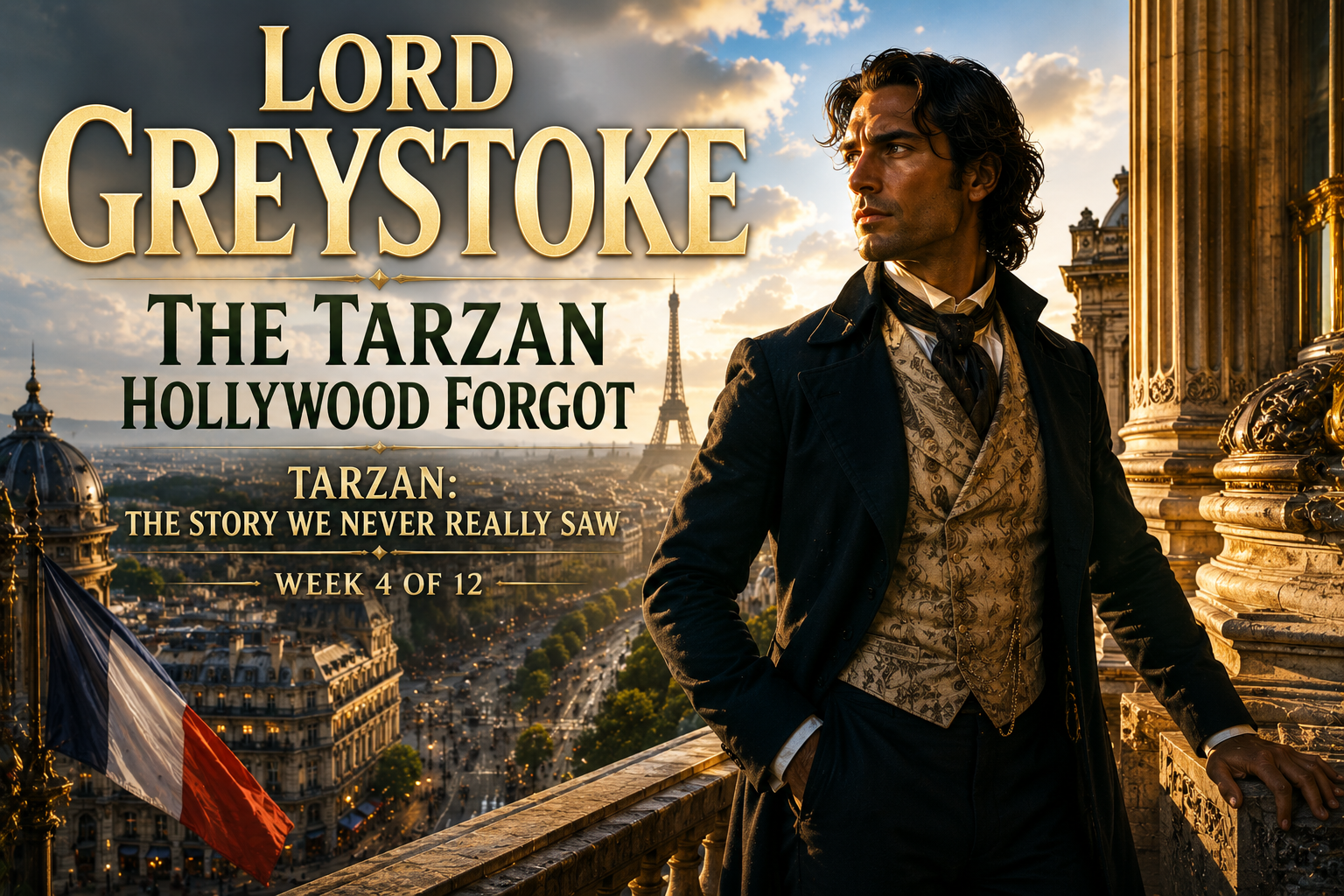
The Tarzan most audiences remember from movies is a creature of the jungle, but the Tarzan Edgar Rice Burroughs developed across the novels was also John Clayton, Lord Greystoke, a sophisticated, multilingual, socially adaptable man capable of navigating European society, political intrigue, international travel and intelligence work without ever surrendering the identity forged in Africa. This distinction is not a decorative extension of the character but one of the central reasons Tarzan remains far more psychologically interesting than the cultural shorthand that eventually replaced him, because the moment he enters civilization the story stops being merely about whether a man raised outside human society can adapt to human rules and becomes something much more provocative: whether civilization can absorb someone who understands its structures without emotionally depending upon them. Tarzan's capacity to move through drawing rooms, political networks and aristocratic environments does not prove that civilization has finally corrected him; it reveals instead that the intelligence, observational discipline and adaptive instincts developed in the jungle were always transferable, and that the man often remembered as primitive was never intellectually confined to the environment in which he was raised.
Watch classic Tarzan movies and TV series by joining the EE Vault. Click here for more information.
The significance of Lord Greystoke in the original Tarzan story therefore lies in the unusual order in which identity and status arrive. Most aristocratic characters are shaped from childhood by family name, privilege, expectation and inherited social position, but Tarzan acquires all of those things only after his character has already been formed without them, which means the Greystoke inheritance cannot become the source of his self-worth because self-worth already exists. Civilization believes it is restoring a lost heir to his rightful place, yet the man it restores has learned to evaluate authority through competence rather than title, loyalty through conduct rather than social convention, and danger through direct experience rather than abstraction. The result is a reversal of the traditional lost-heir narrative: instead of the discovery of noble birth completing an incomplete man, Tarzan's aristocratic identity exposes the limitations of a society that assumes inherited status carries meanings he learned long ago to measure by entirely different standards.
To rediscover the Tarzan Hollywood largely forgot, we therefore have to follow him beyond the familiar jungle imagery and into the environments where his divided identity becomes most intellectually revealing, because it is in civilization that the contrast between Tarzan and John Clayton ceases to be visual and becomes philosophical. He can learn the manners, speak the languages, understand the hierarchies and perform the social role expected of Lord Greystoke, yet none of those accomplishments gives civilization exclusive possession of him, and this psychological distance becomes the source of his unusual freedom. As Tarzan moves through Europe, encounters intrigue and discovers that civilized danger often hides behind etiquette, prestige and respectable surfaces, Burroughs reveals a character who is not moving upward from savagery toward refinement but horizontally between competing systems of value, capable of understanding both because neither has succeeded in persuading him that it alone defines what a human being should be.

Unlock the Entire Empowering Entertainment Library
This article is only the beginning.
Become a member and enjoy unlimited access to every premium magazine article, expert interviews, in-depth features, practical guides, and a growing digital library of hundreds of books covering business, entrepreneurship, film production, personal growth, health, relationships, AI, ADHD, and much more.
One membership. Hundreds of resources. New content added every week.