




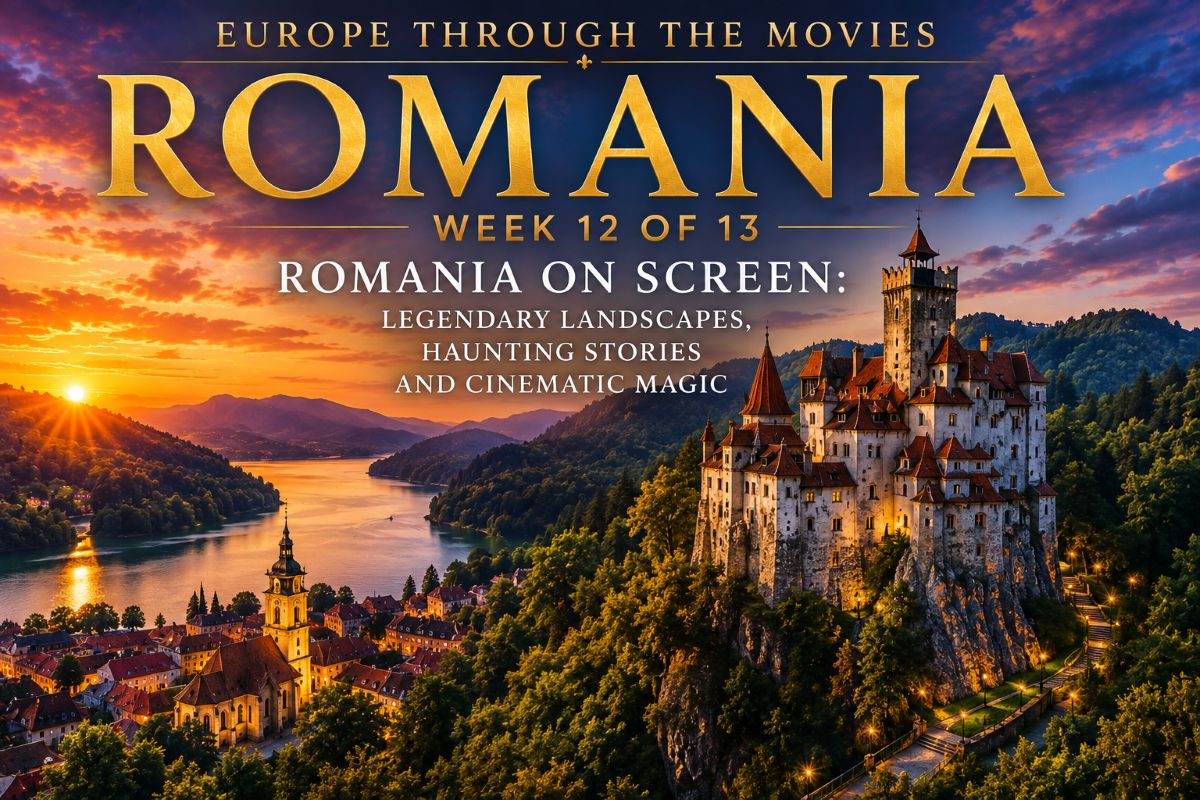
Romania occupies one of the strangest positions in European screen culture because international cinema has spent generations turning the country into an atmosphere before allowing it to remain a place. The most iconic filming locations in Romania, from the castles and medieval towns of Transylvania to the Carpathian forests, Bucharest’s monumental architecture and the historic buildings used for Wednesday, have repeatedly been asked to carry meanings of darkness, aristocratic decay, superstition, mystery and the supernatural, even when the actual geography beneath those associations is far more complex than the mythology imposed upon it. The country has become inseparable in the global imagination from Dracula, yet Bram Stoker never visited Transylvania; its castles are often promoted through a fictional lineage that does not correspond neatly to the historical Vlad III; and contemporary productions such as Wednesday continue to draw upon Romanian architecture precisely because real Gothic, neo-Romanian and historic structures already contain enough visual density to support an invented world without appearing artificial. Romania’s cinematic power therefore comes from a paradox: it has been mythologized so successfully that the traveller arrives carrying a fictional country in memory before encountering the real one.
The deeper fascination of Romania film tourism lies in the distance between those two countries, because the Gothic Romania of popular culture is selective rather than false in any simple sense. The Carpathians genuinely create landscapes of enclosure and exposure in equal measure; medieval towns such as Sighișoara and Brașov possess architecture capable of suggesting continuity with centuries that feel psychologically remote from modern life; castles such as Bran and Corvin carry military, aristocratic and historical significance strong enough to survive even the most aggressive fictional reinterpretation; while Bucharest offers an entirely different visual language of grand boulevards, socialist monumentalism, Belle Époque remnants and contemporary urban life. Filmmakers use fragments of this reality to construct coherent fantasy, but the country itself refuses such coherence, which is precisely why it remains so interesting. Romania can appear ancient, imperial, post-socialist, Gothic, cosmopolitan or rural depending upon where the camera stands, and each version reveals something real while simultaneously obscuring everything beyond the frame.
Following the most famous filming locations in Romania you can actually visit therefore becomes a journey not simply through castles, forests and cinematic landmarks, but through the machinery by which myth attaches itself to geography and eventually becomes difficult to separate from it. The route moves from Bucharest and the remarkable buildings that helped create the world of Wednesday, into Transylvania and the international mythology surrounding Bran Castle, through Corvin Castle and the medieval urban fabric that allows historical imagination to become spatially persuasive, before continuing into the Carpathian landscape where geography itself supplies the emotional conditions Gothic storytelling has exploited for centuries. What emerges is a deeper question than whether Romania “looks like the movies”: how much of what we think we know about a country can be created by stories, and what happens when travel finally gives the real place an opportunity to answer back?
JOIN FOR FREE
Sign up to Hundreds of resources. New content added every week.
PLUS access to our MOVIE CHANNEL
One free account. Unlimited articles and movies. No credit card required.

Already a member? LOGIN HERE
