




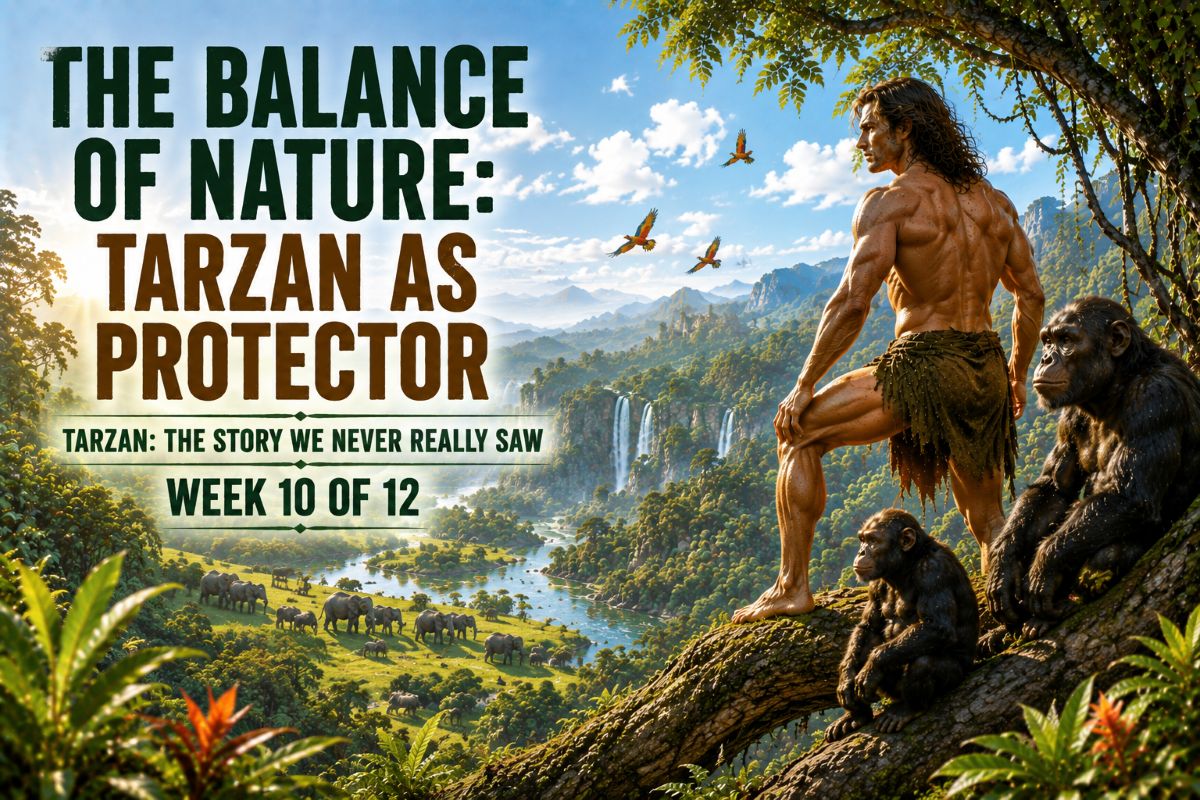
The later Tarzan novels by Edgar Rice Burroughs contain an extraordinary amount of material that mainstream cinema has either barely explored or left almost entirely untouched, and this neglected territory changes the argument for a modern Tarzan remake in a fundamental way. By the middle of the canonical series, Tarzan is no longer moving through variations of a single jungle adventure but through radically different narrative structures involving Opar, lost empires, impostors, secret cults, hidden cities, ancient orders, scientific fantasy, political conflict and increasingly elaborate tests of identity. The authorized Tarzan canon includes twenty-four principal books, ranging from Tarzan and the Golden Lion and Tarzan, Lord of the Jungle through Tarzan and the Lost Empire, Tarzan and the City of Gold, Tarzan and the Leopard Men, Tarzan's Quest, Tarzan and the Forbidden City, Tarzan the Magnificent, Tarzan and the Foreign Legion, Tarzan and the Madman and Tarzan and the Castaways, a breadth of source material that makes the common assumption of narrative exhaustion remarkably difficult to sustain. The problem facing Tarzan is therefore not that Hollywood has adapted him too thoroughly, but almost the opposite: cinema has repeated the most immediately recognizable dimensions of the character so often that audiences have come to associate repetition with the limits of the source.
Watch classic Tarzan movies and TV series by joining the EE Vault. Click here for more information.
This distinction matters because the untapped Tarzan stories reveal a franchise architecture based upon transformation rather than repetition, with each major novel capable of changing the kind of adventure Tarzan inhabits while preserving the psychological structure that makes him recognizable. Tarzan and the Golden Lion returns to Opar while introducing Jad-bal-ja, the golden lion Tarzan raises, the continuing power of La, the Valley of Diamonds, a society in which sentient gorillas dominate humans, and Esteban Miranda, an impostor whose physical resemblance to Tarzan creates a literal confrontation between identity and appearance. Tarzan, Lord of the Jungle moves in another direction entirely, placing Tarzan amid slave traders and a hidden society descended from medieval Crusaders and Knights Templar, while later books send him toward lost empires, secret societies, forbidden cities and enemies whose threat increasingly depends upon political, cultural or psychological complexity rather than simple physical force. Burroughs was not merely searching for larger monsters or more spectacular landscapes; he was repeatedly altering the terms under which Tarzan's intelligence, loyalty, moral judgment and adaptability had to operate.
To examine the Tarzan adventures Hollywood has barely touched is therefore to confront one of the strongest reasons a modern screen reinvention could succeed where a conventional remake might feel unnecessary. The cinematic opportunity does not lie primarily in reproducing the familiar origin with better effects, a larger budget or another variation on the famous visual iconography, because recognition alone cannot justify endless repetition; it lies in using the origin as the psychological foundation for an expanding mythology in which audiences gradually discover that the character they thought they understood belongs to a world they have scarcely encountered. The Golden Lion, the return to Opar, the lost empire, the City of Gold, the Leopard Men, the Kavuru of Tarzan's Quest, the later hidden kingdoms and the increasingly strange circumstances of the final novels reveal an archive of narrative possibilities whose diversity could allow Tarzan to move across adventure, mystery, political drama, lost-world fantasy and psychological conflict without ceasing to be Tarzan. What has been treated for generations as a property requiring another remake may in fact be something much more valuable: an established global mythology whose least familiar material may be more cinematic than the stories everyone already knows.
JOIN FOR FREE
Sign up to Hundreds of resources. New content added every week.
PLUS access to our MOVIE CHANNEL
One free account. Unlimited articles and movies. No credit card required.

Already a member? LOGIN HERE
