




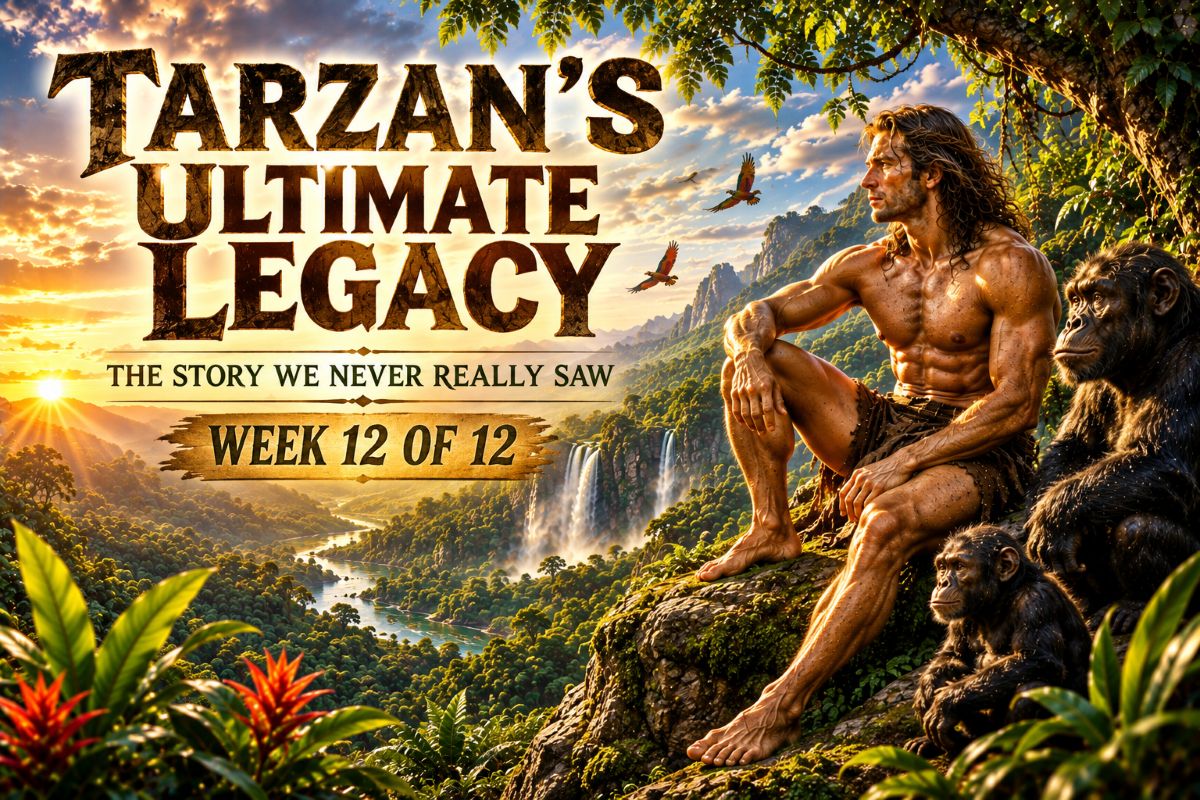
After eleven weeks of returning to Edgar Rice Burroughs’ original Tarzan novels, the history of Tarzan movies, Lord Greystoke, Jane Porter, Korak, Opar, Pal-ul-don, Pellucidar and the enormous mythology Hollywood has only partially explored, I have reached a conclusion that feels less like nostalgia than the logical consequence of everything we have uncovered: I believe another major Tarzan reinvention is inevitable, not because the entertainment industry has exhausted its ideas and will eventually return mechanically to another familiar property, but because Tarzan possesses a combination of cultural recognition, psychological complexity and undeveloped narrative territory that remains extraordinarily rare. The public already knows the name, the silhouette and the fundamental premise, yet the deeper character remains unfamiliar enough to feel new; the source material already contains romance, aristocratic drama, espionage, lost civilizations, generational storytelling and speculative adventure, yet most audiences continue to associate Tarzan almost exclusively with vines, animals and a jungle yell. That discrepancy between what the world recognizes and what the mythology actually contains is precisely what creates the opportunity, because the most powerful modern Tarzan remake or new Tarzan movie would not have to invent relevance around an exhausted character; it would have to reveal how much of the character has never been properly used.
Watch classic Tarzan movies and TV series by joining the EE Vault. Click here for more information.
The case for a modern Tarzan film or television series becomes even stronger when one considers how naturally the original character aligns with the kind of psychologically layered genre storytelling contemporary audiences increasingly expect. Burroughs’ Tarzan is not simply an action hero but a man divided between identities that never completely reconcile: John Clayton by birth, Lord Greystoke by inheritance, Tarzan by lived experience, husband and father through relationships he consciously chooses, outsider and participant within civilization, deeply attached to Africa while remaining connected to the European aristocratic order into which he was born. His greatest conflict therefore exists beneath the adventure, in the unresolved question of whether a human being can inhabit several legitimate identities without allowing one to erase the others, and that question has only become more recognizable in a world increasingly defined by migration, cultural hybridity, inherited histories, competing social roles and the pressure to perform different selves in different environments. The most compelling future Tarzan would not need to be artificially modernized because the psychological architecture is already modern; what requires modernization is the way the world around him is understood, particularly the treatment of Africa, race, gender, colonial history and cultural agency that no intelligent twenty-first-century adaptation can approach with the assumptions of 1912.
What makes me believe Tarzan’s great remake is not merely possible but eventually unavoidable is that the failures and limitations of previous adaptations have preserved rather than destroyed the opportunity. Hollywood spent more than a century making Tarzan famous while simultaneously narrowing the popular image of him, which means a filmmaker willing to return seriously to Burroughs could benefit from global recognition without being forced to repeat the stories that created that recognition. The intelligent, multilingual Greystoke; the self-educated child deciphering humanity from the books in his parents’ cabin; the conflicted lover who cannot enter Jane’s world without risking part of himself; the father who must watch Korak construct another identity; the explorer entering Opar, Pal-ul-don and eventually Pellucidar; and the outsider capable of observing civilization without believing everything civilization says about itself are all waiting behind an image millions of people believe they already understand. The rest of this final article is therefore not an argument for another nostalgic jungle spectacle, but for something much more ambitious: a reconstruction of Tarzan as a serious cinematic mythology, built patiently enough to recover the man before unleashing the universe around him, historically intelligent enough to confront what must change, visually confident enough to make the physical world feel dangerous again, and emotionally mature enough to understand that the greatest reason Tarzan can return is not that he has endured unchanged, but that he was always more capable of transformation than the stereotype built around him.
JOIN FOR FREE
Sign up to Hundreds of resources. New content added every week.
PLUS access to our MOVIE CHANNEL
One free account. Unlimited articles and movies. No credit card required.

Already a member? LOGIN HERE
