




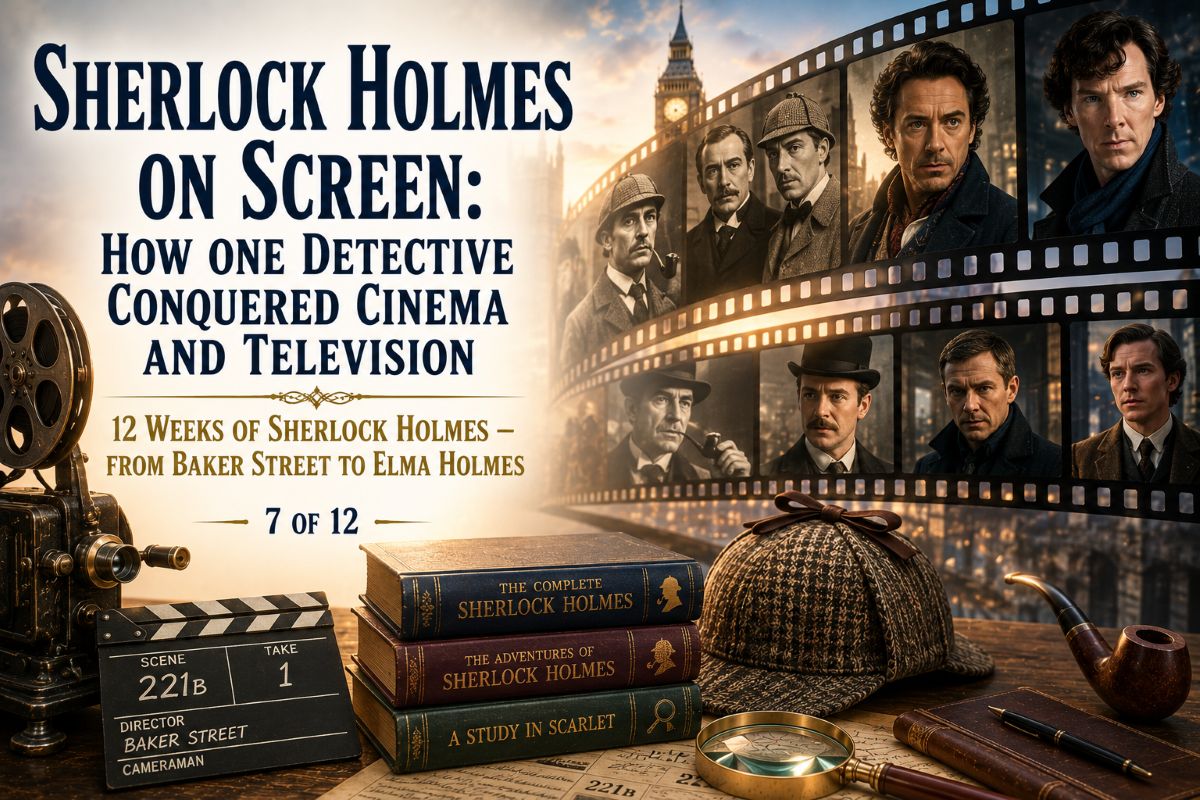
Few fictional characters have been reinvented as relentlessly as Sherlock Holmes, yet what makes his screen history remarkable is not merely the number of adaptations but the extraordinary range of meanings filmmakers and television creators have discovered inside the same basic figure. From early silent cinema to Basil Rathbone's wartime Holmes, from Jeremy Brett's intensely literary interpretation to Robert Downey Jr.'s physically dynamic reinvention and Benedict Cumberbatch's technologically fluent modern detective, Sherlock Holmes has survived changes in acting style, audience expectation, visual language, social values and technology without losing the central intellectual identity Arthur Conan Doyle created in the nineteenth century. Each generation seems compelled to ask the same question in a new form: what would Holmes look like if he belonged completely to us rather than to Victorian Britain, and which elements of the mythology can be altered before the character ceases to feel like Sherlock Holmes?
Get unlimited access to mystery movies and Sherlock Holmes books in the Vault at https://eevault.com. Also, read some of the greatest Sherlock Holmes mysteries here: https://www.empoweringentertainmentpublishing.com/books.
The history of Sherlock Holmes in film and television is therefore far more than an adaptation history; it is a study in cultural survival, because every significant screen version has emphasized a different component of the original mythology. Some productions foreground the gothic atmosphere of gaslit London, others the friendship between Holmes and Watson, others the detective's arrogance, physical courage, psychological isolation or almost superhuman powers of perception, while still others relocate him into contemporary worlds shaped by smartphones, surveillance, forensic technology and globalized crime. The remarkable continuity beneath these transformations suggests that the enduring appeal of Sherlock Holmes does not depend upon deerstalker hats, Victorian interiors or even nineteenth-century investigative methods, but upon a deeper narrative architecture built around extraordinary observation, hidden patterns, intellectual danger and the tension between a brilliant outsider and a society that both needs and struggles to understand him.
To follow Sherlock Holmes from silent film through radio, Hollywood cinema, prestige television and twenty-first-century reinvention is consequently to watch popular culture repeatedly negotiate the difference between fidelity and transformation. Why did Basil Rathbone become, for generations, the visual definition of Holmes even when his films departed substantially from Conan Doyle's period setting? Why did Jeremy Brett's performance acquire such authority among readers of the original stories? Why could Robert Downey Jr. turn Holmes into a muscular action figure without entirely abandoning the detective's intellectual identity, and why did Benedict Cumberbatch's modern London feel recognizably Holmesian despite replacing telegrams with smartphones and hansom cabs with taxis? The answers reveal something larger than the success of individual actors: Sherlock Holmes may be one of the most adaptable characters ever created precisely because Conan Doyle built a mythology whose deepest structure can survive almost everything except the loss of intellectual seriousness.
JOIN FOR FREE
Sign up to Hundreds of resources. New content added every week.
PLUS access to our MOVIE CHANNEL
One free account. Unlimited articles and movies. No credit card required.

Already a member? LOGIN HERE
