




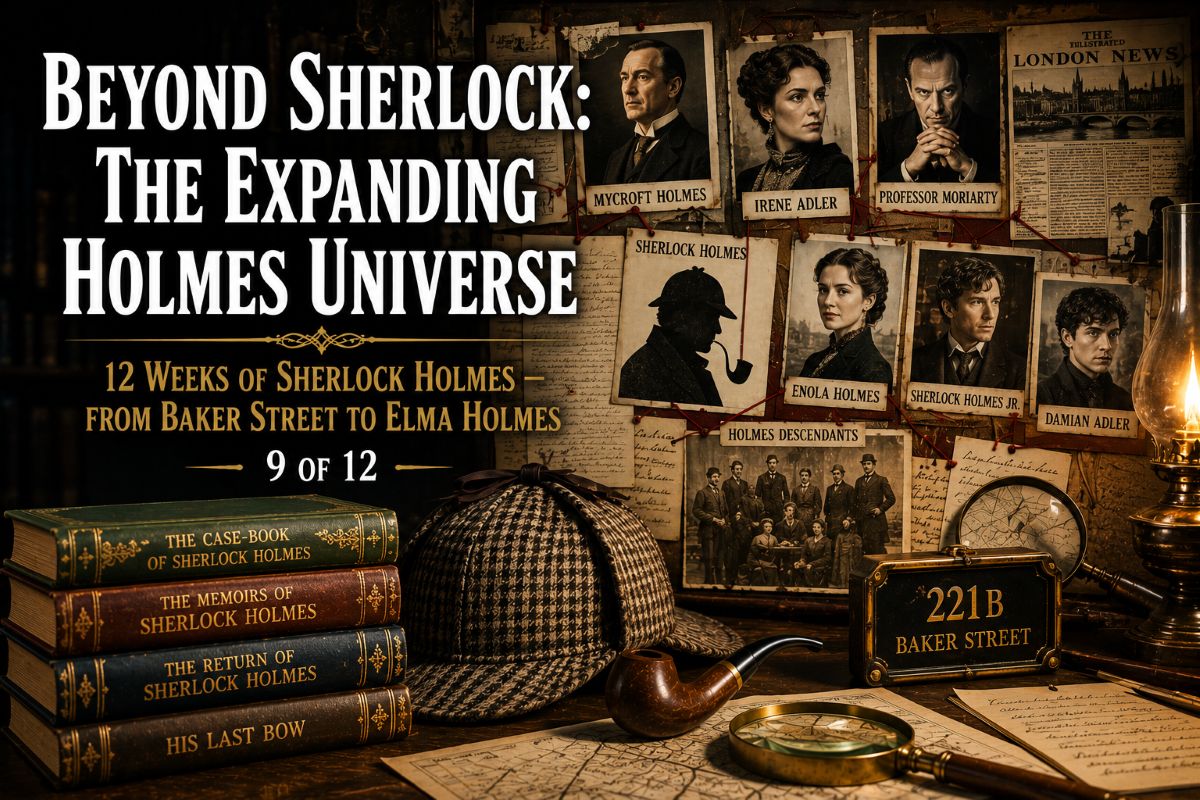
Sherlock Holmes began as the extraordinary center of Arthur Conan Doyle's detective stories, but the clearest evidence of the character's cultural power may be that the fictional world surrounding him eventually became too large to remain entirely his. Across more than a century of Sherlock Holmes books, films, television adaptations, stage productions and later reinterpretations, figures who originally existed in relation to Holmes—Mycroft Holmes, Irene Adler, Professor Moriarty, Dr. John Watson and the wider society surrounding 221B Baker Street—have acquired imaginative lives extending far beyond their initial functions in the canon. Later storytellers have created relatives, descendants, protégés, rivals and alternative Holmes figures, sometimes preserving Conan Doyle's Victorian world and sometimes transporting its intellectual architecture into entirely different periods and perspectives. What began as a series of detective stories has therefore evolved into something closer to a modern mythology, a narrative ecosystem in which the original character remains foundational without necessarily remaining the only possible center.
Get unlimited access to mystery movies and Sherlock Holmes books in the Vault at https://eevault.com. Also, read some of the greatest Sherlock Holmes mysteries here: https://www.empoweringentertainmentpublishing.com/books.
The expanding Sherlock Holmes universe raises a more complicated question than whether audiences will accept another adaptation, because expansion requires a different kind of creative legitimacy from repetition. A new actor playing Sherlock inherits a role the audience already understands, while a new character connected to the Holmes legacy must justify why that connection produces something worth exploring rather than merely borrowing cultural recognition. The distinction explains why some extensions of famous fictional worlds feel inevitable while others feel manufactured: meaningful expansion does not simply attach a familiar surname to an unfamiliar protagonist, but identifies unexplored consequences within the original mythology and develops them through a perspective the central character could never provide. Mycroft can reveal what Holmesian intelligence looks like when embedded within institutions rather than standing outside them; Irene Adler can expose the limitations of Holmes's assumptions about gender, social performance and emotional interpretation; Watson can reveal the human cost of living beside extraordinary intelligence; and later generations can ask what happens when the methods, reputation and psychological inheritance associated with Sherlock Holmes pass into a world radically different from the one that created him.
To travel beyond Sherlock Holmes is therefore not to abandon Conan Doyle's creation but to examine the ultimate consequence of its success: a mythology becomes genuinely powerful when it begins generating questions its creator never needed to answer. Who else within the Holmes family possesses unusual intelligence, and what happens when similar cognitive gifts are shaped by different personalities or moral choices? Can the methods of Baker Street be inherited without producing another imitation of Sherlock? What survives when Victorian assumptions disappear but the intellectual DNA of the stories remains? By examining Mycroft Holmes, Irene Adler, Moriarty, Watson, later descendants and the growing tradition of expanding the Holmes universe beyond its original protagonist, we arrive at the question that will define the final movement of this series: perhaps the future of Sherlock Holmes does not depend upon creating another Sherlock at all, but upon discovering what becomes possible when his legacy is finally allowed to belong to someone fundamentally different.
JOIN FOR FREE
Sign up to Hundreds of resources. New content added every week.
PLUS access to our MOVIE CHANNEL
One free account. Unlimited articles and movies. No credit card required.

Already a member? LOGIN HERE
