




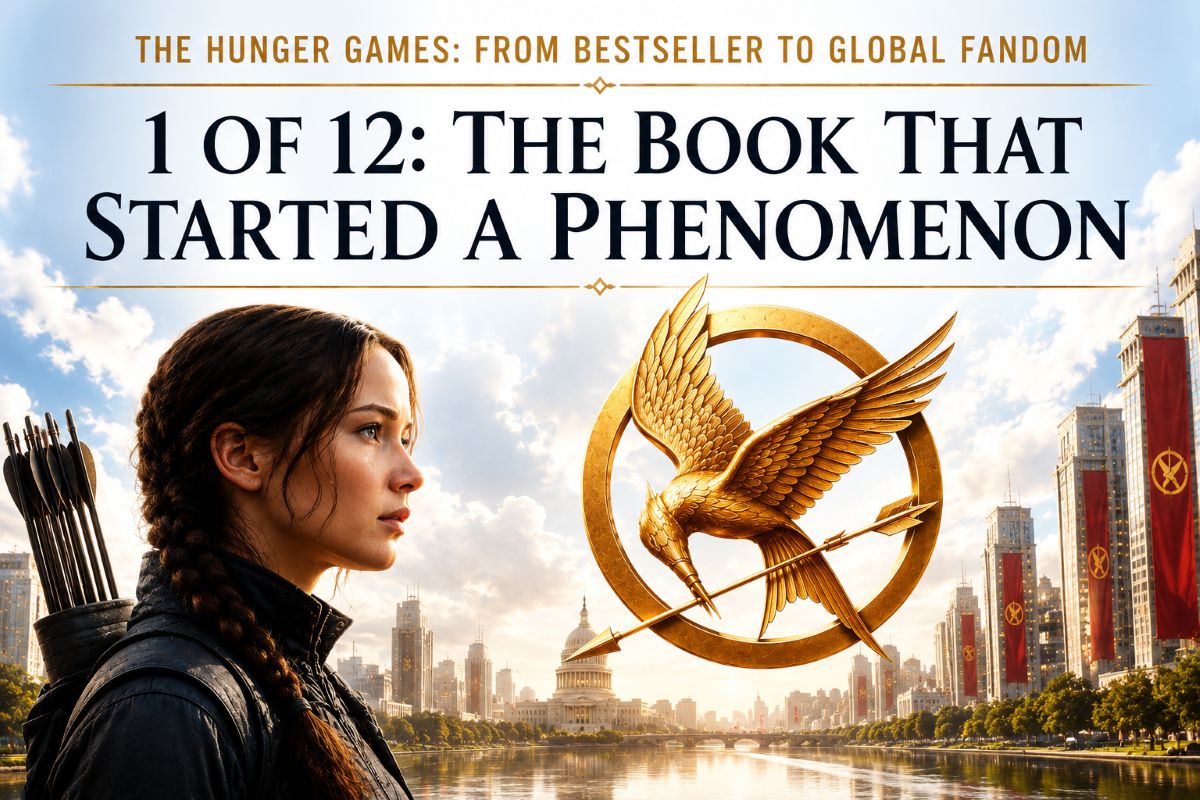
Before Jennifer Lawrence became Katniss Everdeen on screen, before the three-finger salute escaped the boundaries of fiction, and before the Mockingjay became one of the most recognizable symbols associated with twenty-first-century popular culture, The Hunger Games began with a premise so disturbing that its eventual transformation into a global entertainment franchise can obscure how audacious Suzanne Collins’s original novel actually was. Published in 2008, The Hunger Games introduced readers to Panem, a future North American nation in which a wealthy Capitol maintains political control over twelve impoverished districts and annually forces twenty-four children to participate in a televised fight to the death; yet Collins did not construct that premise merely as an exercise in dystopian adventure, because embedded within the novel were questions about authoritarian government, economic inequality, media manipulation, celebrity culture, war, spectatorship and the unsettling ease with which human suffering can become entertainment when enough distance is placed between the spectator and the victim. What eventually became a blockbuster film franchise therefore began not with the conventional architecture of franchise filmmaking, but with a novel whose central mechanism deliberately implicated its own audience in the act of watching.
The origins of The Hunger Games are equally revealing because Collins has explained that the idea emerged while she was channel surfing between reality television and television coverage of the Iraq War, two radically different forms of programming that began to blur together in her tired mind, creating the conceptual collision from which the Hunger Games themselves would eventually emerge. That collision explains why Panem feels simultaneously ancient and disturbingly modern: Collins drew upon the Roman gladiatorial tradition, the myth of Theseus and the Minotaur, the political logic of bread and circuses, the psychological consequences of war and the contemporary machinery of televised competition, combining them into a society in which punishment is not merely administered but broadcast, branded, narrated and consumed. The Capitol does not simply kill children to intimidate the districts; it turns their deaths into compulsory entertainment, dresses the contestants for public consumption, gives them stylists and interviews, constructs narratives around them and forces the oppressed population to participate emotionally in the spectacle, making The Hunger Games remarkably prescient about a media environment in which visibility, personality, narrative and audience engagement increasingly determine whose experiences command public attention.
Understanding how Suzanne Collins created The Hunger Games, however, requires going beyond the familiar story of inspiration and examining why this particular combination of mythology, political anxiety, reality television, adolescent psychology and survival storytelling generated such extraordinary reader attachment after the novel appeared in 2008. The deeper story is not simply how Collins imagined Katniss Everdeen or invented Panem, but how she constructed a narrative that could function simultaneously as an intimate survival story, a critique of spectacle, a political allegory and an extraordinarily powerful engine for reader identification; how the novel initially moved through publishing and word of mouth; why Katniss felt radically different from many young-adult heroines surrounding her; and, most importantly, why readers did not seem satisfied merely to finish the book, but felt compelled to discuss it, recommend it, debate it and recruit other readers into Panem, beginning the transformation from bestselling novel to cultural phenomenon long before Hollywood placed a single image on a movie screen.
JOIN FOR FREE
Sign up to Hundreds of resources. New content added every week.
PLUS access to our MOVIE CHANNEL
One free account. Unlimited articles and movies. No credit card required.

Already a member? LOGIN HERE
