



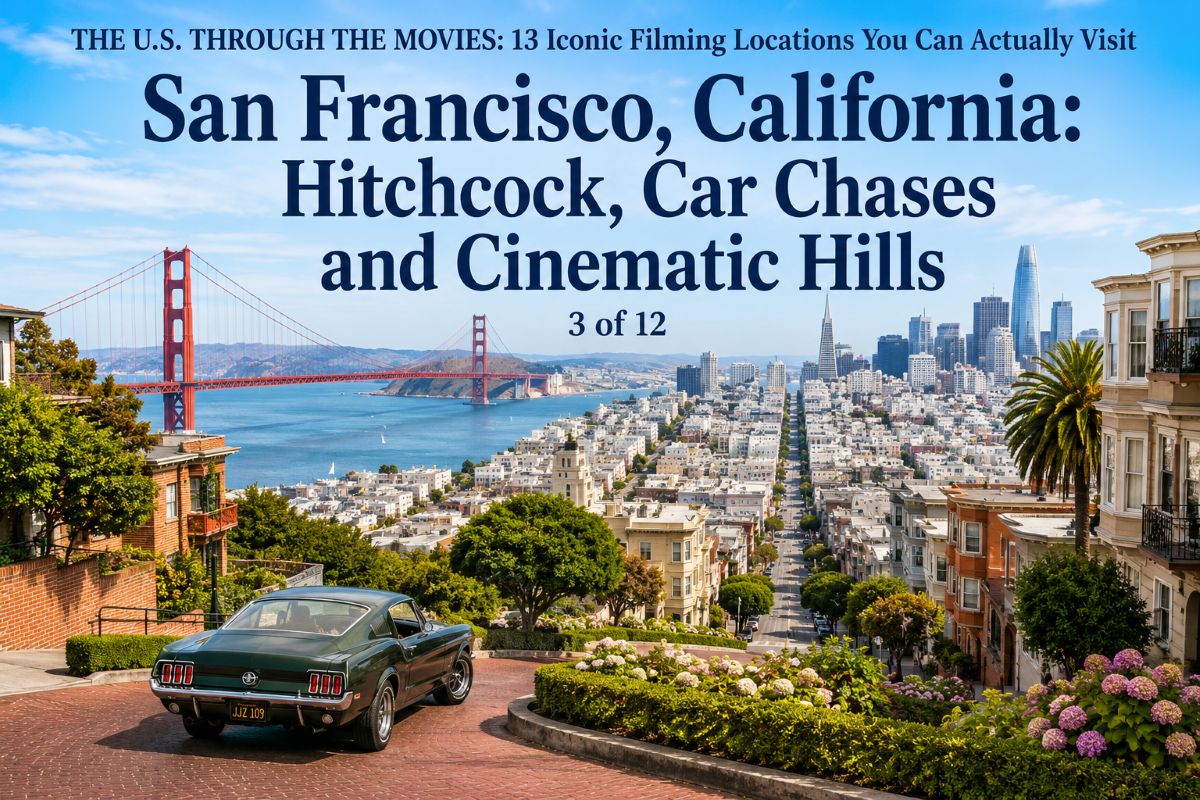
The U.S. Through the Movies: 13 Iconic Filming Locations You Can Actually Visit
Week 3 of 12
San Francisco — Hitchcock, Car Chases and Cinematic Hills
San Francisco has always offered filmmakers something more valuable than beauty: a city whose physical geography already contains drama. Built across steep hills and surrounded by water, interrupted by sudden views of the bay and connected to the wider world through bridges that seem almost impossibly theatrical, San Francisco possesses a visual identity so distinctive that audiences can recognize it within seconds. The Golden Gate Bridge, Alcatraz Island, cable cars climbing impossible gradients, Victorian houses assembled along sloping streets, fog moving through neighborhoods and automobiles disappearing over the crests of hills have given generations of filmmakers a city in which architecture and landscape can participate directly in storytelling. From Alfred Hitchcock's psychologically labyrinthine Vertigo and the kinetic violence of Bullitt to Dirty Harry, Mrs. Doubtfire and The Rock, famous San Francisco filming locations have repeatedly demonstrated that this is not a city directors merely photograph; it is a city they use.
What distinguishes San Francisco movie locations from those of many other American cities is the extent to which filmmakers have converted the city's physical characteristics into emotional and narrative mechanisms. Hitchcock understood that San Francisco's hills, fog, historic buildings and shifting perspectives could make obsession feel spatial in Vertigo; Peter Yates recognized that the gradients of its streets could transform an automobile pursuit into one of the most influential car chases in movie history with Bullitt; Don Siegel used its streets and skyline to frame the moral severity of Dirty Harry; Chris Columbus turned a Pacific Heights Victorian into the emotional center of Mrs. Doubtfire; and The Rock exploited Alcatraz, the bay and the city's monumental landmarks to construct large-scale action around places that already carried powerful associations. Across genres, the same principle persists: San Francisco does not surrender its identity to the movie but forces the movie to negotiate with the city.
To follow San Francisco through its films is therefore to discover much more than a collection of recognizable addresses, because the most fascinating question is not simply where famous scenes were shot but why these particular streets, buildings, hills and landmarks produced such enduring cinematic images. The journey ahead follows Hitchcock into the haunted psychological geography of Vertigo, reconstructs the extraordinary urban choreography of the Bullitt car chase, examines the harder San Francisco embodied by Dirty Harry, returns to the Victorian home that gave Mrs. Doubtfire its emotional anchor, crosses the bay toward the cinematic mythology of Alcatraz in The Rock, and ultimately explores how visitors can experience these iconic San Francisco filming locations while understanding the deeper relationship between geography, character and camera that made the city one of American cinema's most sophisticated natural sets.
JOIN FOR FREE
Sign up to Hundreds of resources. New content added every week.
PLUS access to our MOVIE CHANNEL
One free account. Unlimited articles and movies. No credit card required.

Already a member? LOGIN HERE
