

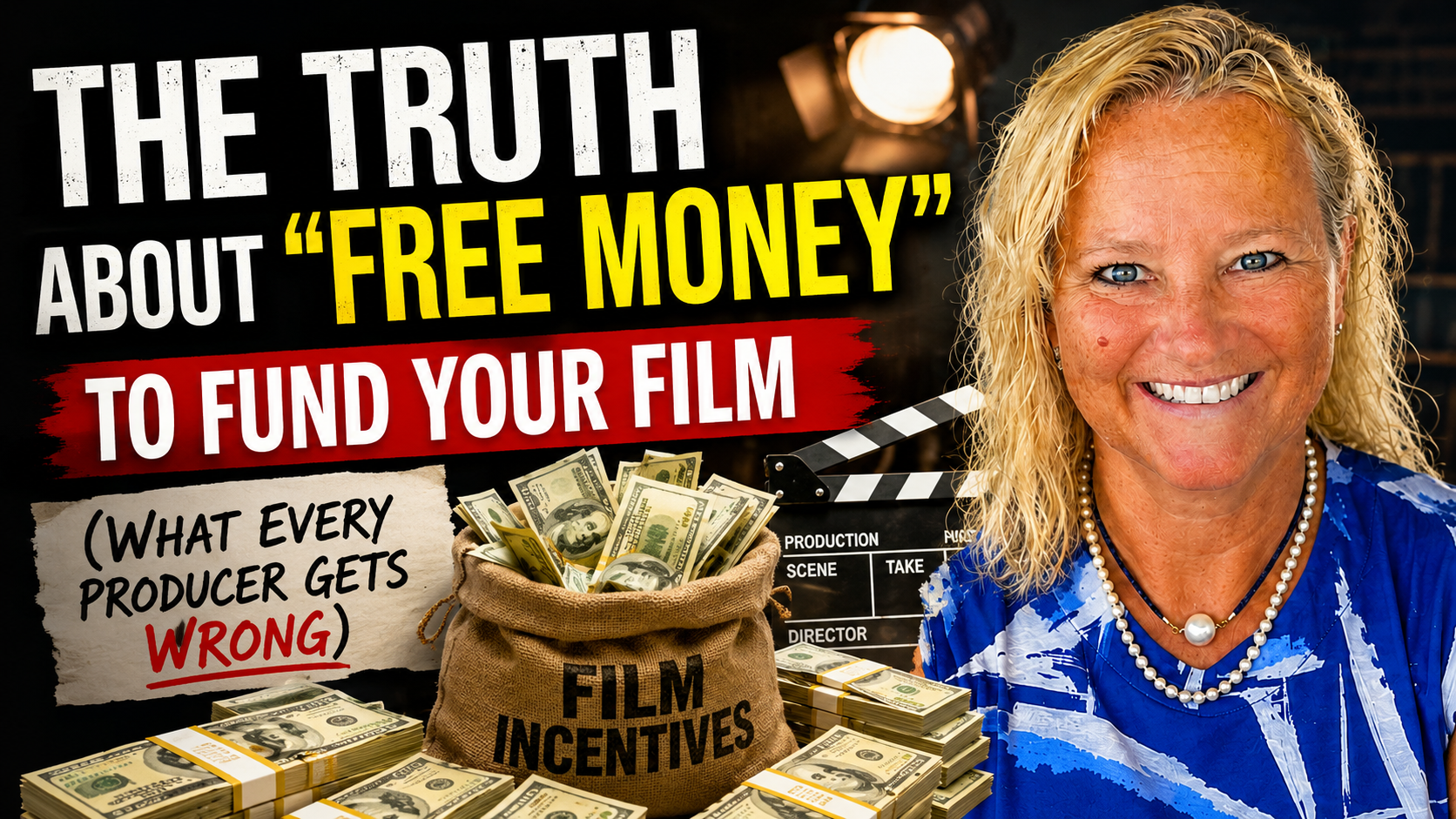
Every year, thousands of independent filmmakers convince themselves that the biggest obstacle standing between them and production is a lack of money. They spend months searching for investors, applying for grants, approaching wealthy individuals, borrowing from friends and family, maxing out credit cards, postponing production, or abandoning projects altogether because they believe financing simply isn’t available. The irony is that, while many producers are desperately chasing capital, governments around the world are actively competing to attract film productions by offering billions of dollars in production incentives. The problem is not that the money doesn’t exist. The problem is that too many filmmakers never learn how to access it or mistakenly assume these programs are only available to major Hollywood studios.
You can learn more by VISITING FILM FUNDING 101 HERE
That misunderstanding has probably delayed more independent films than almost any other financing mistake. Producers spend years trying to raise one hundred percent of their budget from investors without realizing that a significant portion of that budget could potentially come from government-backed incentive programs if the project were structured correctly. The difference between a producer who understands film incentives and one who doesn’t is often measured not only in dollars but in whether the project gets produced at all.
The Biggest Misconception About Film Incentives
One of the oldest myths in independent filmmaking is that governments create film incentive programs because they want to support artists or encourage filmmaking. While supporting the creative industries may certainly be part of the conversation, it is rarely the primary motivation. Governments are not creating these programs simply because they enjoy movies. They create them because film production is an economic engine capable of generating substantial financial activity across dozens of industries.
When a feature film arrives in a city, state, province, or country, the production immediately begins spending money. Hotels fill with cast and crew. Restaurants serve hundreds of additional customers. Equipment rental companies receive large orders. Transportation providers move people and production gear. Construction companies build sets. Security firms provide personnel. Local crew members are hired. Post-production facilities receive contracts. Insurance companies, accountants, caterers, fuel suppliers, location managers, and countless other businesses all benefit from the presence of a single production.
Governments understand this economic ripple effect extremely well. Every production represents jobs, tax revenue, tourism exposure, and increased local business activity. From their perspective, offering a production incentive is often an investment that generates returns far greater than the incentive itself. Rather than viewing these programs as money being given away, governments see them as tools for attracting economic development that might otherwise flow to competing jurisdictions.
Understanding this simple principle immediately changes the way professional producers evaluate film financing. Instead of asking, “Where can I find money?” they begin asking, “Which jurisdictions are actively competing for productions like mine?”
Why Experienced Producers Think Differently
One of the biggest differences between inexperienced and experienced producers is not creativity. It is financial strategy.
Many first-time filmmakers select locations almost entirely for artistic reasons. They fall in love with a city because it perfectly matches the screenplay. They choose a country because of its beautiful landscapes or distinctive architecture. Creative considerations are, of course, important, but experienced producers know that location decisions often have significant financial consequences that extend far beyond aesthetics.
Imagine two locations that both work equally well for your screenplay. One jurisdiction offers no meaningful production incentive. The other provides an attractive incentive that could substantially reduce qualified production costs. The audience may never notice where the film was shot, but your financing structure could be transformed simply because you made a more strategic production decision.
The screenplay remains exactly the same. The performances remain the same. The audience enjoys the same story. Yet the amount of financing required from investors may decrease dramatically, cash flow may improve, and the project may become considerably more attractive to potential financiers. This is why experienced producers rarely separate creative decisions from financial decisions. They understand that the strongest productions are built not only artistically but strategically.
Not All Incentive Programs Are Created Equal
Another costly mistake made by many filmmakers is assuming that all film tax credits work in essentially the same way. Nothing could be further from the truth.
Around the world, production incentive programs differ enormously. Some jurisdictions offer direct cash rebates. Others provide refundable tax credits. Some programs issue transferable tax credits that can be sold or monetized. Certain jurisdictions allow specialized financing institutions to lend against anticipated incentives during production, improving cash flow before principal photography is complete. Others reimburse productions only after filming has concluded and all required audits have been successfully completed.
Eligibility requirements also vary considerably. Some programs require minimum local spending thresholds. Others require the employment of local crew members. Some impose annual funding caps, while others operate under ongoing legislative frameworks. Certain jurisdictions evaluate productions according to cultural criteria, whereas others focus almost exclusively on economic impact.
These differences matter because two incentive programs advertising identical percentages may produce dramatically different financial outcomes. A thirty percent incentive that is straightforward to qualify for and monetize may ultimately prove far more valuable than a forty percent incentive burdened by restrictive eligibility requirements or lengthy reimbursement delays. Professional producers understand that evaluating incentives involves far more than comparing headline percentages.
Looking Beyond the Percentage
One of the most common questions filmmakers ask is surprisingly incomplete.
“What percentage does this state offer?”
While understandable, that question alone provides almost no useful information.
Thirty percent of what? Qualified local spending? Labor only? Below-the-line expenses? Above-the-line compensation? Is there a cap? Can the credit be transferred? Can it be financed before reimbursement? How long does reimbursement typically take? Is funding guaranteed, or are productions competing for limited annual allocations?
Experienced producers ask these questions before making significant production decisions because they recognize that percentages tell only a small part of the story. The overall structure of an incentive program often determines whether it meaningfully strengthens a financing package or merely creates additional administrative complexity.
Understanding these distinctions allows producers to compare opportunities intelligently rather than simply chasing the largest advertised percentage.
Film Financing Is About Structure
Perhaps the greatest misconception surrounding independent film finance is the belief that financing is primarily about finding money. In reality, successful financing is much more often about building the strongest possible financial structure.
Tax credits do not magically finance entire films. They are not substitutes for investors, distribution, pre-sales, equity, debt financing, or careful financial planning. Their true value lies in reducing the amount of capital that must be raised elsewhere while simultaneously strengthening the overall financing package.
Imagine two identical films with identical scripts, identical casts, and identical commercial potential. One producer ignores available production incentives entirely. The other structures the project to take advantage of a carefully selected incentive program. Suddenly the second project may require significantly less private capital, improve projected cash flow, and present a more attractive financial proposition to investors.
Nothing about the creative project has changed.
Everything about the financing structure has.
That distinction separates professional producers from those who continue struggling to finance projects year after year.
The Cost of Learning Too Late
Unfortunately, many filmmakers only begin exploring production incentives after major creative decisions have already been finalized. Locations have been selected. Schedules have been locked. Contracts have been negotiated. Financing assumptions have already been established.
By this stage, changing jurisdictions may be impractical or financially impossible.
This is why understanding incentives should never be treated as an afterthought. Production incentives belong at the very beginning of the financing conversation, not at the end. They should influence budgeting discussions, location selection, scheduling considerations, financing strategy, and investor presentations long before cameras begin rolling.
The producers who consistently secure financing rarely depend upon luck. They spend months building financing structures that maximize every available opportunity. They understand that intelligent planning before production often determines whether financing becomes easier—or considerably more difficult.
Stop Chasing Money. Start Building a Financeable Project.
Perhaps the most important lesson every independent filmmaker can learn is that raising money and building a financeable project are not the same thing.
Far too many producers devote nearly all of their energy to searching for investors while investing very little time understanding the financial tools already available to them. Every year spent pursuing financing without understanding production incentives may represent opportunities that will never return. Every project developed without considering available tax credits may require more investor capital than necessary. Every location chosen without evaluating financial incentives may quietly weaken the project’s financing structure before the first investor presentation ever takes place.
Professional producers rarely ask only one question: “Where can I find the money?”
Instead, they ask a far more valuable question: “How can I reduce the amount of money I need to raise while making my project more attractive to investors?”
That shift in thinking changes everything.
Learn How Professional Producers Use Film Tax Credits
If you are serious about giving your film the strongest possible financial foundation, understanding production incentives should become an essential part of your education as a producer. Film tax credits are not magic solutions, but when understood and used strategically, they can become one of the most powerful financial tools available during the development and financing process.
To help producers navigate this complex subject, I created The Film Tax Credit Blueprint. Inside the program, I explain how professional producers evaluate jurisdictions, compare different incentive programs, avoid costly mistakes, and incorporate tax credits into an intelligent financing strategy designed to strengthen—not complicate—their projects.
Visit FilmFunding101.com/TXB to learn more about The Film Tax Credit Blueprint and discover how understanding production incentives today could save you substantial time, money, and financing challenges on your next film.
