

Christopher Nolan delivered an impressive film. What he didn’t deliver was the overwhelming sense of scale that has made Homer’s masterpiece one of the greatest adventure stories ever written.
Every generation eventually attempts to retell The Odyssey. It has inspired painters, playwrights, novelists, composers, filmmakers, and countless storytellers for nearly three thousand years because it contains every ingredient of a timeless epic: impossible journeys, terrifying monsters, angry gods, moral temptation, devastating loss, and a man’s relentless determination to return home. Few stories have had a greater influence on Western literature, and even fewer continue to captivate audiences after almost thirty centuries.
That is why Christopher Nolan’s adaptation carried such enormous expectations.
If there is a filmmaker working today with both the artistic credibility and technical resources to translate Homer’s vision onto the largest possible cinematic canvas, it is Christopher Nolan. His reputation has been built on creating films that audiences describe as experiences rather than simply movies. His commitment to practical filmmaking, large-format photography, and immersive visual storytelling suggested that The Odyssey would become the definitive adaptation of one of history’s greatest adventures.
Instead, I left the theater with a surprising feeling.
The story remained immense.
The film often felt surprisingly restrained.
The Odyssey does not belong to Christopher Nolan. It belongs to Homer. Long before cinema existed, Homer created one of the greatest adventure stories ever imagined. It is a story populated by gods who control the seas, monsters that have haunted human imagination for centuries, islands unlike any place on Earth, impossible temptations, devastating losses, unforgettable battles, and a hero who refuses to surrender despite facing forces no ordinary man could hope to overcome.
Christopher Nolan did not have to invent any of those ideas.
He inherited them.
His responsibility was not to improve Homer’s story or modernize it. His responsibility was to translate one of history’s greatest epics into the most breathtaking cinematic experience ever created.
In my opinion, that simply did not happen.
What disappointed me most was not the screenplay or even the performances. It was the complete absence of the overwhelming scale that defines The Odyssey. I went into the theater expecting to feel insignificant in the presence of gods. I expected oceans so vast they swallowed entire ships. I expected monsters so enormous that simply revealing them on screen would leave audiences speechless. Instead, I found myself watching a film that repeatedly shrank Homer’s imagination.
Time and again, the camera chose intimacy when it should have embraced grandeur.
Take Poseidon’s wrath.
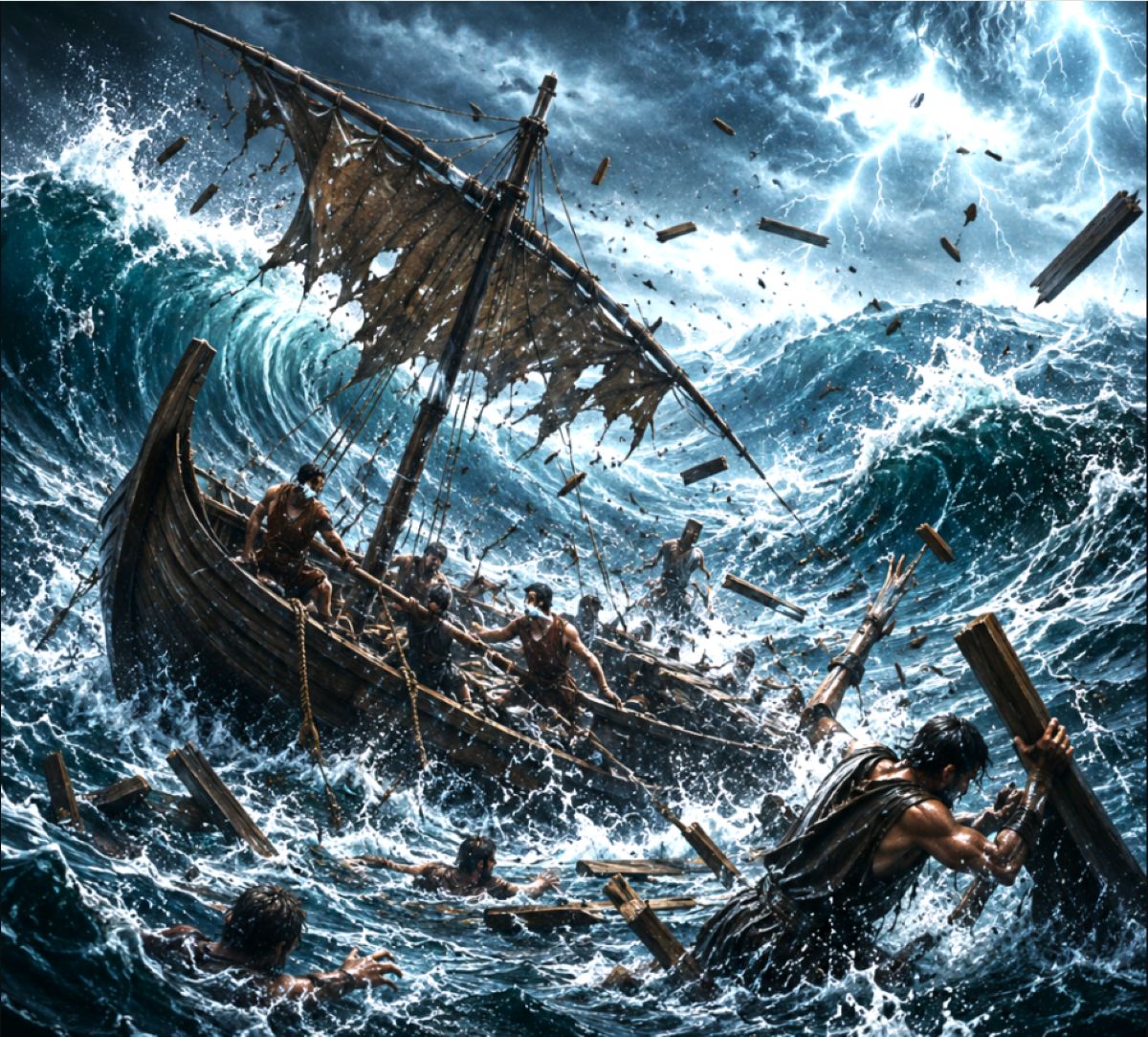
This is not an ordinary storm. In Greek mythology, Poseidon is one of the most powerful gods on Mount Olympus. When he decides to punish Odysseus, the sea itself becomes a weapon. This should have been one of the most visually overwhelming sequences ever filmed. Imagine a tiny wooden ship disappearing between mountains of water while lightning tears across an endless sky. Imagine looking at that vessel from such a distance that it appears almost insignificant against the fury of the ocean. In a single image, the audience would immediately understand what Homer wanted us to feel: mankind is powerless when a god decides to unleash his anger.
Instead, we are given close-ups.
Close-ups of water.
Close-ups of terrified faces.
Close-ups of sailors struggling to stay alive.
The urgency is there, but the grandeur is missing. Rather than witnessing Poseidon’s unimaginable power, I felt as though I was watching another shipwreck sequence that could have appeared in countless other adventure films.
The same problem continues throughout much of the movie.
The Cyclops is one of the most iconic monsters in all of literature. This is not simply a large creature. This is a legend that has survived for thousands of years because generations of readers imagined something almost beyond comprehension. Yet the film rarely allows us to absorb that scale. We receive fragments, reaction shots, and close framing instead of standing back and appreciating just how impossibly enormous this creature should feel compared with the fragile human beings confronting it.
Scylla suffers from the same treatment. Rather than allowing the audience to experience the terror of one of Greek mythology’s greatest monsters, the film offers brief glimpses before rushing on to the next sequence. Again and again I found myself waiting for the camera to step back, to breathe, and to let the spectacle speak for itself. It almost never did.
One of the greatest pleasures of reading The Odyssey is that every destination feels like entering an entirely different world. Each island possesses its own identity, its own dangers, and its own mythology. Every stop on Odysseus’ journey expands the imagination.
In Nolan’s adaptation, however, many of these locations begin to blur together. The pattern becomes repetitive. The crew arrives by boat, encounters danger, escapes, and returns to the boat before repeating the process somewhere else. Because the visual identity of these mythical worlds never becomes fully realized, they begin to feel less like extraordinary destinations and more like temporary stops along the same journey.
For a story celebrated for nearly three thousand years because of its limitless imagination, that represents an enormous missed opportunity.
Even relatively small creative decisions pulled me out of the experience.
One moment that genuinely surprised me involved the dying dog. The visual effects looked noticeably artificial. In a production reportedly costing around $250 million, I found myself wondering why a digital animal was used for such an emotional scene. Hollywood has extraordinary animal trainers capable of creating deeply convincing performances. Instead of becoming emotionally invested, I found myself thinking about the visual effects, and the illusion was broken.
It may seem like a small criticism, but details matter. Every decision either strengthens immersion or weakens it. For me, this was one of those moments that reminded me I was watching technology rather than storytelling.
Another decision that never worked for me was the casting of Athena.
Athena is not just another character in Greek mythology. She is the goddess of wisdom, strategy, justice, and one of the central divine forces guiding Odysseus throughout his journey. For more than two millennia, artists, sculptors, historians, and writers have depicted Athena as one of the defining figures of Greek civilization.
Personally, I believe Zendaya was the wrong choice for the role.
Throughout the film, I never felt that I was watching Athena. I felt that I was watching Zendaya playing Athena. For me, there is an important difference. I never sensed the timeless authority, wisdom, or divine presence that I associate with one of the greatest goddesses in Greek mythology. Every time she appeared on screen, I was reminded that I was watching a contemporary celebrity rather than an immortal deity who has stood at the center of Western mythology for thousands of years.
I also couldn’t help wondering what many Greeks thought when they saw one of the defining figures of their cultural mythology portrayed this way. Greek mythology is not merely fantasy. It is one of the foundational pillars of Western civilization and one of Greece’s greatest cultural legacies. Whether others agree or disagree with me, I found the casting deeply distracting and never once believed I was in the presence of Athena.
What frustrates me most is that none of these shortcomings were necessary.
Christopher Nolan had every advantage a filmmaker could hope for. He had one of the greatest stories ever written. He had extraordinary resources. He had remarkable technology. He had a budget that most directors could only dream about.
Most importantly, he had Homer.
Nearly three thousand years ago, Homer imagined a world that still feels larger than life. He imagined gods capable of controlling the oceans, monsters that continue to inspire modern fantasy, and adventures so extraordinary that they remain part of our collective imagination today.
Ironically, after watching a modern adaptation made with all the tools twenty-first-century filmmaking can offer, I left the theater believing that Homer’s imagination was still far larger than what I had just seen on the screen.
That is why I say Christopher Nolan cheated us out of The Odyssey.
Nolan had everything necessary to make the greatest mythological epic ever filmed, and instead delivered an adaptation that, despite all the hype, too often seemed afraid to fully embrace the breathtaking scale of Homer’s extraordinary vision.
