




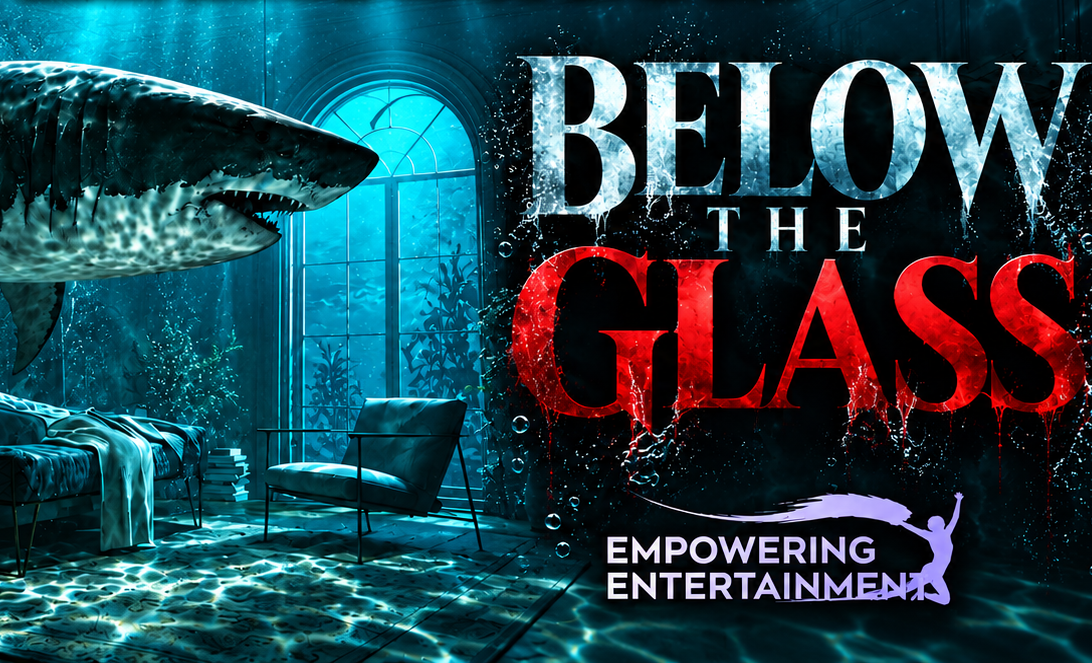
Empowering Entertainment is developing shark thriller brings an underwater resort to life through an independent filmmaking process shaped by artificial intelligence, visual ambition and the enduring mechanics of suspense.
An underwater luxury resort offers a particular kind of escape, surrounding its guests with the extraordinary spectacle of an ocean that most people experience only from the surface, while preserving the comfort and reassurance of an environment designed around their pleasure. In Below the Glass, the feature film currently being developed by filmmaker and entrepreneur Slavica Bogdanov, that promise becomes the foundation of a shark thriller in which the distinction between shelter and exposure gradually acquires terrifying significance, as the architecture that makes the experience possible becomes inseparable from the danger surrounding it.
Set approximately twenty-five metres beneath the surface, the film places its audience inside a destination where warm interiors, elegant social spaces and carefully framed views of the sea create an atmosphere of privileged seclusion. The appeal of such a setting lies in the feeling that the natural world has been brought within reach without requiring anyone to surrender the conveniences of civilisation, yet the arrival of a shark introduces a different understanding of the same surroundings, forcing attention towards the barriers, distances and structural dependencies that luxury ordinarily allows its guests to overlook.
For Bogdanov, the project brings together the imaginative scale of a genre feature and the practical demands of building that feature independently, with artificial intelligence forming part of the production process through which its environments and sequences are taking shape. Below the Glass is being developed scene by scene, through an accumulation of visual decisions whose success depends on their ability to serve a coherent film, sustain its atmosphere and persuade the viewer that the world beneath the surface continues to exist beyond any individual shot.
An Environment Designed to Become Part of the Story
The underwater resort provides more than an unusual backdrop, because its physical organisation determines how the audience understands the characters’ relationship with the ocean and with the possibility of escape. Two wings connected through a central atrium establish a substantial inhabited environment, while solid walls, reinforced columns and rectangular viewing windows give the interiors a sense of structure and weight, making the surrounding water feel like a constant physical presence rather than a decorative effect.
Champagne-silver surfaces and warm interior lighting contribute to the resort’s identity, creating a visual language in which comfort remains recognisable even as the setting becomes increasingly unsettling. The intention is to preserve the appeal of a destination that guests would genuinely want to visit, since the suspense gains force when the audience can understand the original attraction of the place and recognise how quickly the meaning of its most desirable features might change.
A window that initially offers an exceptional view can become the point towards which every eye turns, while an expansive room can take on a different character once its occupants become conscious of the water beyond its boundaries. That changing relationship between the viewer and the environment gives the film a source of tension that extends beyond the appearance of the shark, allowing the setting itself to carry anticipation through the arrangement of space, the limits of visibility and the persistent awareness that ordinary life is continuing beneath an extraordinary volume of water.
The architecture also creates a demanding continuity problem for the production, because a convincing resort must retain its identity across scenes that may be generated and refined separately. Materials, proportions, lighting and spatial relationships need to remain sufficiently consistent for viewers to orient themselves, particularly when danger makes an understanding of where people are, what separates them and how they might move through the building essential to the experience.
Building Suspense Through What the Audience Can Perceive
Shark cinema draws much of its power from an imbalance of information, placing human beings in an environment where their ability to see, move and respond is restricted, while the threat can approach through spaces they cannot fully observe. Below the Glass develops that imbalance through the relationship between its enclosed interiors and the open water outside, giving its characters a measure of protection while keeping the audience conscious of the conditions upon which that protection depends.
Underwater sequences introduce another layer of vulnerability, since every movement must communicate the resistance of the water, the limitations of equipment and the effort involved in helping another person under pressure. The placement of divers, the direction of an approach and the physical clarity of a rescue all become part of the storytelling, requiring action that can be understood emotionally and spatially even when the situation is chaotic.
Sound is being approached with a similarly grounded intention, drawing on elements that belong within the scene rather than relying on a musical score to prescribe the audience’s response. Breathing apparatus, water, movement, human reactions and the sounds of the resort can establish an immediate relationship with the environment, allowing tension to develop through what characters and viewers are able to hear as well as what remains beyond their sight.
Such choices place considerable responsibility on the construction of each sequence, because suspense needs time, contrast and a clear sense of consequence to become more than a succession of dramatic images. A threatening encounter carries greater weight when the audience understands the circumstances surrounding it, just as a moment of apparent safety becomes more compelling when the film has established enough of its world for that reassurance to feel provisional.
Artificial Intelligence Within a Filmmaker’s Process
The use of artificial intelligence is central to how Below the Glass is being made, although the project’s creative demands extend well beyond the generation of visually striking material. Each sequence must contribute to an evolving whole, which means that an image can be impressive in isolation and still require revision because its movement, geography, character continuity or dramatic emphasis does not support the scene in which it belongs.
This makes selection and refinement fundamental parts of the work, with the filmmaker continually assessing whether a result advances the story or merely resembles the intended idea. A shark’s movement needs to relate convincingly to the people and structures around it, a diver’s equipment needs to remain consistent, and an interior needs to preserve its established identity, because the viewer’s confidence in the fictional world is built through details that often attract attention only when they fail.
The production therefore involves an ongoing negotiation between imagination and execution, as ambitious concepts are translated into sequences that can withstand scrutiny across multiple shots. Regeneration, adjustment and editing form part of that process, while decisions about pacing and emphasis determine how the resulting material will ultimately function as cinema.
For an independent filmmaker, this approach creates room to pursue environments and situations that would otherwise require a substantially different production infrastructure, while introducing its own practical constraints and creative responsibilities. Below the Glass is taking shape within that space, where access to new tools expands what can be attempted, and the quality of the final film remains dependent on the judgement applied throughout its development.
Following a Film While Its World Takes Shape
There is a distinctive appeal in encountering a film during the period when its identity is becoming visible, as separate environments, characters and sequences begin to reveal the larger experience they are intended to create. With Below the Glass, that process offers an opportunity to follow both the development of an underwater thriller and the decisions involved in bringing an ambitious independent production towards completion.
The emerging footage provides glimpses of that world, from the controlled elegance of the resort to the vulnerability of people moving through the ocean beyond it, while the continuing work concerns how those elements will connect through performance, rhythm and narrative progression. The finished feature will depend on those relationships, as the atmosphere established in quieter passages gives meaning to the moments when the environment becomes dangerous and the characters’ options begin to narrow.
As production continues, Bogdanov is opening a closed circle of contributors for those who would like a closer connection to Below the Glass and the opportunity to watch the project unfold. Readers who share an interest in independent cinema, shark thrillers and the creative possibilities of AI filmmaking are invited to become part of that circle through the link below, joining the journey while the world beneath the glass is still taking shape.
Discover the closed circle of contributors and follow Below the Glass as it unfolds: https://www.empoweringentertainmentpublishing.com/below-the-glass
