




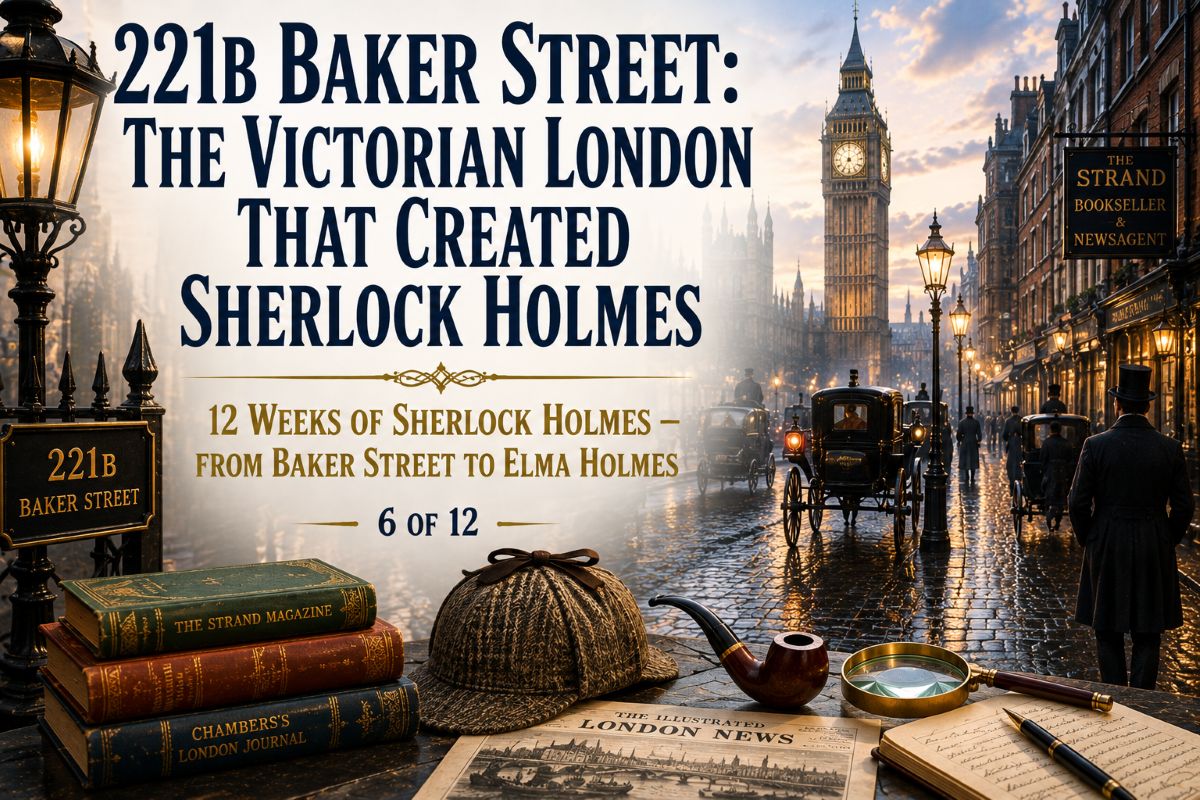
Sherlock Holmes is inseparable from Victorian London because Arthur Conan Doyle did not merely place his detective inside the city; he built Holmes out of the city's contradictions, technologies, anxieties and rapidly changing systems of knowledge. The London of the Sherlock Holmes stories is a metropolis expanding beyond the scale at which ordinary people could fully understand it, a place of railways, telegraph wires, newspapers, gaslight, crowded streets, private clubs, lodging houses, wealthy drawing rooms, criminal districts, anonymous strangers and new institutions struggling to impose order upon unprecedented complexity. In that environment, 221B Baker Street becomes more than the fictional address of a famous detective. It becomes a strategic observation point inside the modern city, a place from which Holmes receives fragments of seemingly unrelated lives and reconstructs the hidden structures connecting them. Without Victorian London, Sherlock Holmes would lose more than atmosphere; he would lose the historical conditions that made his method feel both plausible and revolutionary.
Get unlimited access to mystery movies and Sherlock Holmes books in the Vault at https://eevault.com. Also, read some of the greatest Sherlock Holmes mysteries here: https://www.empoweringentertainmentpublishing.com/books.
The rise of Sherlock Holmes also coincided with a profound transformation in the way nineteenth-century Britain understood crime, evidence and urban identity. London's population had expanded dramatically across the century, creating levels of anonymity that older communities had rarely experienced, while developments in policing, forensic inquiry, photography, communications and mass journalism changed how crime could be investigated and how quickly information could circulate. A person could disappear into the city, assume another identity, cross neighborhoods without being known, conduct business through intermediaries and exploit the distance between social classes, yet that same city increasingly produced records, traces, timetables, footprints, telegrams, newspaper reports and physical evidence capable of revealing movement. Conan Doyle recognized that this tension between anonymity and detectability was extraordinarily fertile territory for detective fiction, and Holmes became the ideal intelligence for an age in which society feared that modern life was becoming unreadable while simultaneously developing new tools for reading it.
To understand 221B Baker Street and the Victorian London of Sherlock Holmes is therefore to understand why the detective became possible when he did, because the mysteries are not isolated puzzles suspended outside history but expressions of a city undergoing extraordinary technological, social and psychological transformation. The deeper story includes the emergence of the Metropolitan Police, public fascination with sensational crime, the accelerating circulation of newspapers, the importance of railways and cabs to Holmes's investigations, the social geography that allowed radically different worlds to exist within the same metropolis, and the symbolic power of fog, darkness and domestic interiors in a society obsessed with respectability. By looking closely at the London surrounding Holmes, we can see that Conan Doyle's greatest detective was created not only from the mind of a writer or the influence of Joseph Bell, but from a city teaching an entire culture that modern life would increasingly depend upon the ability to find patterns inside overwhelming amounts of information.
JOIN FOR FREE
Sign up to Hundreds of resources. New content added every week.
PLUS access to our MOVIE CHANNEL
One free account. Unlimited articles and movies. No credit card required.

Already a member? LOGIN HERE
