




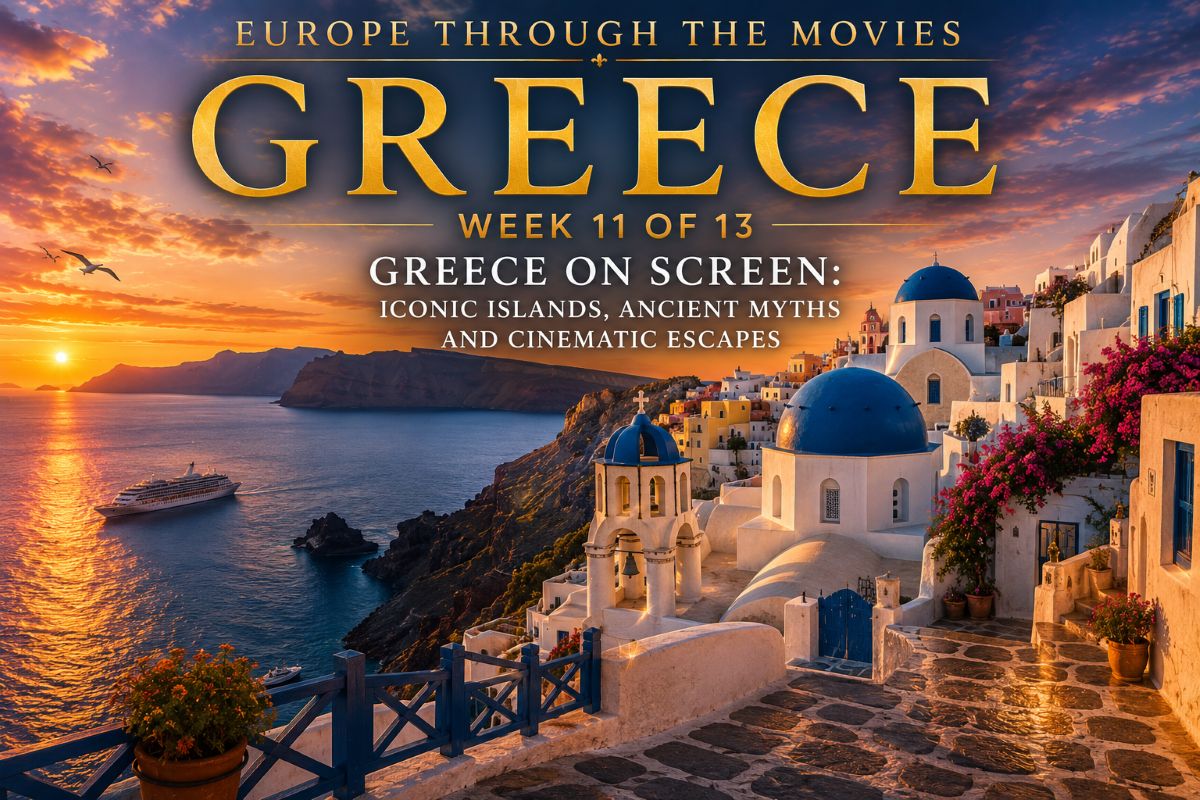
Greece occupies a singular place within the cinematic imagination because filmmakers rarely use it as a neutral geographical setting; they use it as an argument about how life might feel if the structures governing ordinary existence were somehow loosened. The most iconic filming locations in Greece, from Skopelos and Skiathos in Mamma Mia! to Kefalonia in Captain Corelli’s Mandolin, Corfu and the precipitous monasteries of Meteora in For Your Eyes Only, have repeatedly allowed cinema to transform actual islands, villages, beaches, mountains and historic architecture into emotional landscapes associated with freedom, romance, memory, danger and escape. Yet the power of these images depends upon something more complex than blue water, whitewashed buildings or Mediterranean sunlight, because Greece brings to the screen an extraordinary tension between apparent timelessness and profound historical depth: the same landscape that can appear to promise liberation from modern life has been occupied, cultivated, fought over, abandoned, rebuilt and remembered across centuries, which means the apparent simplicity of the image is often supported by a reality of enormous cultural density. Mamma Mia! turned Skopelos into the fictional island of Kalokairi, using Kastani Beach and the cliff-top chapel of Agios Ioannis Kastri to create one of contemporary cinema’s most recognizable Mediterranean fantasies, while Captain Corelli’s Mandolin used Kefalonia’s beauty as the setting for a wartime story in which love and ordinary life are invaded by occupation, violence and loss; For Your Eyes Only, meanwhile, found in Corfu and Meteora a Greece capable of combining elegance, danger and geographical extremity within the visual language of James Bond. (Visit Skopelos)
The deeper fascination of Greece film tourism begins precisely where the postcard interpretation ends, because the locations that appear effortless on screen are powerful partly because their landscapes impose real conditions upon human life. Islands organize movement through sea and distance; mountain villages create forms of isolation that cannot be reproduced by simply removing mobile phones from a screenplay; monasteries positioned on immense rock formations make spiritual separation physically legible; old harbours turn arrival and departure into events rather than routine transactions; while the constant proximity of water produces an openness that cinema repeatedly converts into the possibility of personal reinvention. This is why Greek filming locations you can actually visit can support stories as different as the exuberant romantic fantasy of Mamma Mia!, the moral and historical gravity of Captain Corelli’s Mandolin and the espionage tension of For Your Eyes Only without becoming interchangeable, because each production extracts a different psychological quality from the same larger geographical condition: life is visibly shaped by place. Greece is not functioning merely as scenery behind the characters; it changes what movement means, what isolation means, what community means and, crucially, what escape might cost once the fantasy encounters reality.
Following the most famous movie locations in Greece therefore becomes a journey through the distance between the country cinema promises and the country that actually exists, beginning on Skopelos, where Mamma Mia! created perhaps the purest modern fantasy of the Greek island as a place where abandoned possibilities can be recovered, before moving to neighbouring Skiathos and the wider Sporades, then south and west toward Kefalonia, where Captain Corelli’s Mandolin transformed Mediterranean beauty into a painful counterpoint to wartime occupation, across to Corfu, where Bond found sophistication and danger beneath the apparent serenity of the Ionian landscape, and finally inland to Meteora, where monasteries balanced above enormous stone pillars reveal why filmmakers sometimes choose real locations precisely because no constructed fantasy could carry the same psychological authority. The journey reveals that Greece’s extraordinary cinematic power comes not from its ability to become another country, as we saw in Budapest or Prague, but from its capacity to become a heightened version of itself, allowing filmmakers to simplify, romanticize or intensify what is already present until geography begins to resemble a state of mind.
JOIN FOR FREE
Sign up to Hundreds of resources. New content added every week.
PLUS access to our MOVIE CHANNEL
One free account. Unlimited articles and movies. No credit card required.

Already a member? LOGIN HERE
