




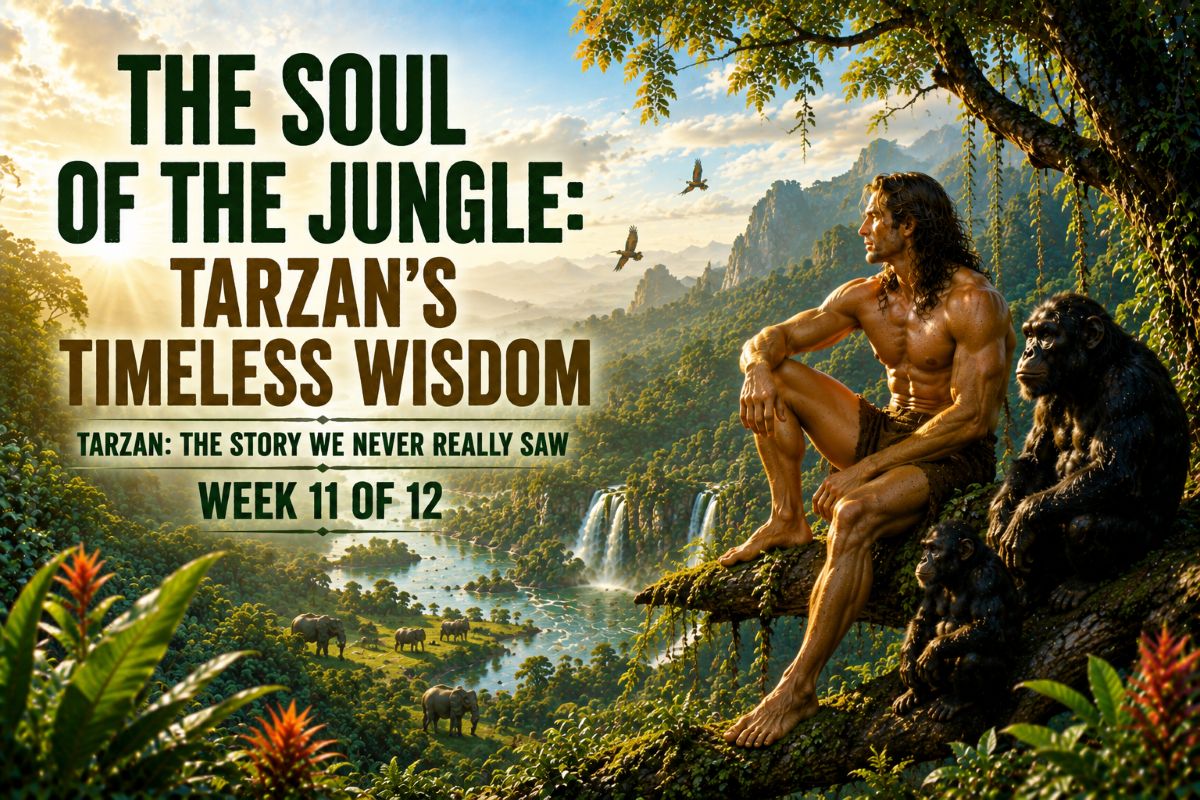
The history of Tarzan on film stretches back more than a century, beginning with Tarzan of the Apes in 1918, starring Elmo Lincoln as the adult Tarzan and Gordon Griffith as the younger version, only a few years after Edgar Rice Burroughs had introduced the character in print. The American Film Institute records the 1918 production as one of the earliest major screen translations of Burroughs' novel, establishing a pattern that would repeat throughout the next hundred years: filmmakers were immediately attracted to the visual power of Tarzan, but cinema also began deciding which dimensions of the character were easiest to preserve. Across silent serials, studio adventures, television, prestige drama, animation and modern blockbuster cinema, different generations repeatedly returned to the same mythology, yet each return selected from Burroughs rather than reproducing him completely. The body survived almost every adaptation, the jungle remained essential, Jane endured, danger remained spectacular and the image of the man moving through trees became universal, while the psychologically divided John Clayton, the multilingual aristocrat, the self-educated outsider, the critic of civilized hypocrisy and the protagonist of increasingly strange lost-world adventures proved much harder to keep intact.
Watch classic Tarzan movies and TV series by joining the EE Vault. Click here for more information.
The transformation became decisive with Johnny Weissmuller's Tarzan in MGM's Tarzan the Ape Man in 1932, because the enormous popularity of that film did more than produce a successful interpretation; it helped establish the version against which later screen Tarzans would be measured. AFI identifies the 1932 production as the first full-length sound Tarzan feature and the beginning of Weissmuller's extraordinary twelve-film run as the character between 1932 and 1948, while Turner Classic Movies notes that the film's success made Weissmuller's interpretation culturally definitive even though Burroughs himself objected to the reduction of his sophisticated British aristocrat into a far more monosyllabic jungle man. This matters because once an adaptation becomes more culturally influential than the source, later filmmakers inherit not only the books but the audience's memory of previous films, and Tarzan gradually entered precisely that condition. The famous yell, simplified language, magnificent physique and elemental jungle identity became so powerful that they ceased to feel like choices made by one era of filmmaking and began to feel like Tarzan himself.
Yet the century-long screen history also proves that Tarzan can survive radically different interpretations, from the physical mythology of Weissmuller to the more psychologically serious Greystoke: The Legend of Tarzan, Lord of the Apes in 1984, which deliberately returned attention to the conflict between jungle formation and aristocratic society, and Disney's Tarzan in 1999, which restored the emotional force of the two-world dilemma for an entirely new generation. The British Film Institute describes Greystoke as a straight-faced origin story whose second half places Christopher Lambert's Tarzan inside the upper reaches of society and emphasizes his inability to find an easy place within them, while Disney itself defines its animated film around the collision of Tarzan's two worlds after the arrival of humans and Jane. Looking across these adaptations therefore reveals something more important than a ranking of which actor made the best Tarzan: Hollywood repeatedly came close to recovering different fragments of Burroughs' original conception, but rarely brought the full architecture together, and the gap between those fragments may explain why the character still feels unfinished on screen despite having been filmed for more than a hundred years.
JOIN FOR FREE
Sign up to Hundreds of resources. New content added every week.
PLUS access to our MOVIE CHANNEL
One free account. Unlimited articles and movies. No credit card required.

Already a member? LOGIN HERE
