




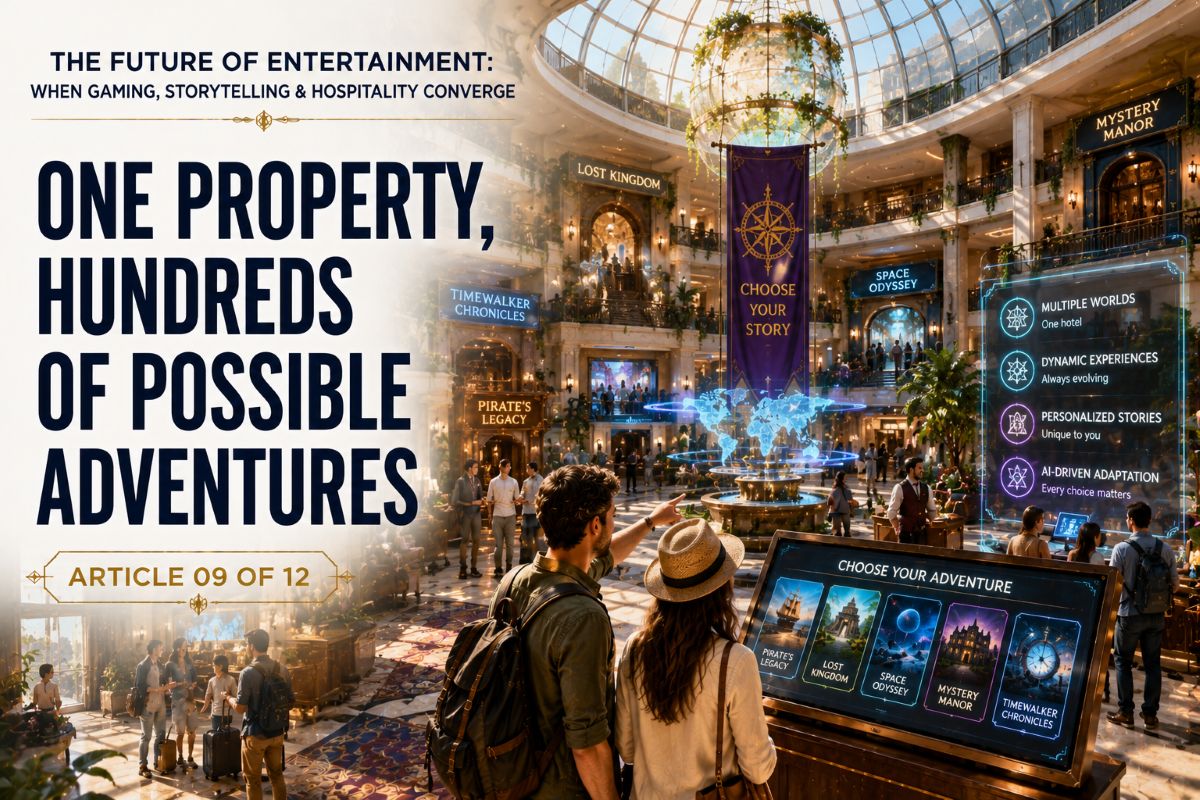
The most expensive assumption in immersive entertainment may be the belief that every new story requires a new physical world, because architecture, land, interiors, technical infrastructure and operational systems are among the least flexible components of destination entertainment. Theme parks, resorts and highly themed properties can create extraordinary environments, but their physical scale also creates a strategic constraint: once a location has been built around one dominant experience, changing that experience can require enormous additional capital. Gaming solved an analogous problem long ago by separating the underlying platform from the content running through it, allowing the same hardware to support thousands of different worlds, systems and narratives. If immersive hospitality, artificial intelligence, adaptive storytelling, augmented reality, movie IP, gaming and interactive entertainment can achieve even a partial version of that separation in physical space, then the economics of entertainment hospitality could change dramatically, because the same room, corridor, restaurant, garden or ballroom might support many different experiences without needing to be physically reconstructed for each one.
This possibility does not depend upon turning hotels into digital overlays or replacing architecture with screens, because the most compelling version would preserve the physical richness of hospitality while making meaning increasingly programmable. A staircase can remain physically identical while functioning as the site of a conspiracy in one narrative, a ceremonial threshold in another and an entirely ordinary passage for guests who choose no participation at all; a restaurant can host a mystery, a diplomatic encounter, a competitive faction event or a completely conventional dinner depending upon the story currently active; and a room can contain different narrative significance according to the guest's identity, previous choices and level of participation. The power lies in recognizing that physical space and narrative meaning do not need to be permanently fused, allowing hotel technology, AI-driven personalization, interactive storytelling and game design to create experiential variation over a stable architectural base.
The strategic consequence is substantial because a property designed as a flexible entertainment platform can potentially evolve through software, narrative design, performer orchestration, environmental control and selective physical modification rather than continuous reconstruction. New movie IP could be introduced, seasonal stories could refresh familiar spaces, returning guests could encounter entirely different narrative structures, and several levels of participation could coexist within the same hotel without compromising conventional hospitality. To understand why this matters, we have to move beyond the seductive language of personalization and examine a much deeper idea: the future of immersive hospitality may depend upon separating what the building permanently is from what the experience temporarily means.
JOIN FOR FREE
Sign up to Hundreds of resources. New content added every week.
PLUS access to our MOVIE CHANNEL
One free account. Unlimited articles and movies. No credit card required.

Already a member? LOGIN HERE
