




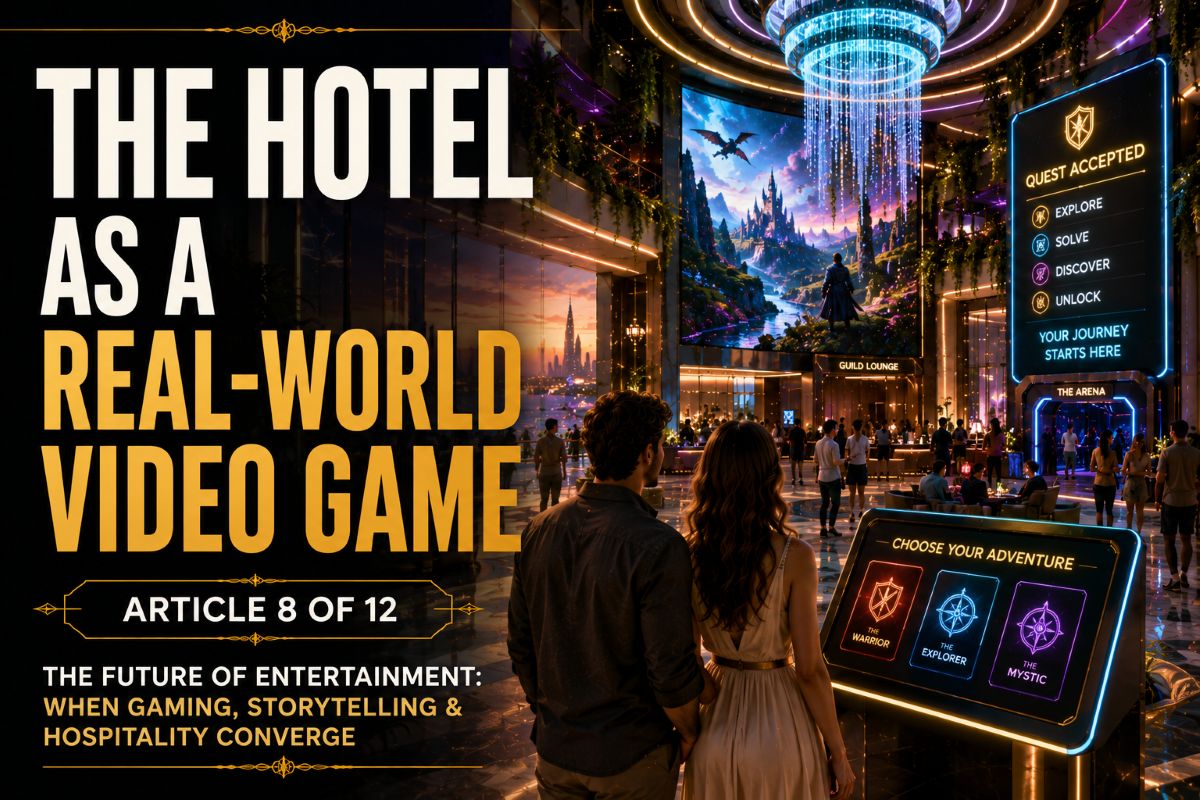
The idea of transforming a hotel into a real-world video game can sound superficial if interpreted through the familiar language of gamification, because hospitality does not become more compelling simply by distributing points, installing screens, adding leaderboards or asking guests to complete arbitrary challenges between breakfast and the swimming pool. The more consequential opportunity lies beneath the visible conventions of gaming, within the sophisticated psychological architecture through which video games, role-playing games, open-world gaming and interactive entertainment transform environments into systems of possibility. Games teach players that spaces can contain undiscovered meaning, that knowledge can change what becomes accessible, that actions can influence subsequent events, that progress can alter relationships and status, and that returning to a familiar environment with greater understanding can produce an experience fundamentally different from encountering it for the first time. When these principles are combined with immersive hospitality, movie IP, interactive storytelling, experiential travel and hotel technology, the hotel ceases to be merely a collection of rooms and amenities and begins acquiring the characteristics of a persistent playable world.
The distinction matters because the strongest game design rarely depends upon constant stimulation; it depends upon creating a coherent relationship between curiosity, action and consequence. A hotel designed according to these principles would not require guests to spend their vacation staring at an application or performing an endless sequence of tasks, because the physical property itself could become the interface: floors could represent different levels of access or knowledge, rooms could contain narrative significance beyond accommodation, restaurants could become locations where relationships and information intersect, objects could acquire new meaning as the participant learns more, and access to particular environments could evolve according to choices made earlier in the stay. Gaming mechanics in hospitality would therefore function not as decorative entertainment layered onto a conventional hotel but as an invisible architecture of agency through which the guest gradually learns that the property notices, remembers and responds.
The commercial implications become even more significant when progression extends beyond a single stay, because traditional hospitality largely asks returning guests to repeat an experience they previously enjoyed, while gaming has spent decades perfecting the psychology of returning to environments precisely because they are not finished. A participant who leaves an interactive hotel or immersive entertainment resort with unresolved relationships, unexplored spaces, incomplete knowledge and a persistent identity has a reason to return that cannot be reduced to loyalty points or another room upgrade; the destination has retained narrative value. Understanding the hotel as a real-world video game therefore requires moving beyond the vocabulary of attractions and examining the deeper architecture of playable environments—how rules become invisible, how progression becomes meaningful, how failure can exist without damaging a vacation, how different guests can inhabit different versions of the same property, and how physical hospitality might ultimately achieve something digital gaming has pursued for decades: a world sufficiently coherent that people do not merely visit it, but gradually learn how to live inside it.
JOIN FOR FREE
Sign up to Hundreds of resources. New content added every week.
PLUS access to our MOVIE CHANNEL
One free account. Unlimited articles and movies. No credit card required.

Already a member? LOGIN HERE
