



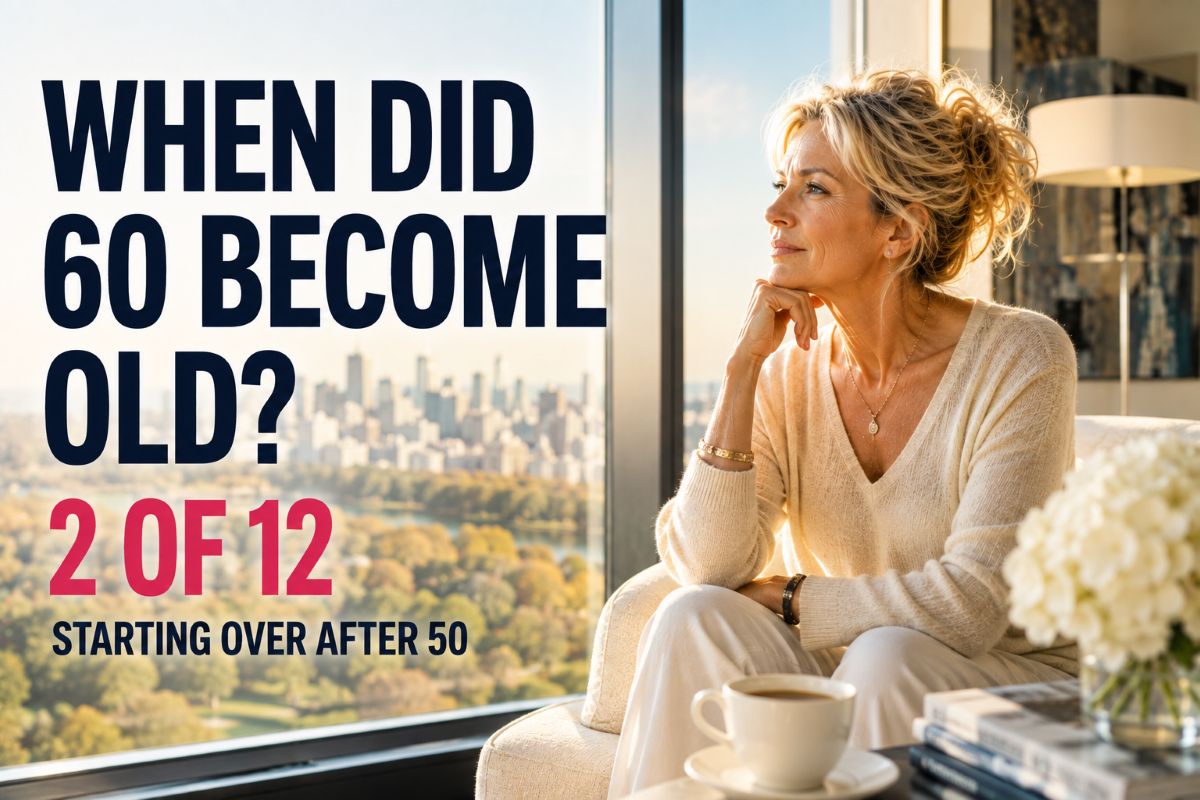
STARTING OVER AFTER 50
When Did 60 Become Old?
2 of 12
Most of us formed an idea of what it meant to be 60 long before we had any possibility of understanding what being 60 actually felt like. We saw 60 from the outside, through parents, grandparents, teachers, neighbours, television characters and the cultural language of an era in which people were frequently expected to become old considerably earlier than they are today. Those images settled quietly into memory and became part of our psychological definition of aging: how a 60-year-old dressed, what a 60-year-old body looked like, whether a 60-year-old still had ambition, whether romance and sexuality still belonged to them, whether careers were expanding or contracting, and whether the future remained a territory of possibility or had become primarily a period of preservation. This is one reason the fear of turning 60 can become so intense for people starting over after 50. We are not simply approaching an age; we may be approaching an identity that was defined for us decades before we were old enough to question it, and when that inherited image includes physical decline, retirement, illness, invisibility or death, a birthday can begin to feel less like another year of life than an unwanted entrance into old age.
The psychology of aging becomes even more complicated when family history gives those cultural images emotional force. A parent who seemed old at 60, a father who died at 65, a grandmother who died at 66, or relatives whose lives became progressively smaller as they aged can create an extraordinarily persuasive internal chronology, because the human mind does not experience those memories as abstract statistics; it experiences them as evidence. This is how fear of aging after 50 can become entangled with anticipatory grief, health anxiety, fear of physical deterioration and the belief that there may not be enough time left to start over financially, rebuild a career, find love, create a business, pursue an abandoned dream or simply enjoy the life one has worked so hard to create. Yet inherited expectations about aging are not predictions, and understanding the difference between family history, cultural conditioning, biological aging and our own future is essential if we are going to answer one of midlife's most unsettling questions: when we say that 60 feels old, are we actually describing ourselves—or remembering somebody else?
To answer that question seriously, we have to examine where our internal picture of old age came from, why childhood memories can remain more psychologically powerful than the reality standing in front of us, how previous generations experienced their sixties under very different social and cultural conditions, why women in particular have been taught to associate aging with disappearance, and how the fear of becoming our parents can quietly determine the choices we make about our own future. What emerges is not another comforting argument that “age is just a number,” because age is real and time does matter, but something considerably more useful: a way of separating what aging actually requires us to confront from the inherited story of aging we may have been carrying for half a century without ever consciously choosing it.
JOIN FOR FREE
Sign up to Hundreds of resources. New content added every week.
PLUS access to our MOVIE CHANNEL
One free account. Unlimited articles and movies. No credit card required.
Already a member? LOGIN HERE
