




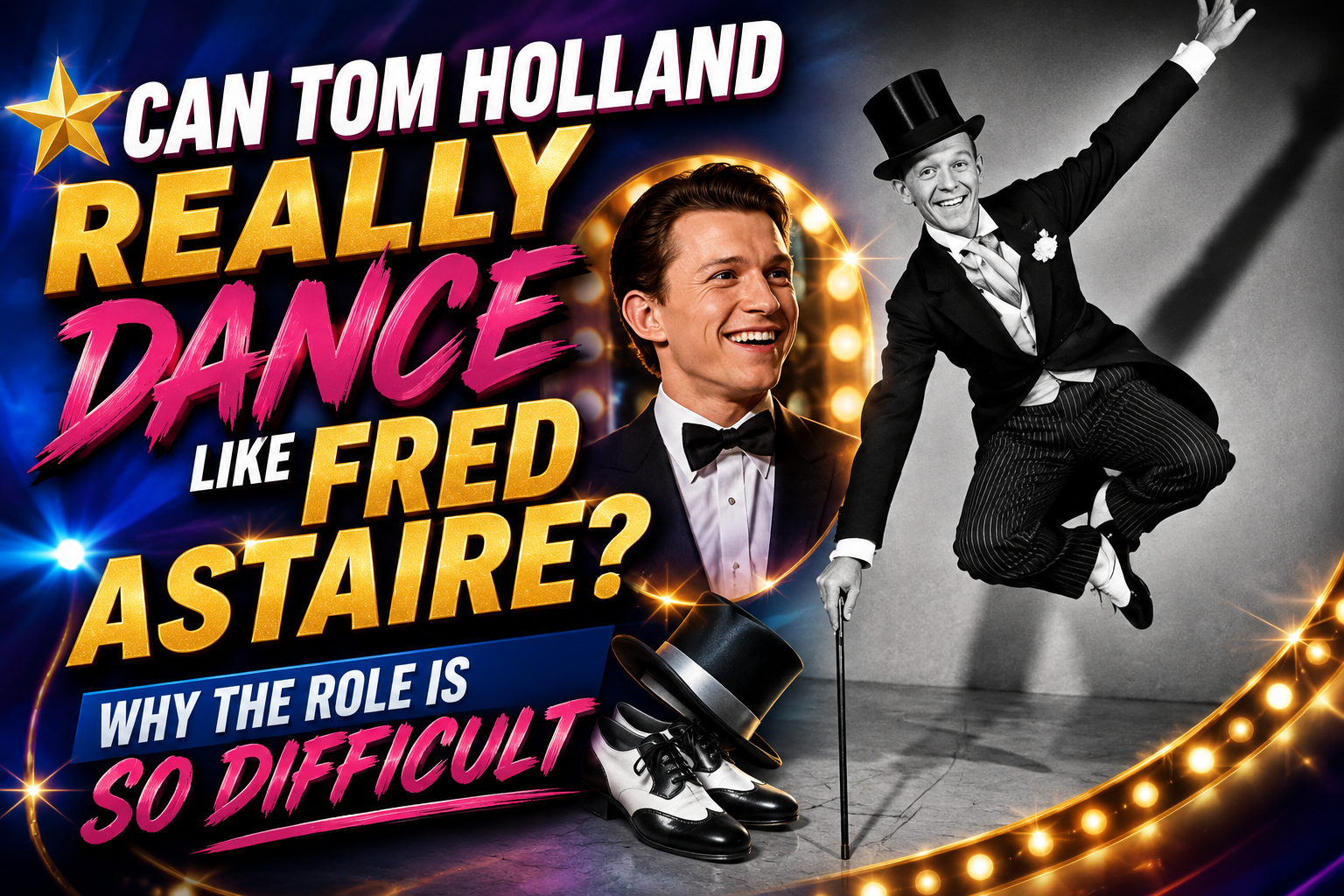
Tom Holland would seem, at first glance, to be one of the most logical contemporary actors to take on Fred Astaire. He has danced since childhood, performed professionally in Billy Elliot the Musical, built a screen career around unusual physical dexterity, and demonstrated repeatedly that he can integrate movement with character rather than treating physical performance as something separate from acting. Yet those advantages can obscure the scale of what he is attempting. Playing Fred Astaire is not fundamentally a question of whether Holland can dance, nor even whether months of intensive preparation can bring him close to Astaire’s technique. The far more difficult challenge is whether he can reproduce the artistic contradiction that made Astaire almost impossible to imitate: an enormous accumulation of discipline, precision and physical intelligence transformed so completely that the audience experiences none of the labor and sees only freedom.
That challenge is precisely why Holland’s preparation deserves to be considered against the original performances rather than through publicity photographs or isolated comparisons. You can watch Fred Astaire’s original movies and explore other classics inside the EE Vault with a 7-day free trial at https://www.empoweringentertainmentpublishing.com/classic-movies, where the scale of the problem becomes immediately visible. Astaire does not merely complete difficult choreography; he appears to inhabit it without calculation, allowing his face to remain expressive, his upper body remarkably composed and his relationship with the music seemingly instinctive even when his feet are executing sequences that required extraordinary preparation. Holland is therefore preparing not simply to reproduce a famous dancer, but to recreate a form of mastery whose defining characteristic was its ability to conceal itself.
Tom Holland Is Not Starting From Zero—and That Matters
Holland’s childhood experience in Billy Elliot the Musical is more significant than a convenient biographical detail because serious dance training during formative years creates a physical education that can remain embedded long after the performer stops dancing professionally. Balance, rhythm, coordination, spatial awareness and the relationship between music and movement are not merely intellectual skills that can be memorized later; they become patterns through which the body learns to organize itself. Holland may need to rebuild and redirect those abilities toward a radically different style, but he is not encountering dance as a foreign language. His body has already learned that movement can communicate character and that choreography must eventually become sufficiently internalized for performance to survive beyond conscious calculation.
His subsequent career adds another layer to that preparation. The physical demands of playing Spider-Man required coordination, acrobatic confidence, timing and an unusual comfort with movement in front of cameras, while years of action filmmaking taught him how physical performance changes when marks, lenses, repeated takes and technical constraints become part of the environment. These are meaningful advantages because Astaire’s art existed precisely at the intersection of bodily mastery and cinematic awareness. A performer who can dance beautifully but does not understand the camera may struggle to reproduce the particular quality Astaire created on screen, just as an experienced film actor without serious physical training could reproduce mannerisms while remaining unable to inhabit the movement that defined the man.
Yet Holland’s advantages should not be exaggerated into evidence that the transformation will therefore be easy. His previous physical languages are substantially different from Astaire’s. Billy Elliot trained him within another theatrical and choreographic vocabulary, while superhero performance emphasizes acceleration, impact, acrobatics and explosive physical commitment. Astaire’s elegance depends upon a different organization of energy, one in which extraordinary control often manifests as apparent absence of effort. Holland therefore faces the unusual task of using the physical intelligence he already possesses while resisting some of the habits that made that intelligence so effective in his previous work.
The Problem With Asking Whether Holland “Can Dance”
The question most likely to surround the film—can Tom Holland really dance like Fred Astaire?—contains an assumption that reduces Astaire’s achievement to technical difficulty. If the role were primarily a matter of learning steps, an exceptionally disciplined actor with a strong dance background could approach the problem through sufficiently intensive training. Choreography can be broken down, repeated, corrected and gradually transferred into muscle memory. The difficulty is substantial, but the pathway is comprehensible. Astaire becomes much harder to reproduce once we recognize that the steps themselves were only the visible surface of a far more integrated artistic system.
His movement possessed a particular relationship with rhythm, posture, transition and intention. The feet could be extraordinarily active while the upper body retained composure; a technically complicated phrase could arrive with the conversational ease of an ordinary gesture; a pause could become as expressive as a burst of movement because Astaire understood precisely where the music created space. Most importantly, the choreography rarely appears to consume his attention. He remains psychologically present inside the number, capable of flirting, responding, persuading, teasing or withdrawing while executing material that would force a less completely prepared performer to concentrate primarily upon survival.
This is the threshold Holland must cross. Competence means remembering what movement comes next and executing it correctly; mastery begins when the performer possesses enough control that the choreography no longer occupies the whole mind. Astaire operated beyond competence because technical knowledge had become embodied deeply enough to leave room for interpretation. Holland does not merely need to know the dance. He needs enough surplus control to act inside it, and that difference between execution and inhabitation may prove more difficult than any individual sequence he is asked to learn.
Athleticism and Elegance Are Not the Same Physical Language
Holland’s athleticism is an obvious asset, but it also illustrates one of the central misconceptions surrounding Astaire. Physical difficulty is not always communicated through visible exertion. Contemporary action performance frequently derives excitement from force: bodies accelerate, collide, leap, fall and recover, while muscular effort becomes part of the spectacle. Astaire often creates the opposite effect. The difficulty remains enormous, yet the body appears to have eliminated everything unnecessary, allowing control to become so refined that exertion almost disappears from the image.
Elegance in this sense is not decoration added to athletic ability. It is a particular economy of movement produced through control. Excessive tension in the shoulders, a fractionally heavy transition, an arm arriving without the precise relationship to the torso or a face revealing concentration can alter the entire impression even when the steps remain technically correct. Astaire’s apparent lightness came from the integration of countless details that audiences may not consciously identify but perceive collectively as ease. His dancing does not simply demonstrate what the body can do; it reorganizes our perception of how difficult doing it must be.
For Holland, this may require a process of subtraction rather than accumulation. He already knows how to make physical action exciting, but Astaire asks whether he can make complexity appear unremarkable. The transformation cannot be achieved by suppressing energy until the performance becomes restrained; the energy must instead be redistributed so efficiently that it produces precision without visible strain. That distinction is subtle enough to separate a technically impressive imitation from a performance capable of suggesting why Astaire was singular.
Musicality Cannot Be Recreated by Counting Correctly
One of the least visible and most important aspects of Astaire’s artistry is his relationship with music. A dancer can remain perfectly synchronized while still appearing to follow the music from outside, treating rhythm as a structure to which movement must conform. Astaire often creates the impression that movement and music originate from the same impulse. He does not merely arrive on the beat; he inhabits the space around it, using anticipation, delay, acceleration and stillness to make musical phrasing visible through the body.
This quality is exceptionally difficult to imitate because it cannot be reduced to choreography alone. Two performers can execute identical steps at technically correct moments while producing radically different experiences. One may appear to be remembering a sequence while the other appears to be responding spontaneously to sound. The difference lies partly in microtiming—the almost imperceptible decisions about when a gesture begins, how long a transition breathes and where weight settles in relation to the musical phrase—but it also depends upon a deeper understanding of why the movement belongs to that particular moment.
Holland therefore needs more than physical repetition. He must acquire enough familiarity with Astaire’s musical world that rhythm stops functioning as an external instruction and becomes part of characterization. This is where imitation reaches its limits. Reproducing the visible geometry of a famous routine may satisfy superficial resemblance, but reproducing its internal musical logic requires the performer to understand what Astaire was hearing and how that hearing shaped the body. Without that understanding, accuracy can become strangely lifeless.
The Upper Body May Reveal More Than the Feet
Audiences naturally associate Astaire with extraordinary footwork, yet one of the clearest measures of his control can be found above the waist. Complex rhythmic activity frequently occurs beneath an upper body that remains composed, expressive and apparently unconcerned with the difficulty below it. That separation creates much of the illusion of ease because the usual physical evidence of concentration has been removed. The body is working intensely without appearing to broadcast the work.
This is where the difference between learning choreography and embodying it becomes brutally visible. When a performer has not fully internalized difficult movement, tension migrates elsewhere. Shoulders tighten, arms become overly deliberate, facial expression becomes fixed, breathing changes or transitions acquire a slight anticipatory hesitation. None of these imperfections necessarily prevents the sequence from being completed correctly, but collectively they tell the audience that the performer is performing a task. Astaire’s mastery lies partly in preventing that information from reaching us.
Holland’s preparation must therefore continue far beyond the moment at which he can execute a routine successfully. The choreography has to become sufficiently secure that his upper body and face are liberated from technical concentration and returned to acting. Only then can the audience believe that the character is thinking about the woman across from him, the emotional situation within the scene or the pleasure of the music rather than silently calculating what his feet must do next.
Fred Astaire Never Stopped Acting When He Started Dancing
This integration of technique and psychology is perhaps the most important reason Astaire remains difficult to reproduce. His dances do not generally function as neutral exhibitions inserted into the narrative; they extend the dramatic life of the character. Courtship becomes choreography, hesitation becomes distance, confidence becomes rhythm and emotional alignment becomes synchronization. The performer does not temporarily disappear behind the dancer because the dancer is one of the ways the character communicates.
That distinction creates a formidable challenge for any biographical actor. Holland cannot simply divide his preparation into scenes in which he must “act like Astaire” and sequences in which he must “dance like Astaire.” If the transformation is convincing, the same physical identity must inhabit both. The way Astaire walks into a room, adjusts his posture, turns toward another person or responds to music belongs to the same bodily intelligence that later appears within the choreography. A performer whose physical characterization activates only when the dance begins will inevitably reveal the construction.
The body therefore has to carry biography. Years of dance training change how a person occupies space even when no formal choreography is occurring, and portraying Astaire requires Holland to suggest that accumulated history. The audience may never consciously notice whether his ordinary walk contains the physical economy of a dancer, but inconsistency will register instinctively if the man speaking between musical numbers appears physically unrelated to the man who suddenly begins dancing inside them.
Ginger Rogers Reveals Why Astaire Cannot Be Recreated Alone
The challenge becomes even greater when partnership enters the equation because Astaire’s screen identity was repeatedly defined through interaction with dancers who brought their own rhythm, personality and resistance. Ginger Rogers is the most famous example, and their work demonstrates why technical synchronization is not enough. A great partnered dance is not two individuals completing predetermined movements simultaneously; it is the illusion that movement is being generated through relationship.
Astaire’s precision becomes meaningful because he is listening physically. Distance changes in response to another body, timing becomes negotiation, and leadership is communicated without destroying the partner’s independence. Rogers could resist, answer and redirect him, which gave the choreography dramatic tension. The eventual synchronization feels emotionally satisfying precisely because it emerges from difference rather than existing automatically from the beginning.
Holland’s success will consequently depend partly upon the performer opposite him and upon the amount of rehearsal devoted to creating a genuine shared language. Chemistry cannot be manufactured simply by placing two technically competent dancers inside accurate choreography. The partners must reach a level at which they appear to respond rather than remember, allowing predetermined movement to acquire the emotional unpredictability of conversation. If the film recreates famous Astaire-Rogers material, audiences familiar with the originals will perceive the absence of that relational intelligence immediately even if every step is technically correct.
The Camera May Be Holland’s Most Unforgiving Co-Star
Astaire’s own philosophy of filming dance intensifies every aspect of this challenge. As explored in the previous article in this series, his preference for preserving the dancer’s body and maintaining choreographic continuity reduced the opportunities for editing to manufacture an impression of mastery. If the new film chooses to honor that philosophy rather than merely reproducing Astaire’s costumes and famous poses, Holland will need to withstand a similarly revealing camera.
Sustained full-body framing changes the psychological and technical demands of performance because there are fewer places to hide uncertainty. A sequence assembled from shorter pieces allows difficult material to be divided, individual moments to be perfected and editorial rhythm to conceal transitions that may be less secure. A longer continuous passage requires the performer to preserve musicality, character, posture, technique and emotional intention simultaneously, knowing that a significant error near the end may invalidate minutes of otherwise exceptional work.
This is not simply a test of stamina. The deeper difficulty is remaining free while knowing that precision is unforgiving. Conscious caution can destroy the very quality the performer is attempting to recreate because Astaire’s style depends upon the absence of visible anxiety. Holland must therefore achieve enough technical security to perform under pressure without allowing that pressure to become part of what the camera sees. The more faithfully the filmmakers embrace Astaire’s visual principles, the less they will be able to protect their star from comparison with them.
The Danger of an Excellent Fred Astaire Impression
Biographical performance always involves recognizable external characteristics because audiences need enough continuity between historical subject and actor to accept the transformation. Astaire presents a particularly seductive trap because his iconography is so strong. The posture, tailoring, gestures, vocal rhythms and choreography offer abundant material for imitation, and a sufficiently gifted actor could reproduce many of those surfaces convincingly. Yet an excellent impersonation could still fail to become a meaningful Fred Astaire performance.
The difference lies in causality. Mannerisms become dramatically interesting only when the actor understands the psychological and professional structures that produced them. Astaire’s perfectionism, relentless rehearsal, musical intelligence and concern with how dance was photographed were not separate curiosities surrounding the famous image; they created that image. His elegance was not simply a personality trait but the visible result of a philosophy in which enormous labor existed precisely to eliminate the appearance of labor.
Holland therefore has to discover the man underneath the recognizable movements rather than assembling the man from them. If he merely reproduces the exterior, viewers familiar with Astaire may admire the accuracy while remaining emotionally outside the performance. If he understands why Astaire needed such control, what artistic standards governed his preparation and how deeply his identity was intertwined with the pursuit of apparent ease, the physical resemblance can begin to acquire psychological weight.
The Most Difficult Part of the Transformation Is Making the Transformation Disappear
Modern celebrity culture encourages audiences to admire visible preparation. We learn how much weight an actor gained or lost, how many months were spent training, how difficult a stunt became and how many hours of rehearsal preceded a performance. The transformation itself becomes part of the product, inviting viewers to watch the film partly through awareness of what the actor endured to create it. Astaire’s artistic ideal creates an almost perfect inversion of that culture because his success depended upon making preparation invisible.
Holland may train for months, repeat sequences until exhaustion and reconstruct physical habits that took Astaire decades to develop, but the finished performance should ideally erase our awareness of that work. If the audience watches every dance thinking primarily about how impressive it is that Tom Holland learned to do this, the result may demonstrate remarkable dedication without fully reaching Astaire. The highest achievement would occur when the viewer stops congratulating Holland for the preparation because the preparation has disappeared into character.
This is why the role is more demanding than a conventional physical transformation. Holland is not merely asked to acquire a skill and display it. He is asked to acquire enough skill that display ceases to feel like display, allowing technique to become personality and rehearsal to become spontaneity. The better he succeeds, the less obvious the labor responsible for the success should become.
Why the First Real Dance Footage Will Matter So Much
When substantial footage from the film eventually appears, the most revealing questions will have little to do with whether Holland resembles Astaire in a still photograph. The camera will tell us how seriously the production has taken the challenge. How much of Holland’s body remains visible? How frequently do the sequences cut? Are transitions preserved? Does the choreography breathe within the frame? Does Holland appear to be completing difficult material, or does he appear sufficiently free inside it to continue acting?
Those details will reveal whether the production understands Astaire primarily as a recognizable cultural image or as an artist whose methods were inseparable from his significance. A film could reproduce famous dances through sophisticated editing and still create an entertaining representation of his life, but it would avoid one of the central artistic risks inherent in the subject. Allowing Holland to perform sustained choreography visibly would expose him to comparison in a way that is far more dangerous—and therefore far more meaningful.
The first footage may consequently answer the question surrounding this entire production more clearly than months of interviews can. Holland does not need to become Fred Astaire’s technical equal, an impossible and historically meaningless standard for an actor preparing one role against a man who developed his art across a lifetime. He does, however, need to convince us that he understands what Astaire was attempting to make invisible. If the camera can remain with him and we stop seeing the work, the transformation will have begun.
The Question Is Not Whether Tom Holland Can Dance Like Fred Astaire
The more useful question is whether Holland can understand Fred Astaire deeply enough to make dancing like him dramatically believable. Exact duplication is neither possible nor necessary. A biopic is not an archival reconstruction, and acting becomes sterile when resemblance is treated as the highest form of truth. What matters is whether Holland can communicate the principles that made Astaire distinctive: musicality that feels instinctive rather than counted, physical control that eliminates unnecessary tension, partnership that resembles conversation, and preparation so complete that the audience experiences freedom instead of labor.
Holland enters the challenge with unusually strong advantages. He possesses real dance history, formidable physical intelligence, years of experience integrating movement with screen performance and enough acting ability to understand that choreography must ultimately serve character. Those qualities make the casting fascinating precisely because they give him a credible path toward the role without making success inevitable. The remaining distance between a gifted contemporary performer and Fred Astaire is where the artistic drama lies.
That distance is also why the film could become one of the most revealing performances of Holland’s career. Spider-Man transformed physical virtuosity into superhero spectacle; Astaire demands that physical virtuosity disappear inside elegance. One role amplifies extraordinary movement until it appears impossible, while the other requires extraordinary movement to become so controlled that it appears natural. Holland has spent years demonstrating what his body can do. Fred Astaire asks whether he can make us forget that he is doing anything difficult at all.
Tom Holland’s dance background makes him an intriguing choice for Fred Astaire, but it does not answer the most important questions surrounding the transformation. Beyond the paywall, we examine why Astaire’s apparent ease required a lifetime of accumulated technique, how Holland’s existing physical strengths could actually work against him if they are not fundamentally reshaped, why partnership and period movement may prove harder than spectacular choreography, and what the filmmakers must do if they want audiences to experience Fred Astaire rather than merely admire Tom Holland’s preparation. Subscribe to Empowering Entertainment Magazine to unlock the complete analysis, and your subscription also includes the EE Vault, giving you classic movies, books, games and more alongside the stories that explore how entertainment history continues to shape what comes next.
JOIN FOR FREE
Sign up to Hundreds of resources. New content added every week.
PLUS access to our MOVIE CHANNEL
One free account. Unlimited articles and movies. No credit card required.

Already a member? LOGIN HERE
