




How Film Commissions Must Adapt to the $11 Billion Microdrama Economy
Article 8 of 12
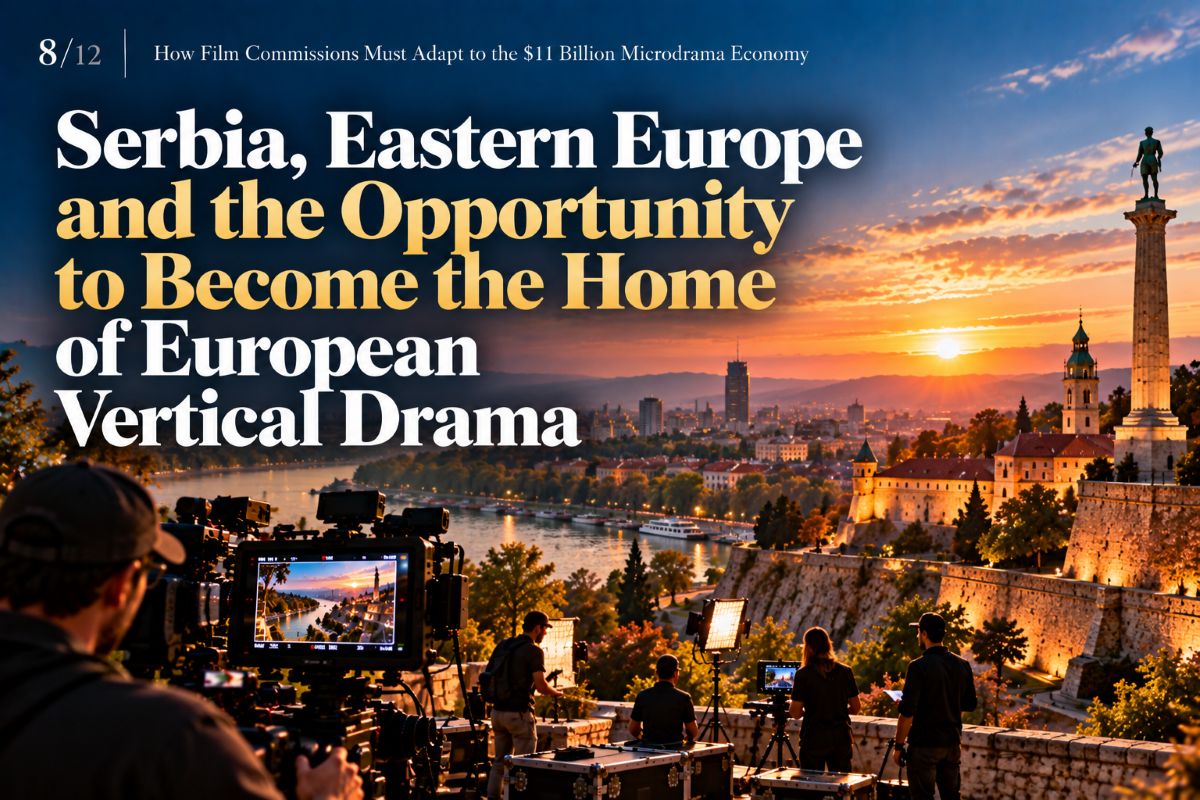
Serbia, Eastern Europe and the Opportunity to Become the Home of European Vertical Drama
The Next Major Production Hub May Not Be the Territory With the Largest Studios or the Biggest Incentive Budget, but the One That Understands First How to Turn Hundreds of Small Productions Into a Permanent Industry
For Serbia and the wider production economies of Central and Eastern Europe, microdrama presents an opportunity fundamentally different from the traditional competition for international film and television. The region has spent years proving that sophisticated screen production does not have to remain concentrated in Los Angeles, London, Paris or the most expensive Western European capitals, building professional crews, production-service companies, studios, equipment infrastructure and international experience while maintaining cost structures capable of making foreign production economically attractive. Serbia already markets a 25–30 percent production incentive, access to experienced crews and more than 500 searchable locations, while positioning its production companies as multilingual partners capable of servicing shoots throughout the Balkans. Those strengths have traditionally been deployed in competition for conventional films, television series and commercials, but microdrama changes the scale at which they could become strategically powerful.
The opportunity is accompanied by an equally striking contradiction. Under Serbia's current audiovisual incentive rules, a feature or television film must allocate more than €300,000 to production in Serbia to meet the applicable minimum, while a television series must allocate more than €150,000 per episode; qualifying television series must also contain at least three episodes, with each episode lasting at least forty minutes. Those requirements are perfectly recognizable within the economics of conventional television, but they effectively describe the opposite of a typical vertical series, where the entire production may cost approximately what Serbia currently expects to be spent on a single qualifying television episode and where an episode may last one to three minutes rather than forty. Serbia therefore possesses many of the ingredients required to become a highly competitive vertical-production territory while maintaining an incentive definition through which the format itself can remain almost completely invisible.
That gap could become one of the most interesting production-policy opportunities in Europe because Serbia does not need to compete with California or Britain by reproducing their entire entertainment ecosystems. It needs to become exceptionally good at one production category whose economics reward precisely the combination the region can offer: professional crews, adaptable locations, comparatively competitive production costs, geographic variety, manageable distances and the ability to deliver large quantities of scripted content rapidly. If one territory in Central or Eastern Europe creates an incentive architecture capable of recognizing twenty, fifty or one hundred vertical productions as a single recurring economic relationship, it could acquire an advantage far greater than the value of the initial rebate. It could become the place where international platforms build European production pipelines, where local crews accumulate specialized expertise faster than competitors and where a new generation of producers learns how to manufacture scripted entertainment at industrial frequency.
JOIN FOR FREE
Sign up to Hundreds of resources. New content added every week.
PLUS access to our MOVIE CHANNEL
One free account. Unlimited articles and movies. No credit card required.

Already a member? LOGIN HERE
