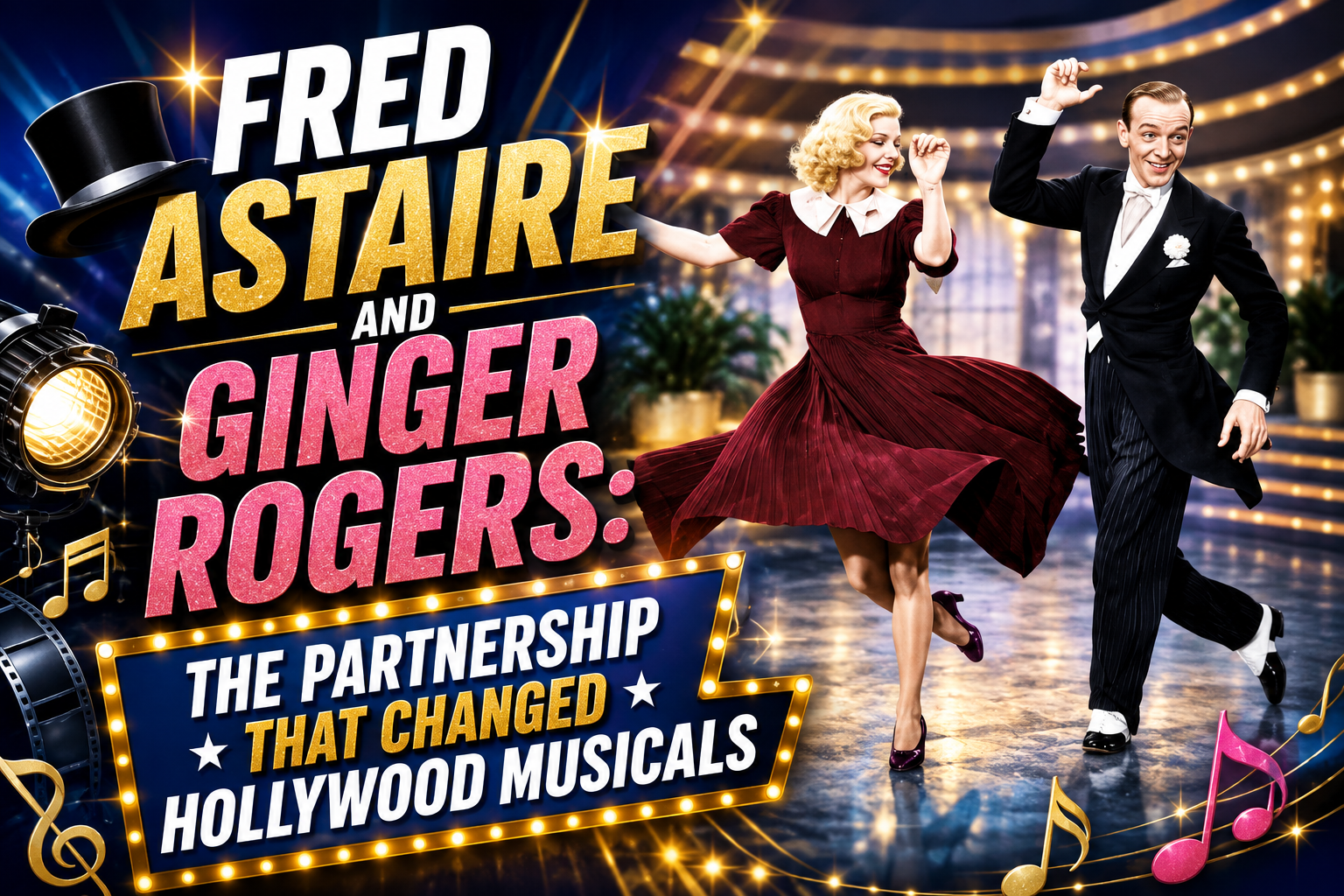
Few screen partnerships have become as culturally inseparable as Fred Astaire and Ginger Rogers. Their names are now so tightly linked that the pairing itself has become shorthand for romantic elegance, perfect timing and the golden age of the Hollywood musical. Yet the enduring power of Astaire and Rogers cannot be explained by nostalgia alone. Across ten films, they helped redefine what dance could accomplish on screen, turning choreography into courtship, conflict, persuasion and emotional revelation while changing the way audiences understood movement within a cinematic story.
Before Tom Holland brings Fred Astaire back into the center of popular culture for a new generation, there is no better way to understand why Astaire became legendary than to watch the original partnership that made his screen identity unforgettable. You can explore Fred Astaire’s classic films and other golden-age movies inside the EE Vault with a 7-day free trial at https://www.empoweringentertainmentpublishing.com/classic-movies, allowing you to experience the chemistry, rhythm and cinematic sophistication of Astaire and Rogers before that history is filtered through a contemporary biopic.
More Than a Famous Pair
Astaire and Rogers are often remembered as though they emerged fully formed as one of Hollywood’s definitive romantic duos, but their partnership was not initially conceived as a grand historical event. Their first film together, Flying Down to Rio in 1933, did not even place them at the center of the story. They appeared in supporting roles, yet their dance sequences generated such extraordinary audience interest that the industry quickly recognized the potential of the pairing. What had begun as one element inside a larger production became the foundation for a series of films that would help define the American musical during the 1930s.
The significance of this origin lies in the fact that chemistry cannot be engineered simply through choreography. Two technically accomplished dancers can share a frame without generating emotional electricity, while Astaire and Rogers possessed an immediate ability to make movement feel relational rather than merely synchronized. Their dancing created the impression that something was happening between the characters rather than simply being performed by them. The audience did not only admire the steps; it interpreted the steps as part of a conversation.
That distinction is central to understanding their importance. Hollywood had already embraced musical spectacle, but Astaire and Rogers helped demonstrate how deeply dance could be embedded into storytelling itself. Their numbers often emerged from emotional situations and then altered those situations by the time the music ended. Courtship could begin in verbal resistance and evolve through physical synchronization; romantic uncertainty could become visible through changes in distance, tempo and balance. The choreography carried narrative weight because the dancers were not merely performing in front of the story. They were advancing it.
Why Ginger Rogers Was Never Simply Astaire’s Partner
Popular memory sometimes flattens Rogers into a supporting role within the Fred Astaire mythology, as though her primary function were to provide an elegant counterpart to his superior technique. That interpretation dramatically underestimates what made the partnership work. Rogers was not merely the person beside Astaire; she was the dramatic force that prevented his virtuosity from becoming self-contained. Her acting instinct, timing and emotional responsiveness gave the dances friction, resistance and human stakes.
Astaire’s elegance could become dramatically interesting because Rogers did not simply yield to it. She answered it. In many of their strongest numbers, the dance begins with some form of emotional asymmetry: one character is more certain than the other, one pursues while the other resists, one proposes a rhythm that the other has not yet accepted. Rogers’s ability to communicate hesitation, humor, skepticism or attraction through movement gave Astaire something to respond to, and that exchange transformed choreography into dramatic structure.
This is why the common observation that Rogers did everything Astaire did “backwards and in high heels,” while witty, only begins to capture her contribution. Her physical accomplishment was extraordinary, but her deeper importance lay in how fully she integrated technique with character. She did not look like a dancer executing difficult material while separately acting a scene. The acting and dancing became the same event. That synthesis is one of the reasons audiences could understand the emotional logic of their numbers without any specialized knowledge of dance.
The Dance as Courtship
The Astaire-Rogers films repeatedly transformed romantic development into choreographic development. This was not merely a stylistic flourish. It allowed the musical to dramatize intimacy without relying exclusively upon dialogue, and in doing so it gave physical movement a narrative authority rarely matched elsewhere in popular cinema. Two characters who could not yet articulate what they felt might nevertheless begin to move in the same rhythm, allowing the audience to witness emotional alignment before the screenplay formally acknowledged it.
This pattern is especially powerful because dance requires negotiation. One partner cannot create harmony alone. Timing must be shared, balance must be trusted and movement must be responsive rather than unilateral. As a metaphor for romance, the form therefore carries meaning before any individual step is interpreted. When Astaire and Rogers gradually synchronize, the physical structure of the dance itself suggests a relationship becoming possible.
The elegance of their best sequences comes from the refusal to overstate this metaphor. The films rarely need to announce what the dance “means” because the audience experiences the emotional shift directly. A change in distance, a shared turn or the moment when one performer begins to mirror the other can register as dramatically as a confession. The choreography becomes emotionally legible without becoming simplistic.
Top Hat and the Creation of an Iconic Image
If Flying Down to Rio revealed the partnership and The Gay Divorcee established its commercial power, Top Hat transformed Astaire and Rogers into something approaching myth. Released in 1935, the film crystallized many of the visual and emotional elements that would become permanently associated with them: the immaculate evening clothes, the sophisticated interiors, the romantic misunderstanding and the sensation that dance could temporarily suspend ordinary social reality.
“Cheek to Cheek” remains one of the most revealing sequences because it demonstrates how little external complexity is necessary when the emotional and physical relationship between performers is strong enough. The choreography is technically demanding, yet the effect is intimate rather than exhibitionistic. The audience is not encouraged to count steps or marvel at athleticism. Instead, the movement creates the impression of two people entering a private world structured by shared rhythm.
That privacy is one of the great paradoxes of the Hollywood musical. The dance unfolds in front of a camera, within an elaborate studio production, before an audience of millions, yet Astaire and Rogers could make it feel secluded. Their technical control allowed the machinery surrounding them to disappear, leaving the impression of emotional immediacy. The illusion was carefully constructed, but the experience felt spontaneous.
Swing Time and the Emotional Maturity of the Partnership
By the time Swing Time arrived in 1936, Astaire and Rogers no longer needed to prove that their partnership worked. That freedom allowed the films to explore deeper emotional registers. The musical numbers become more than demonstrations of charm or romantic playfulness; they reveal longing, uncertainty and vulnerability with a degree of sophistication that complicates the lighter image often associated with the pair.
“Never Gonna Dance” is particularly important because it shows choreography carrying emotional loss rather than simply romantic exhilaration. The sequence builds through movement, allowing the characters’ relationship to be understood physically. What makes it powerful is not that Astaire and Rogers abandon elegance, but that elegance becomes the vehicle for something more painful. Their control does not reduce emotion; it concentrates it.
This development reveals why the partnership endured artistically even as the surrounding formula became familiar. Astaire and Rogers were capable of expanding the emotional vocabulary of their dances. The same fundamental principles—shared rhythm, visual clarity, relational movement—could express delight in one film and melancholy in another. The sophistication of the partnership lay in this flexibility.
The Camera Had to Respect the Partnership
Astaire’s approach to filming dance is inseparable from the success of his work with Rogers. He favored framing that allowed the audience to see the body clearly and continuity that preserved the relationship between movement and space. This preference was not a technical eccentricity. It was essential to the emotional credibility of the partnership because the audience needed to see both dancers interacting physically rather than receiving the impression of interaction through rapid editing.
A romantic dance depends upon spatial information. How close are the performers? Who initiates movement? Who follows, resists or redirects? How do they transition from separation into synchronization? Excessive cutting can obscure these relationships, while sustained framing allows the audience to understand them intuitively. Astaire’s visual philosophy therefore supported the emotional logic of the choreography.
This is one reason the films remain so watchable today. The camera does not constantly instruct the audience where to look through aggressive editing. Instead, it often trusts the choreography itself to organize attention. That trust creates a viewing experience in which performance retains authority, and the partnership feels physically real rather than cinematically manufactured.
Rogers Made Astaire More Interesting
Great partnerships often reveal dimensions of an artist that solo work cannot expose, and Rogers did exactly that for Astaire. His precision became more dramatically meaningful because it encountered resistance; his elegance became more romantic because it had someone to persuade; his timing became more expressive because it existed within exchange. Rogers did not diminish Astaire by matching him. She enlarged the range of what his artistry could communicate.
This is why the partnership should not be understood as a hierarchy in which one performer supplied technique and the other supplied charm. The most important quality was interdependence. Astaire’s movement required a partner capable of responding with enough intelligence and authority to prevent the scene from becoming a demonstration. Rogers’s presence ensured that dance remained relational rather than unilateral.
Their chemistry therefore emerged from structure as much as personality. Astaire’s controlled style and Rogers’s dramatic responsiveness created tension, and tension creates narrative. The audience was not simply watching two people who looked good together. It was watching two different energies discover how to inhabit the same rhythm.
Why Their Partnership Changed Hollywood Musicals
The historical importance of Astaire and Rogers lies partly in their ability to collapse the distinction between narrative and musical number. Earlier musical forms often treated songs and dances as interruptions or showcases, moments when the story paused so entertainment could occur. Astaire and Rogers demonstrated how the number itself could become the story, allowing character relationships to evolve through movement.
This integration raised the artistic expectations placed upon the Hollywood musical. Choreography could no longer be evaluated solely for technical brilliance or spectacle. It could carry psychological and narrative meaning, and when it did, the musical form became capable of expressing emotional developments unavailable to conventional dialogue. The body became a storytelling instrument.
Their influence extended beyond the films they made together because later filmmakers inherited this expanded understanding of what screen dance could accomplish. The musical could be romantic, psychologically nuanced and cinematically sophisticated without sacrificing accessibility. Astaire and Rogers helped prove that popular entertainment and artistic intelligence were not opposites.
The Partnership Was Never as Effortless as It Looked
The visual ease of Astaire and Rogers can obscure the extraordinary preparation behind it. Their dances depended upon rigorous rehearsal, technical precision and an ability to repeat complex material under the demands of film production while preserving the illusion of spontaneity. The more effortless the result appeared, the more likely it was that enormous discipline had been required to produce it.
This tension between labor and appearance is central to Astaire’s entire career, but Rogers participated fully in creating the illusion. High heels, heavy costumes, repeated takes and demanding choreography were not incidental burdens. They were part of the physical reality hidden beneath the polished surface. The partnership’s elegance therefore becomes more impressive once the effort required to achieve it is understood.
The artistry lies not in denying the labor but in transforming it. Astaire and Rogers made precision feel like freedom because the preparation was so complete that technique no longer appeared consciously managed. The audience saw ease because the performers had already absorbed the difficulty.
Why Tom Holland Must Understand Ginger Rogers to Understand Fred Astaire
A Fred Astaire biopic that treats Rogers merely as a famous co-star would miss one of the most important forces shaping his screen identity. Holland may be preparing to play Astaire, but the character he is portraying was repeatedly defined through relationship. Astaire’s most enduring screen persona did not emerge in isolation. It developed through interaction with partners capable of revealing different aspects of his artistry.
Understanding Rogers is therefore essential to understanding Astaire. Holland will need to communicate not only technical mastery but the responsiveness that made partnership possible. Astaire’s dancing was never simply about control over his own body. It involved awareness of another performer’s timing, balance and emotional intention.
This dimension is particularly important because contemporary biopics often focus heavily on individual genius, constructing narratives in which extraordinary figures appear largely self-generated. The Astaire-Rogers story resists that simplification. Astaire was undoubtedly singular, but some of his greatest screen achievements were collaborative by definition.
The Partnership Became Larger Than Either Performer
There is a reason the phrase “Fred and Ginger” carries meaning even for people who have never watched one of their films. The partnership transcended individual careers and became a cultural symbol of romantic elegance, synchronization and cinematic grace. That symbolic power can sometimes obscure the complexity of the work, but it also testifies to how deeply the image entered collective memory.
Their legacy survives because the partnership offers something more enduring than nostalgia for a particular era. It represents the fantasy of two distinct individuals discovering perfect coordination without losing individuality. The dancers remain themselves even as they move together, and the resulting harmony feels earned rather than imposed.
That idea gives their work an emotional resonance beyond the specific conventions of 1930s Hollywood. The clothes may belong to another period, the social world may feel distant and the musical form may no longer dominate popular cinema, but the underlying desire for connection through mutual responsiveness remains immediately recognizable.
The Astaire-Rogers Legend Is Only the Surface
The familiar image of Fred Astaire and Ginger Rogers gliding across a ballroom can make their partnership appear almost too polished to analyze. Yet beneath that surface lies a sophisticated system of performance, choreography, cinematography and dramatic structure that changed the possibilities of the Hollywood musical. Their work was not important because they looked elegant together. It was important because they made movement carry story.
Continue beyond the paywall to discover how Astaire and Rogers built emotional tension through choreography, why their contrasting performance styles created such extraordinary screen chemistry, how their films changed the visual grammar of dance, and why the partnership remains essential to understanding the challenge Tom Holland now faces in portraying Fred Astaire. Become an Empowering Entertainment Magazine subscriber to unlock the complete feature, and your membership also includes the EE Vault, where classic movies, books, games and more allow you to experience the history behind the stories you are reading.

Unlock the Entire Empowering Entertainment Library
This article is only the beginning.
Become a member and enjoy unlimited access to every premium magazine article, expert interviews, in-depth features, practical guides, and a growing digital library of hundreds of books covering business, entrepreneurship, film production, personal growth, health, relationships, AI, ADHD, and much more.
One membership. Hundreds of resources. New content added every week.