Fred Astaire made dozens of films across a screen career that stretched from the early 1930s into the final decades of his life, leaving behind far more than the familiar image of a man in white tie and tails dancing beside Ginger Rogers. For viewers discovering him because Tom Holland is preparing to portray him in a forthcoming biopic, the real question is not whether Astaire deserves to be watched but where to begin. His greatest films reveal an artist constantly expanding the possibilities of dance on screen, moving from the exhilarating romantic partnerships of the 1930s to increasingly ambitious experiments in choreography, cinematography and musical storytelling.
Before Tom Holland’s portrayal inevitably becomes the Fred Astaire that millions of younger viewers encounter first, there is particular pleasure in meeting Astaire through the performances that created the legend. You can explore Fred Astaire’s original movies and other classics inside the EE Vault with a 7-day free trial at https://www.empoweringentertainmentpublishing.com/classic-movies, allowing you to experience the extraordinary difference between knowing Astaire as a cultural icon and actually watching what happened when the music began and Hollywood’s cameras were placed in front of him.
Where Should You Begin With Fred Astaire?
The size of Astaire’s filmography can make the first encounter deceptively difficult. Beginning chronologically offers historical context, while choosing only the most famous titles risks reducing his career to the celebrated partnership with Ginger Rogers. Selecting films solely for their dance sequences creates another distortion because Astaire’s achievement cannot be understood through isolated choreography alone. His significance emerged from the relationship between movement, character, music, camera and story, which means the strongest introduction should reveal not merely his technical ability but the evolution of the cinematic language he helped create.
A useful journey through Astaire therefore begins with the films in which Hollywood discovered what he and Rogers could accomplish together, then moves outward toward the later works in which he danced with other extraordinary partners and operated within increasingly sophisticated productions. Seen in that progression, Astaire stops looking like a performer who repeatedly executed variations upon the same elegant persona. His career becomes an extended exploration of what screen dance could communicate, how the camera could participate without overwhelming the dancer, and how radically different partners could reveal different dimensions of the same performer.
For contemporary audiences approaching Astaire through the excitement surrounding Tom Holland’s forthcoming portrayal, this distinction matters enormously. A biopic will inevitably compress a lifetime into a dramatic structure, choosing particular relationships, conflicts and achievements to represent a career too extensive to reproduce in full. The original films provide something biography cannot: direct access to the work itself. Instead of being told that Astaire possessed extraordinary musical intelligence or that his partnership with Rogers transformed Hollywood musicals, audiences can observe those qualities unfolding in real time.
1. Flying Down to Rio — The Moment Hollywood Discovered Astaire and Rogers
The logical beginning is not a film built around Fred Astaire and Ginger Rogers at all. Released in 1933, Flying Down to Rio starred Dolores del Río and Gene Raymond, while Astaire and Rogers appeared in supporting roles. Yet their chemistry during the musical numbers became one of the film’s great revelations, demonstrating that screen partnerships are not always manufactured through strategic planning. Sometimes audiences simply recognize something happening between two performers before the industry itself fully understands what it has found.
Watching the film today is fascinating precisely because the mythology has not yet hardened around them. Astaire and Rogers are not being presented as the definitive dancing couple of Hollywood; they are becoming that couple before our eyes. The freshness of the encounter provides an important corrective to the retrospective assumption that their partnership was inevitable. Hollywood history is filled with combinations that looked promising on paper but produced little electricity on screen, while Astaire and Rogers possessed the much rarer ability to make technical synchronization feel like personal communication.
The success of their appearance helped establish the partnership that would dominate the next phase of Astaire’s career. For a modern viewer, Flying Down to Rio therefore functions almost like an origin story. It allows us to witness the moment before an iconic image became iconic, when two performers were discovering a screen language that audiences would soon recognize instantly.
2. The Gay Divorcee — When the Partnership Became the Main Event
If Flying Down to Rio revealed the possibility, The Gay Divorcee demonstrated what could happen when Astaire and Rogers were placed at the center of the experience. Released in 1934 and developed from the stage musical Gay Divorce, in which Astaire had already appeared, the film gave the pair the narrative space required for dance, romance and comedy to become fully integrated. The result helped establish the formula that would make their films such an important part of 1930s popular culture while simultaneously showing how much sophistication could exist within apparently effortless entertainment.
The extended “The Continental” sequence is particularly revealing because it demonstrates that dance in an Astaire film could expand beyond an isolated star number into a larger cinematic construction. Yet the grandeur of the production does not erase the essential intimacy of Astaire’s appeal. Even surrounded by elaborate staging, his movement remains legible, his relationship to the music remains precise, and the camera permits the choreography to possess continuity rather than treating it merely as raw material for editing.
For someone discovering Astaire for the first time, The Gay Divorcee establishes an essential principle that will recur throughout his strongest work: dance is not something added after the characters have finished communicating. Dance is one of the ways they communicate. Attraction becomes movement, hesitation becomes timing, romantic pursuit becomes choreography, and the musical form allows psychological developments to occur through the body rather than solely through dialogue.
3. Top Hat — The Essential Fred Astaire Movie
If only one Astaire film could be selected as an introduction to the cultural phenomenon, Top Hat would be extraordinarily difficult to displace. Released in 1935, it captures the Astaire-Rogers partnership near the height of its powers while surrounding them with Irving Berlin songs, elegant production design, sophisticated comedy and some of the imagery that would become permanently associated with Astaire. This is the world many people imagine when they hear his name, but the film is considerably more interesting than the nostalgic shorthand it eventually produced.
“Cheek to Cheek” remains one of the defining Astaire-Rogers sequences because it demonstrates the extraordinary emotional economy of their partnership. The choreography does not need to announce itself as an athletic achievement in order to command attention. Instead, movement gradually creates intimacy, and the elegance of the sequence emerges from the impression that the characters are discovering a private language together. Technical precision is everywhere, but it has been absorbed so thoroughly into romantic expression that the viewer is not required to separate virtuosity from emotion.
“Top Hat, White Tie and Tails” reveals another dimension of Astaire, presenting elegance not as passive refinement but as dynamic control. The costume that became synonymous with him functions almost like an extension of choreography, while the famous imagery demonstrates how completely Astaire could transform clothing, rhythm and gesture into screen identity. To watch Top Hat carefully is to understand why cultural icons are sometimes created not through a single spectacular act but through the alignment of performer, material, partner, music and filmmaking at precisely the right historical moment.
4. Swing Time — When Perfection Acquired Emotional Depth
Released in 1936, Swing Time is frequently placed among the finest Astaire-Rogers films, and its importance lies partly in the emotional maturity it brings to the partnership. By this point, audiences already understood what Astaire and Rogers represented, allowing the film to deepen rather than merely establish their screen relationship. The result contains some of their most celebrated work while revealing how dance could carry emotional nuance far beyond the exhilaration of technical accomplishment.
“Never Gonna Dance” is particularly important because it demonstrates what happens when Astaire’s philosophy of movement is placed in service of emotional loss. The sequence builds through dance rather than using dance as an escape from narrative seriousness, allowing choreography to become an expression of longing and romantic uncertainty. The physical control remains extraordinary, but virtuosity is no longer the principal subject. The audience understands what the characters feel because the movement itself has become emotionally articulate.
“Pick Yourself Up,” by contrast, demonstrates the playfulness that made Astaire and Rogers such persuasive screen partners. The shift between apparent instruction, competition and mutual delight creates a scene in which character evolves through rhythm. Their best films repeatedly accomplish this transformation, moving beyond the idea that musical numbers exist because audiences expect songs and dances and toward the more sophisticated proposition that characters sometimes reveal themselves most completely when ordinary speech becomes insufficient.
5. Shall We Dance — Gershwin, Astaire and the Expansion of the Musical
By 1937, the Astaire-Rogers partnership was established enough to support experimentation, and Shall We Dance brought their screen language into contact with the music of George and Ira Gershwin. The combination is historically significant because Astaire’s career cannot be separated from the extraordinary composers whose work he interpreted. His contribution to American popular music was not that of a conventionally powerful singer but of an interpreter whose understanding of phrasing and rhythm allowed songs to acquire an intimate, conversational quality.
Astaire’s voice was never the kind designed to overwhelm an audience through sheer vocal force, and that limitation became part of his strength. He treated songs as extensions of character, approaching melody with the same sensitivity to timing that governed his dancing. In his hands, singing and movement belonged to the same expressive system, each shaped by an understanding that sophistication frequently becomes more persuasive when it is not announced aggressively.
The film also reminds modern audiences that Astaire’s historical importance extends beyond dance. His screen career became one of the great meeting places between Hollywood cinema and the American songbook, helping preserve and popularize music by some of the twentieth century’s most consequential composers. To explore Astaire’s movies is therefore to enter a much larger cultural history in which dance, popular music, filmmaking and theatrical traditions continually intersect.
6. Holiday Inn — Astaire Beyond Ginger Rogers
One of the dangers of beginning with the Astaire-Rogers films is that their partnership is so persuasive that it can become difficult to imagine either performer outside it. Holiday Inn, released in 1942 and pairing Astaire prominently with Bing Crosby, provides an important expansion of that image. The film belongs to a different phase of Astaire’s career and allows viewers to see how effectively his screen presence could function within another kind of musical relationship.
Astaire and Crosby embodied radically different performance energies. Crosby’s relaxed vocal persona and Astaire’s physical precision could have competed for attention, yet their contrast instead creates a broader understanding of musical stardom during the period. Astaire no longer needs the romantic architecture of his partnership with Rogers to justify his presence; his command of movement has become sufficiently established that it can operate within an ensemble of major performers and still remain unmistakably his own.
Modern viewers should also approach Holiday Inn historically rather than nostalgically without qualification. Like a number of works from classical Hollywood, it contains material reflecting racial attitudes and performance traditions that are disturbing to contemporary audiences, including a blackface sequence. A serious appreciation of film history requires the ability to recognize artistic achievement without erasing the cultural failures embedded within the same artifacts. Understanding Astaire’s era therefore means encountering both the brilliance that survives and the prejudices that should not be romanticized simply because the surrounding film has become a classic.
7. Easter Parade — Fred Astaire and Judy Garland
Easter Parade, released in 1948, offers another essential step in understanding Astaire because it places him opposite Judy Garland, one of the most emotionally distinctive musical performers Hollywood ever produced. Their partnership differs profoundly from Astaire and Rogers, which is precisely why the film belongs on an introductory journey. A great partner does not merely reproduce an established chemistry with a different face; the new combination changes the performance itself.
Garland’s expressive power emerged from a different artistic center than Rogers’s. Her singing possessed an emotional immediacy capable of making a song feel autobiographical even within the artificial structures of a studio musical, while Astaire’s disciplined elegance often worked through understatement. Their interaction therefore produces a fascinating balance between emotional openness and controlled sophistication. Astaire does not cease being Astaire, but another partner reveals qualities that the Rogers films did not need to emphasize in quite the same way.
The film is also significant because Astaire had announced his retirement before returning to replace Gene Kelly after Kelly was injured. What could have been the closing of one phase instead became the beginning of another extraordinarily productive period. That return complicates the idea of Astaire as an artist tied exclusively to the 1930s, demonstrating that his screen identity could survive changing partners, changing musical styles and an industry moving toward a different postwar sensibility.
8. Royal Wedding — The Dance on the Ceiling
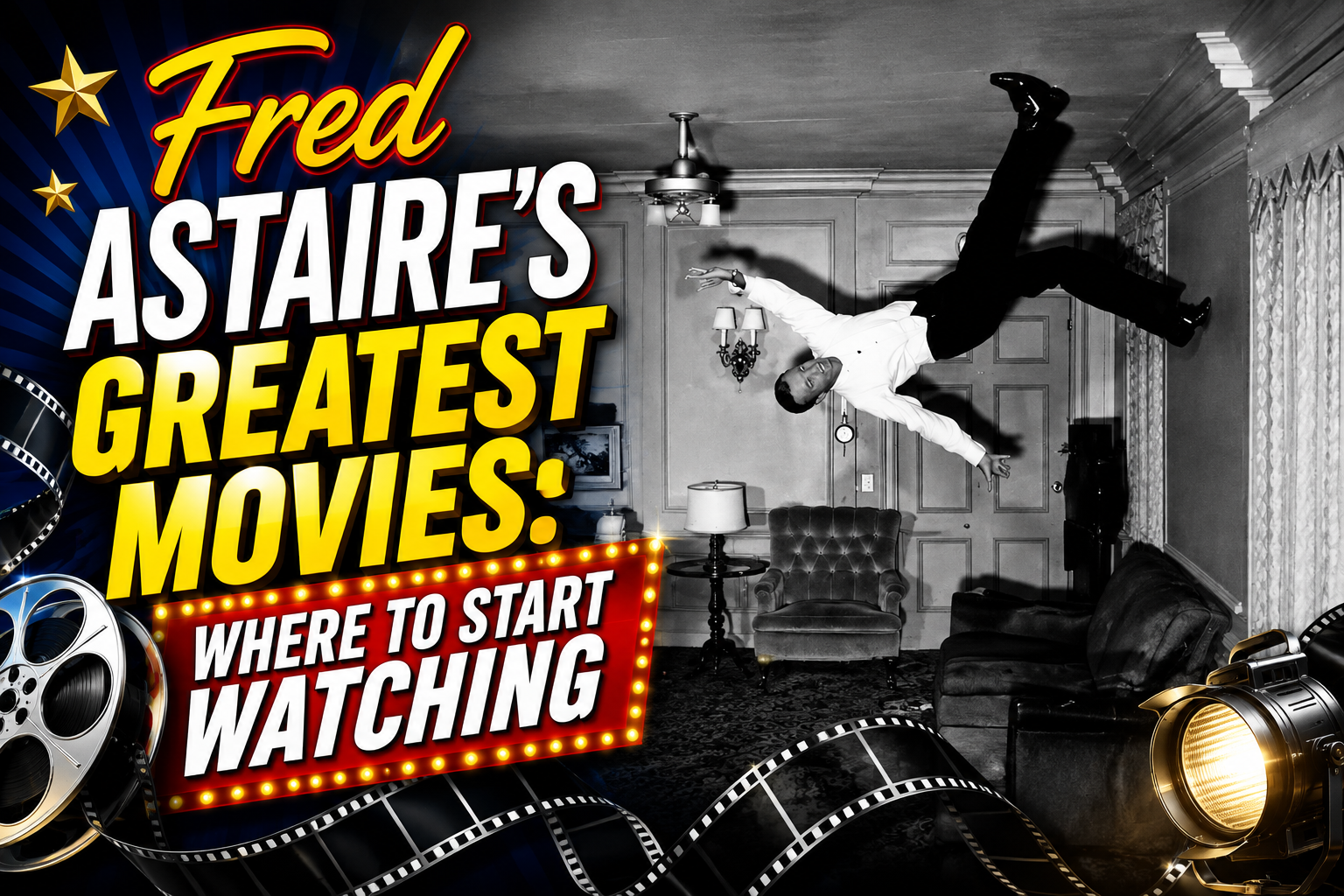
Even people who have never watched a complete Fred Astaire film may have encountered one of the most famous images from Royal Wedding: Astaire dancing across the walls and ceiling of a room while the apparent laws of gravity collapse around him. Released in 1951, the film contains “You’re All the World to Me,” a sequence that remains a remarkable example of how technological ingenuity can support rather than replace physical performance.
The effect was achieved through a rotating room constructed with the camera fixed in relation to the set, allowing Astaire to move as the environment itself revolved. What makes the sequence enduring is not merely the cleverness of the mechanism but the way Astaire adapts his physical performance to it. The technological concept would be interesting as an engineering demonstration; it becomes magical because the performer integrates the illusion into choreography, making an impossible environment appear temporarily natural.
This sequence also complicates simplistic descriptions of Astaire as an artist who wanted cameras merely to remain stationary and document dancing. His philosophy was not hostile to cinematic invention. What mattered was that invention should serve movement rather than obscure inadequate movement. Royal Wedding demonstrates the distinction beautifully: the filmmaking creates an impossible physical world, but Astaire still has to dance convincingly inside it.
9. The Band Wagon — Astaire at Artistic Maturity
Released in 1953, The Band Wagon belongs to the period when Astaire was no longer simply a musical star but an established institution confronting the evolution of entertainment around him. That context gives the film unusual depth because questions of artistic relevance, theatrical ambition and changing tastes become intertwined with the musical form itself. Astaire’s age does not diminish his presence; it adds another layer to it.
The celebrated “Dancing in the Dark” sequence with Cyd Charisse demonstrates how profoundly a different partner could alter Astaire’s screen language. Charisse brought extraordinary line, control and sensuality to dance, creating a partnership less associated with the playful romantic friction of Rogers and more with an almost dreamlike visual sophistication. The sequence unfolds with a serenity that disguises its precision, using movement to establish intimacy without requiring spectacular narrative machinery.
For viewers who assume Astaire’s greatness belongs principally to youth, The Band Wagon is essential. His authority has deepened rather than disappeared. The performance is not attempting to compete with younger dancers through escalating athleticism; it demonstrates something more difficult to acquire because it cannot be learned quickly—the economy, musical understanding and confidence produced by decades of mastery.
10. Funny Face — Astaire, Audrey Hepburn and a Changing Hollywood
Funny Face, released in 1957, places Astaire opposite Audrey Hepburn and surrounds them with fashion, Paris, photography and the sophisticated visual language of a Hollywood entering a new era. The age difference between the stars is unmistakable to modern audiences, yet the film remains culturally fascinating because it demonstrates how successfully Astaire’s persona could be repositioned within a cinematic environment very different from the streamlined black-and-white musicals that first established him.
Hepburn was herself becoming an emblem of a new kind of elegance, and placing her alongside Astaire creates a symbolic bridge between generations of screen sophistication. Astaire represents an established tradition of musical performance while Hepburn embodies a modernity increasingly connected to international fashion and postwar cosmopolitanism. The film therefore becomes more than another romantic musical; it captures a moment in which one version of cinematic elegance encounters the version that would help replace it.
For anyone following the forthcoming Tom Holland film, this capacity for reinvention is particularly important. Astaire’s career cannot be adequately represented as a single golden period followed by decline. He repeatedly survived transformations in the industry because the underlying principles of his artistry were adaptable. Styles changed, partners changed, audiences changed and Hollywood itself changed, yet his understanding of rhythm, performance and camera remained valuable.
The Best Way to Watch Fred Astaire Is to Watch His Evolution
A list of “best Fred Astaire movies” can easily become a collection of famous titles without explaining why watching them together matters. The more rewarding approach is to see these films as stages in an artistic evolution. Flying Down to Rio captures the discovery of an extraordinary partnership; The Gay Divorcee and Top Hat show that partnership becoming a cinematic language; Swing Time reveals its emotional depth; Shall We Dance places Astaire within the larger tradition of the American songbook; and the later films demonstrate that his artistry was never dependent upon one partner, one decade or one formula.
That progression also reveals why isolating Astaire’s most spectacular dance clips can never provide the complete experience. Individual routines may display the technical brilliance immediately, but the films reveal how movement functions in relation to character and story. When a dance arrives after a relationship has been established, the smallest gesture can carry narrative meaning because the audience understands what is at stake between the people moving. Astaire’s achievement becomes deeper when choreography is restored to the dramatic context for which it was created.
This is one of the pleasures available to audiences discovering him before Tom Holland’s biopic arrives. Instead of waiting for a contemporary film to decide which moments define Fred Astaire, viewers can construct their own understanding from the original work. They can see the young performer finding his cinematic identity, the legendary partnership with Rogers reaching extraordinary heights, the mature artist adjusting to new collaborators and the veteran performer proving that elegance rooted in musical intelligence does not simply disappear with age.
Watching Fred Astaire Changes the Question Tom Holland Must Answer
Once several of these films have been seen, the central question surrounding the forthcoming biopic becomes considerably more interesting. It is no longer simply whether Tom Holland can learn to dance well enough to resemble Fred Astaire. Holland is an experienced physical performer with a genuine dance background, and intensive training can produce an impressive degree of technical transformation. The much harder question is whether a contemporary actor and filmmaker can reproduce the peculiar artistic logic that made Astaire appear so effortless.
That challenge becomes visible only after watching the originals because Astaire’s greatness often resides precisely where modern spectacle teaches audiences not to look. He does not always demand attention through scale, speed or aggressive editing. Sometimes the astonishing element is simply that the camera remains present while a complete thought is expressed through movement, that an impossibly complicated passage appears conversational, or that a romantic relationship changes before our eyes without either character needing to explain what has happened.
Watching the films therefore raises the stakes for Holland’s portrayal rather than merely providing historical background for it. The better one understands Astaire, the less sufficient physical resemblance becomes. The role requires an actor to portray not simply what Astaire did but the contradiction at the center of how he did it: obsessive preparation transformed into freedom, extraordinary technical difficulty transformed into ease, and complete physical control transformed into the appearance of spontaneity.
There Is Far More Behind These Movies Than Their Famous Dance Numbers
The films on this list provide an extraordinary introduction to Fred Astaire, but they also open a much larger story about Hollywood itself. Behind the elegance were changing studio systems, creative partnerships, technical innovations, cultural contradictions and an artist continually adapting to an industry that could easily have confined him to the particular formula that first made him famous. Understanding why some of these films became masterpieces while others became historical curiosities requires looking beyond the famous steps and asking what each stage of Astaire’s career reveals about the evolution of screen entertainment.
Continue beyond the paywall to discover how Astaire escaped the greatest trap created by his own success, why his partnerships with Ginger Rogers, Judy Garland, Cyd Charisse and Audrey Hepburn reveal radically different dimensions of his artistry, what his greatest films teach us about the difference between choreography and cinematic storytelling, and which performances Tom Holland should study most closely if he wants to capture something deeper than imitation. Become an Empowering Entertainment Magazine subscriber to unlock the complete feature, and your membership also includes the EE Vault, where classic movies, books, games and more turn the history you are reading about into entertainment you can actually explore.

Unlock the Entire Empowering Entertainment Library
This article is only the beginning.
Become a member and enjoy unlimited access to every premium magazine article, expert interviews, in-depth features, practical guides, and a growing digital library of hundreds of books covering business, entrepreneurship, film production, personal growth, health, relationships, AI, ADHD, and much more.
One membership. Hundreds of resources. New content added every week.