

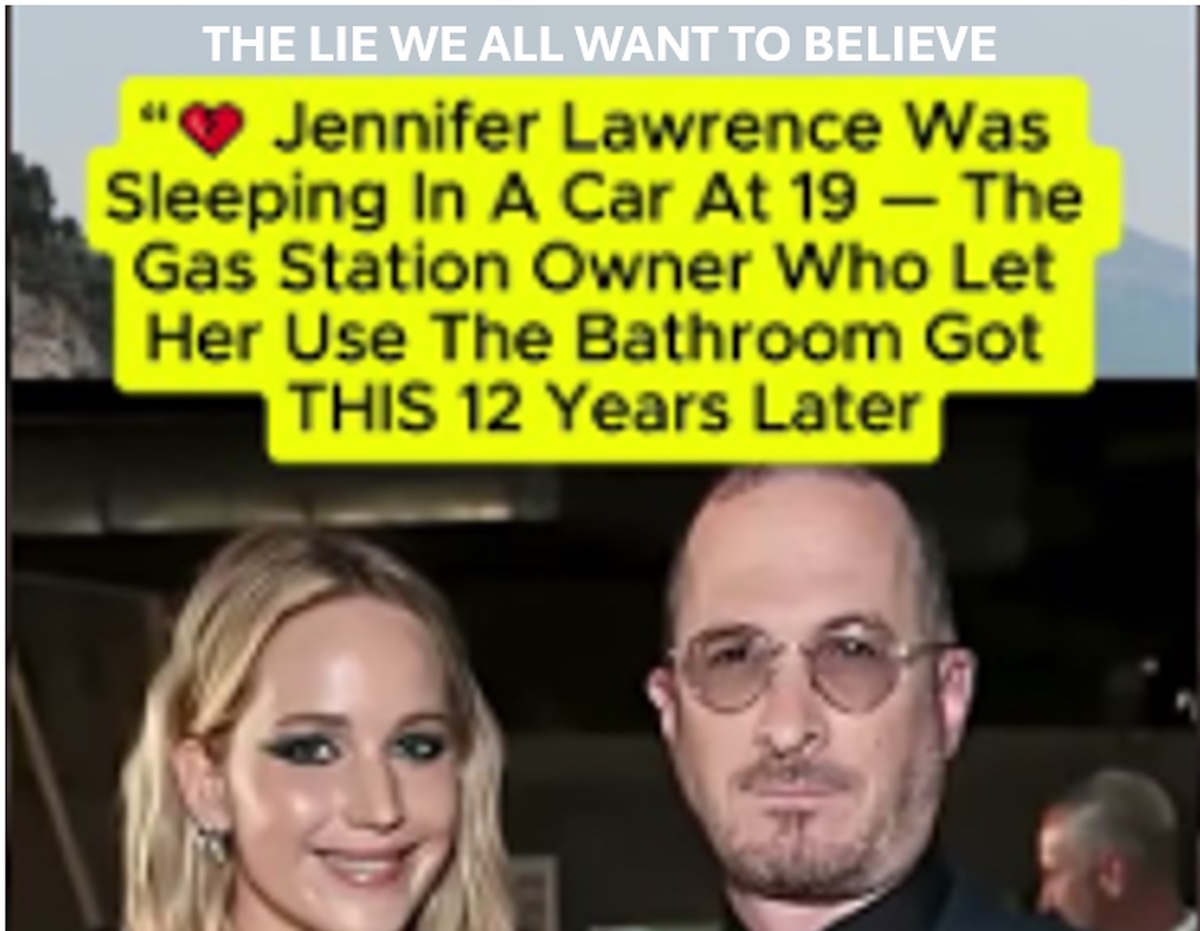
You were right. The claim is about a gas station, not a restaurant. The post says that, in 2009, a gas-station owner called “Mr. Patel” gave a struggling Jennifer Lawrence food, coffee and phone charging; that she later bought the $2.3 million property and made him its owner. It is false—Snopes investigated and found no evidence it happened.
The post is almost perfectly designed to travel.
Above a photograph of Jennifer Lawrence, it tells the story of a young woman supposedly sleeping in her car while pursuing an acting career in Los Angeles. For months, according to the viral caption, a gas-station owner named Mr. Patel notices her, gives her food and coffee, lets her charge her phone, and asks nothing in return. Years later, after becoming an Oscar-winning star, Lawrence allegedly tracks him down, buys the $2.3 million property where he works, and hands him the keys.
“You gave me humanity when I felt invisible.”
It is an exquisite line. It is also invented.
There is no credible reporting, public record, interview, statement from Jennifer Lawrence, or identifiable gas-station owner that supports this story. The image offers no location, no full name, no date that can be independently checked, no photograph of the supposed recipient, and no source beyond the post itself. The central claim has been fact-checked and found to be false. Yet it has travelled widely because, for a few seconds, it gives us something social media has made increasingly scarce: a clean moral ending.
The story’s power lies in its simplicity. A stranger is kind when he has no reason to be. A young woman remembers. Success does not harden her; it magnifies her gratitude. Wealth is not hoarded, wasted, or displayed. It is used to restore dignity to the person who once offered it freely. The narrative offers generosity as a form of justice, and it lets the reader leave with the comforting impression that goodness is eventually returned in full.
Of course we want that to be true.
We are living through an era in which stories of money often arrive attached to anxiety: rising costs, precarious work, impossible housing, businesses struggling to stay open, dreams abandoned because the numbers no longer work. A gas station is not merely a business in this particular fable. It represents survival, long hours, ordinary service, immigrant ambition, and the fragile promise that hard work may still build a life. To imagine a global star rescuing the man who once gave her a cup of coffee is to imagine a world where decency is noticed and remembered.
That is why these stories bypass the part of us that would normally ask questions.
The emotional reward arrives before the evidence. We read the caption, picture the exhausted young actress in a car, picture the quietly generous owner, picture the triumphant return, and feel moved. By the time we reach the share button, we have already received what the post was designed to provide: relief from cynicism. Fact-checking can feel almost cruel in that moment, as though asking for a source means choosing coldness over compassion.
But skepticism is not the enemy of compassion. It is one of the ways we protect it.
False celebrity stories routinely borrow the language of genuine generosity because it makes them difficult to challenge. They depend on personalities the public already finds plausible. Jennifer Lawrence has long been associated with directness, humor, and a grounded public image; she is an ideal figure for a tale about remembered kindness. The fiction does not need to be wildly unbelievable. It only needs to sound like something we hope a beloved celebrity might do.
The cost of that fiction is not always obvious. It uses a real person’s name and reputation as raw material. It transforms hardship into a sentimental device. It rewards anonymous pages for producing emotional content without accountability. Most importantly, it conditions audiences to equate being moved with being informed.
That habit matters far beyond one flattering post about a Hollywood actress and a gas-station owner. The same emotional reflex that makes us share a beautiful unverified story can also be used to spread fabricated political claims, false medical advice, invented crimes, and targeted attacks on real people. A culture trained to share first and verify later becomes easy to manipulate—not because people are unintelligent, but because they are human.
The Jennifer Lawrence gas-station myth is persuasive because it expresses something admirable in us: we want gratitude to matter. We want unseen kindness to come back into the light. We want fame and wealth to remain connected to humanity rather than float entirely above it.
Those instincts are worth keeping. The story is not.
The next time a viral post presents an impossibly satisfying act of generosity, the best response is not to become suspicious of every good deed. It is simply to pause long enough to ask: Who reported this? Is there a name, a place, a date, a statement, or evidence beyond the caption? If the story is real, those questions will strengthen it. If it is not, we have prevented a beautiful lie from becoming more powerful than the truth.
