

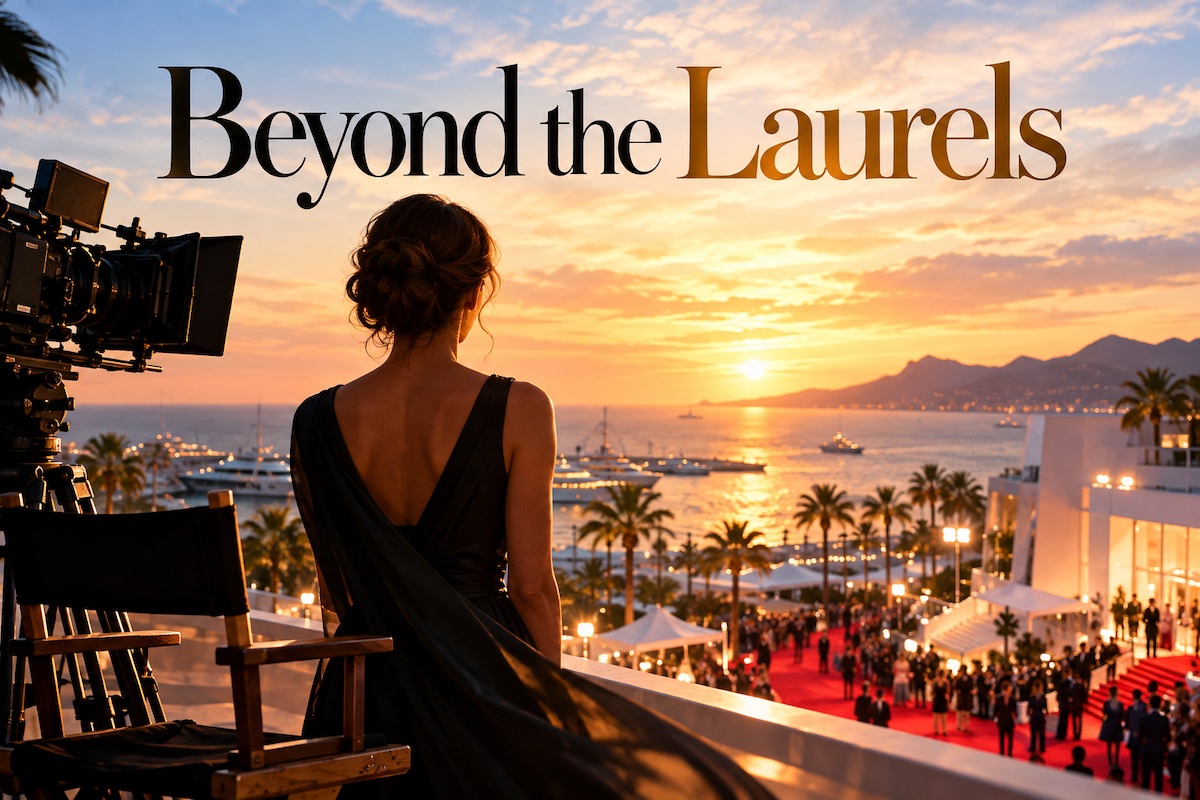
On the Côte d’Azur, EE Screen Festival is being built around a question increasingly
relevant to independent filmmakers: what happens after the applause?
For decades, the film festival has occupied an almost mythical place in the imagination of
independent filmmakers. It is where years of work can finally emerge from editing rooms and
private screenings into the public sphere; where an unknown director can suddenly find an
audience; where a producer can discover that a deeply personal project resonates far beyond the
people who helped make it. A selection can become validation, an award can provide credibility,
and the right screening can change the trajectory of a film.
Yet behind the photographs, laurels and awards ceremonies lies a less glamorous reality familiar
to filmmakers around the world. When the festival ends, the fundamental challenges facing an
independent production often remain remarkably unchanged. The film may still need
distribution. The producer may still be searching for international partners. The director may still
need representation or financing for a second feature. A screenplay may have accumulated
awards without ever reaching someone capable of putting it into production. Even a film warmly
received by an audience can return from the festival circuit without having established a
meaningful route toward the marketplace.
It is precisely this space between recognition and opportunity that EE Screen Festival intends
to address.
Launching on the Côte d’Azur from October 13–16, 2027, EE Screen Festival is positioning
itself not simply as another destination on an increasingly crowded international festival circuit,
but as part of a broader ecosystem connecting creative recognition with the professional world
filmmakers must ultimately navigate.
Its premise is both ambitious and refreshingly straightforward: if a festival identifies exceptional
work, its responsibility need not end when the award is presented.
When Recognition Becomes a Beginning
The international festival circuit remains one of cinema’s most important discovery mechanisms.
Festivals provide filmmakers with credibility, audiences with access to work they might
otherwise never encounter, and the industry with an opportunity to identify emerging voices
outside established commercial channels. For independent filmmakers in particular, the
significance of a selection can be considerable. It becomes part of the project’s history,
strengthens future conversations and can provide external validation after years spent developing
a film largely in isolation.
The difficulty is that recognition and professional advancement are not necessarily the same
thing.
A filmmaker can accumulate laurels without securing distribution. A screenwriter can win
competitions without finding a producer. An extraordinary performance can receive an award
while remaining virtually invisible to casting directors and production companies. Independent
cinema is filled with accomplished projects that were celebrated briefly and then struggled to
convert that attention into a meaningful next chapter.
EE Screen Festival has been conceived around a different interpretation of what a festival
relationship with filmmakers can become. Rather than viewing the awards ceremony as the
conclusion of that relationship, the festival is building mechanisms intended to extend selected
projects into a wider entertainment ecosystem.
Winners are expected to receive editorial exposure through EE Magazine and visibility through
the festival’s broader media network. Depending upon the project, its rights, commercial
potential and the opportunities available, selected filmmakers may also enter conversations
involving distribution, platforms, producers and other industry professionals. EE Vault, the
entertainment platform within the wider Empowering Entertainment ecosystem, creates another
potential avenue through which suitable work can continue reaching audiences.
None of this means that receiving an award automatically produces a distribution agreement,
financing commitment or production deal. Serious filmmakers understand that no credible
festival can promise such an outcome. What a festival can do, however, is create access,
visibility and carefully considered opportunities for discovery.
That distinction is important. The value lies not in promising filmmakers an outcome that cannot
responsibly be guaranteed, but in ensuring that exceptional work does not simply disappear once
the auditorium empties.
The Industry on the Other Side of the Screening Room
Perhaps the most consequential element of the EE Screen Festival model is the environment
being created around it.
The festival will take place during the same October dates as the EE Media Market on the Côte
d’Azur, creating proximity between the cultural celebration of filmmaking and the commercial
infrastructure responsible for moving projects through the international entertainment business.
For independent producers, those two worlds are inseparable.
Cinema may begin with imagination, but bringing that imagination to audiences requires an
extraordinary network of commercial relationships. Films need financing, sales, distribution,
marketing and increasingly sophisticated strategies for reaching fragmented global audiences.
Producers must understand territories, platforms, rights, incentives, co-production structures and
rapidly changing viewing habits. Emerging filmmakers must learn not only how to create
remarkable work, but how to position that work within an industry undergoing profound
transformation.
Traditionally, filmmakers often encounter these different parts of the business separately.
Festivals celebrate the finished work. Markets facilitate transactions. Conferences examine
industry change. Networking events attempt to create relationships between people who may
have very little time to discover whether they have anything meaningful to discuss.
Placing a festival beside an international market creates the possibility of a more fluid
relationship between those environments.
A film discovered during a screening can become the subject of a conversation elsewhere during
the week. A producer attending an industry session can encounter a filmmaker whose work
would otherwise never have crossed their desk. A sales professional, platform executive or
production company can discover projects not because they arrived through a conventional
submission pipeline, but because the work itself commanded attention.
For filmmakers, that proximity can be considerably more valuable than another photograph
holding a trophy.
A Festival Reflecting the Screen Industry as It Exists Now
EE Screen Festival is also arriving at a moment when the definition of screen entertainment is
expanding dramatically.
Feature films and traditional short films remain fundamental to festival culture, and they form an
important part of the festival’s competition. Documentary, animation, television and episodic
storytelling are represented as well, alongside categories recognizing acting, screenwriting and
emerging creative talent.
But the contemporary audience no longer experiences storytelling through a single format.
Vertical storytelling and microdrama have created new viewing behaviors and, in several
international markets, substantial new businesses. Artificial intelligence is beginning to influence
development, production and post-production while provoking legitimate creative, ethical and
legal debates throughout the industry. Independent animation continues to evolve as technology
makes sophisticated production accessible to smaller teams. Streaming has changed the
economics of distribution, while direct-to-audience platforms and community-driven
entertainment models continue challenging assumptions about how films are discovered and
monetized.
EE Screen Festival is making room for those emerging forms alongside traditional cinema.
That is more than a programming decision. It reflects an understanding that the filmmaker
arriving in 2027 may have a very different career from the filmmaker who entered the industry
twenty years earlier. A director may move between feature films, limited series, vertical
narratives and branded storytelling. An animator may operate a small independent studio capable
of producing work that once required significantly larger infrastructure. A writer may develop
intellectual property across books, games, film and episodic entertainment.
The boundaries are becoming increasingly porous.
A festival interested in the future of filmmakers must therefore be interested in the future of the
screen itself.
The Aurelia and the Meaning of an Award
At the symbolic center of EE Screen Festival is the Aurelia, its signature award.
Created as a platinum figure with open wings, the Aurelia is intended to represent elevation,
creative courage and the movement of a story beyond its creator and into the world. Its design
speaks to something fundamental about why awards continue to matter even in an industry
saturated with competitions and distinctions.
A meaningful award is not valuable because of the object alone. Its significance comes from
what the recognition communicates.
It says that someone stopped.
Someone watched.
Someone considered the work among countless competing stories and believed that it deserved
to be remembered.
For independent filmmakers, whose careers are often built through years of persistence before
substantial external validation arrives, that moment can be profoundly important. Recognition
provides confidence, but it also provides a language through which other people can begin
discovering the work.
The question is what happens next.
When recognition is connected to editorial visibility, industry discovery and continued
professional relationships, an award can become something larger than a ceremonial conclusion.
It can become a credential that travels with the filmmaker into the next conversation.
That philosophy sits at the heart of the Aurelia and, more broadly, the festival being built around
it.
From the Côte d’Azur to a Wider International Community
The choice of the Côte d’Azur carries its own significance.
Few regions are as deeply associated with the international mythology and business of cinema.
For generations, filmmakers, producers, financiers, distributors, actors and journalists have
converged on the French Riviera, making it one of the most recognizable meeting points between
film culture and the global entertainment industry.
EE Screen Festival enters that landscape with an international rather than exclusively regional
ambition.
Its categories are designed to welcome filmmakers working across countries, cultures, genres and
production models, including independent voices that may not yet have access to the traditional
gateways of the international business. Faith and family storytelling, social-impact cinema and
environmental work sit alongside mainstream narrative filmmaking, animation and emerging
technologies.
That breadth matters because the next important filmmaker does not necessarily emerge from an
established production center.
Extraordinary stories are being made everywhere.
The challenge has always been ensuring that they travel far enough to be discovered.
Cinema With an Impact Beyond Cinema
The festival’s philosophy also extends beyond the careers of participating filmmakers.
EE Screen Festival has committed 10% of its profits toward initiatives intended to create
measurable impact beyond the entertainment industry, with ocean preservation and marine life
forming a central part of that commitment alongside broader environmental and educational
objectives.
On the Côte d’Azur, the relationship with ocean preservation feels particularly relevant. The
Mediterranean is not merely scenery surrounding the event; it is part of the cultural and
environmental identity of the region.
The commitment also reflects a broader question confronting cultural organizations: if creative
industries generate economic and social value, how much of that value can be directed back
toward the world from which their stories emerge?
Cinema has always possessed the capacity to influence how audiences see people, places and
ideas. A festival can extend that influence beyond programming by deciding that part of its
economic success should support tangible causes outside its own walls.
For filmmakers increasingly interested in the values of the organizations with which they
associate their work, that philosophy may become another meaningful dimension of the festival
experience.
The Changing Calculation for Independent Filmmakers
There was a time when simply being selected by a festival could be enough to justify the cost of
submission, travel and promotion. Today’s independent filmmakers are increasingly
sophisticated about where they invest both their money and their attention.
They examine who attends. They look at what happens to previous winners. They consider
whether audiences are genuinely present, whether press opportunities exist and whether the
festival has meaningful relationships beyond its own organization. They ask whether the event
understands distribution and whether participating in it can contribute to the larger strategy
surrounding a film.
Those are reasonable questions.
Independent filmmaking is too difficult, too expensive and too demanding for filmmakers to treat
the festival circuit merely as a collection of decorative laurels.
The strongest festivals of the coming decade may therefore be those capable of preserving
everything that makes festivals culturally important—the communal experience of watching
films, the celebration of craft, the discovery of new voices and the emotional significance of
recognition—while simultaneously acknowledging that filmmakers need practical pathways
forward.
EE Screen Festival is being constructed around precisely that intersection.
The screenings matter because films deserve audiences. The awards matter because excellence
deserves recognition. The conversations matter because filmmaking has always been
collaborative.
But what happens afterward may matter most of all.
Beyond the Laurels
There is a particular moment at almost every film festival when the photographs have been
taken, the final conversations are winding down and filmmakers begin leaving with awards
tucked carefully into luggage.
For some, the festival will become a cherished memory.
For others, something unexpected will have happened.
Someone will have asked to read the next screenplay. A producer will have requested a meeting.
A distributor will have wanted to continue a conversation. A journalist will have discovered a
story worth covering. A filmmaker will have met the collaborator who changes the direction of a
project that does not yet exist.
Careers in entertainment are rarely transformed by a single grand gesture. More often, they
change through a succession of encounters whose significance becomes apparent only later.
That is why the question surrounding the future of film festivals is no longer simply whether they
can recognize extraordinary work.
It is whether they can help extraordinary work travel further.
For EE Screen Festival, that question is becoming the foundation of the event itself. On the Côte
d’Azur in October 2027, filmmakers will arrive carrying finished films, unfinished ambitions and
stories they have spent years fighting to tell.
Some will leave with an Aurelia.
The larger ambition is that they leave with something considerably harder to place on a shelf: a
genuine reason to believe the next chapter has already begun.
EE Screen Festival takes place October 13–16, 2027, on the Côte d’Azur, France.
eescreenfestival.com
