
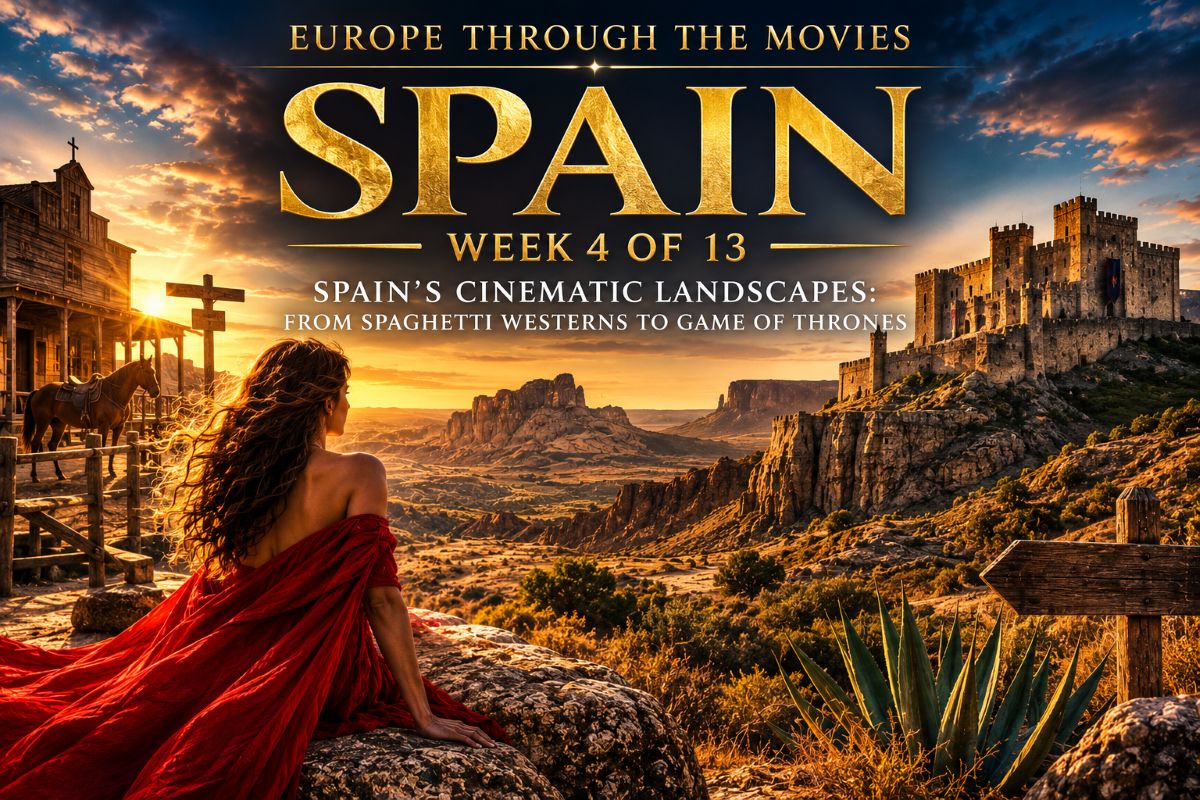
Spain has spent decades performing an extraordinary cinematic trick: becoming almost everywhere except itself. The most iconic filming locations in Spain have played the American West, North Africa, ancient kingdoms, futuristic worlds and entire fantasy continents, often so convincingly that audiences never realize they are looking at Spanish geography at all. The Tabernas Desert of Almería became one of the defining landscapes of the Spaghetti Western, allowing filmmakers such as Sergio Leone to construct a mythic version of the American frontier without leaving Europe; Seville’s monumental architecture has appeared in productions including Star Wars: Episode II – Attack of the Clones and Lawrence of Arabia; Girona, Cáceres and other historic cities were transformed into parts of Westeros for Game of Thrones; while San Juan de Gaztelugatxe on the Basque coast became one of the visual foundations for Dragonstone. Few European countries possess such range, and fewer still have allowed cinema to borrow so many contradictory identities without erasing the character of the real places underneath them.
The fascination of Spain film tourism lies precisely in this tension between recognition and disguise. A traveller can stand in the desert outside Almería and understand how European filmmakers reinvented the mythology of the American frontier, then move north into medieval cities whose stone streets required remarkably little alteration before becoming fictional kingdoms, or arrive in Seville and encounter architecture so visually complete that filmmakers have repeatedly chosen to transform it rather than rebuild something comparable on a soundstage. The country’s geography makes this versatility possible: deserts, Mediterranean coastline, volcanic terrain, Moorish palaces, Gothic cities, Renaissance squares, mountain ranges and Atlantic cliffs exist within a single national border, while the architectural record of Roman, Islamic, Christian and modern Spain creates layers of visual history that can be redirected toward almost any narrative. What audiences experience as cinematic invention is often, at its foundation, a carefully selected fragment of Spanish reality.
Following the most famous movie and television locations in Spain you can actually visit reveals how profoundly filmmakers depend upon places that already contain narrative power, beginning in Almería, where Leone discovered that landscape could create an entire genre mythology, before moving into Seville’s palaces and plazas, the medieval streets used by Game of Thrones, the Basque coastline that became Dragonstone, and the Spanish locations that have stood in for planets, deserts and vanished civilizations. Yet the deeper story is not simply that Spain is photogenic, because beautiful locations alone do not create enduring screen worlds; what matters is the country’s ability to become culturally legible in radically different ways, allowing filmmakers to strip away one identity and reveal another without ever fully neutralizing the geography underneath. To travel through cinematic Spain is therefore to witness one of location filmmaking’s most sophisticated acts: the transformation of a real country into a succession of imagined worlds that remain physically accessible long after the fiction has ended.

Unlock the Entire Empowering Entertainment Library
This article is only the beginning.
Become a member and enjoy unlimited access to every premium magazine article, expert interviews, in-depth features, practical guides, and a growing digital library of hundreds of books covering business, entrepreneurship, film production, personal growth, health, relationships, AI, ADHD, and much more.
One membership. Hundreds of resources. New content added every week.