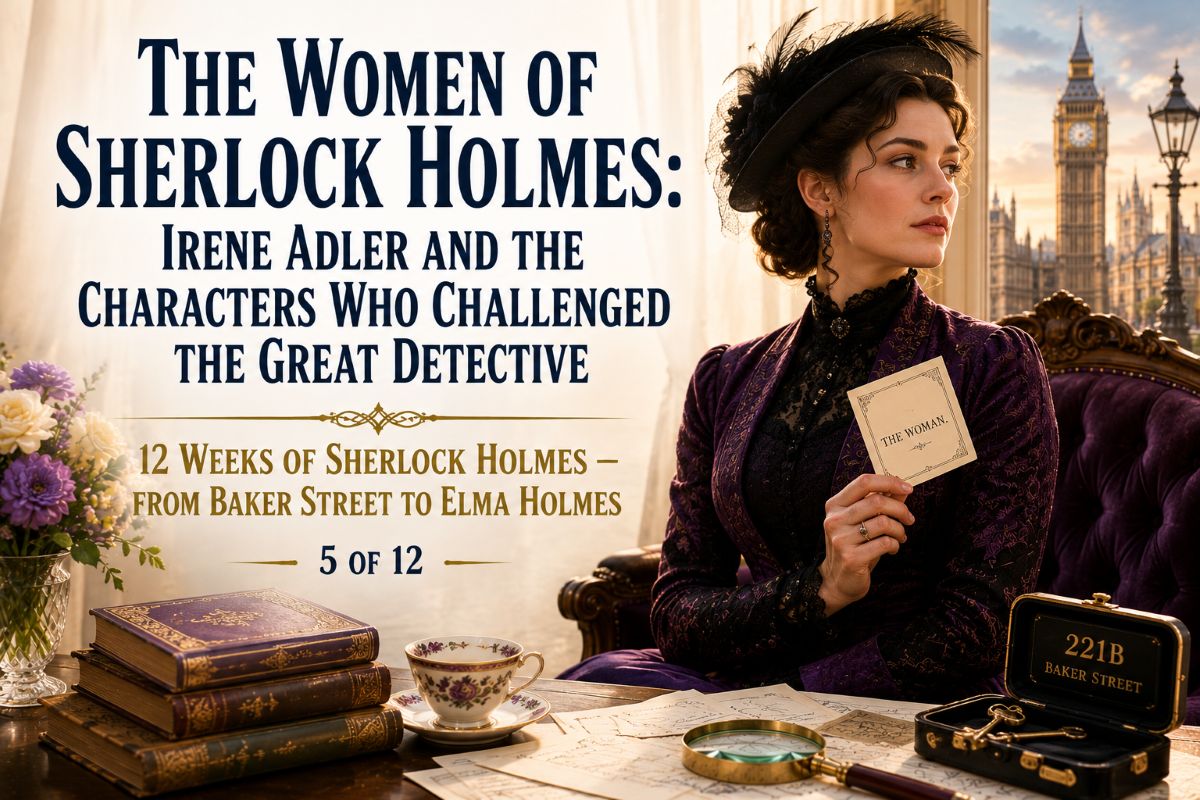
The women of Sherlock Holmes occupy a more complex place in Arthur Conan Doyle's detective universe than popular memory sometimes allows, because while the original stories emerged from the social assumptions of late Victorian and Edwardian Britain, several of their most memorable female characters resist the passive roles that period convention might seem to prescribe. No figure demonstrates this more powerfully than Irene Adler, the American opera singer introduced in A Scandal in Bohemia, whose cultural reputation has grown far beyond the limited space she occupies in the canon. Sherlock Holmes does not admire Adler because she becomes a romantic fantasy in the modern sense, nor because Conan Doyle constructs her as a sentimental exception to Holmes's emotional detachment; he remembers her because she defeats his assumptions, understands the danger surrounding her, anticipates his strategy and preserves control over her own future. In doing so, Irene Adler becomes one of the earliest and most enduring examples of a character who challenges Holmes not by matching his methods exactly, but by exposing the danger of believing that superior analytical intelligence necessarily produces superior understanding of another human being.
Get unlimited access to mystery movies and Sherlock Holmes books in the Vault at https://eevault.com. Also, read some of the greatest Sherlock Holmes mysteries here: https://www.empoweringentertainmentpublishing.com/books.
The larger question of women in the Sherlock Holmes stories extends well beyond Irene Adler, however, because Conan Doyle repeatedly places Holmes before women whose social position, vulnerability, intelligence, secrecy or determination complicate the moral landscape of the case. Victorian law and custom often restricted women's autonomy in matters of property, marriage, inheritance, sexuality and public reputation, meaning that many of the dangers faced by women in the Holmes canon arise not merely from individual villains but from the social structures surrounding them. A threatened inheritance, coercive marriage, concealed identity or compromised reputation can become life-altering because the society in which these women live makes their options narrow and their exposure costly. Holmes's investigations consequently reveal a world in which crime frequently exploits existing inequalities, while women who survive or resist those dangers must do so with forms of intelligence that are sometimes social, strategic and emotionally perceptive rather than forensic.
To examine Irene Adler and the other women who challenge Sherlock Holmes is therefore to examine more than gender representation within a famous detective series, because these characters reveal the limits of Holmes's own interpretive framework and expose tensions within the Victorian world that made his cases possible. We will explore why Irene Adler's victory matters, how Conan Doyle's portrayal differs from the romantic mythology later adaptations built around her, what characters such as Violet Hunter, Helen Stoner, Mary Morstan and other women reveal about agency and vulnerability, and why Holmes is sometimes most intellectually interesting when the obstacle before him is not insufficient evidence but an assumption he has failed to interrogate. The deeper significance of these women lies in the way they force the mythology outward, away from the fantasy of a man who can understand everything, and toward the more difficult truth that human beings are never reducible to the categories through which even the most brilliant observer first chooses to see them.

Unlock the Entire Empowering Entertainment Library
This article is only the beginning.
Become a member and enjoy unlimited access to every premium magazine article, expert interviews, in-depth features, practical guides, and a growing digital library of hundreds of books covering business, entrepreneurship, film production, personal growth, health, relationships, AI, ADHD, and much more.
One membership. Hundreds of resources. New content added every week.