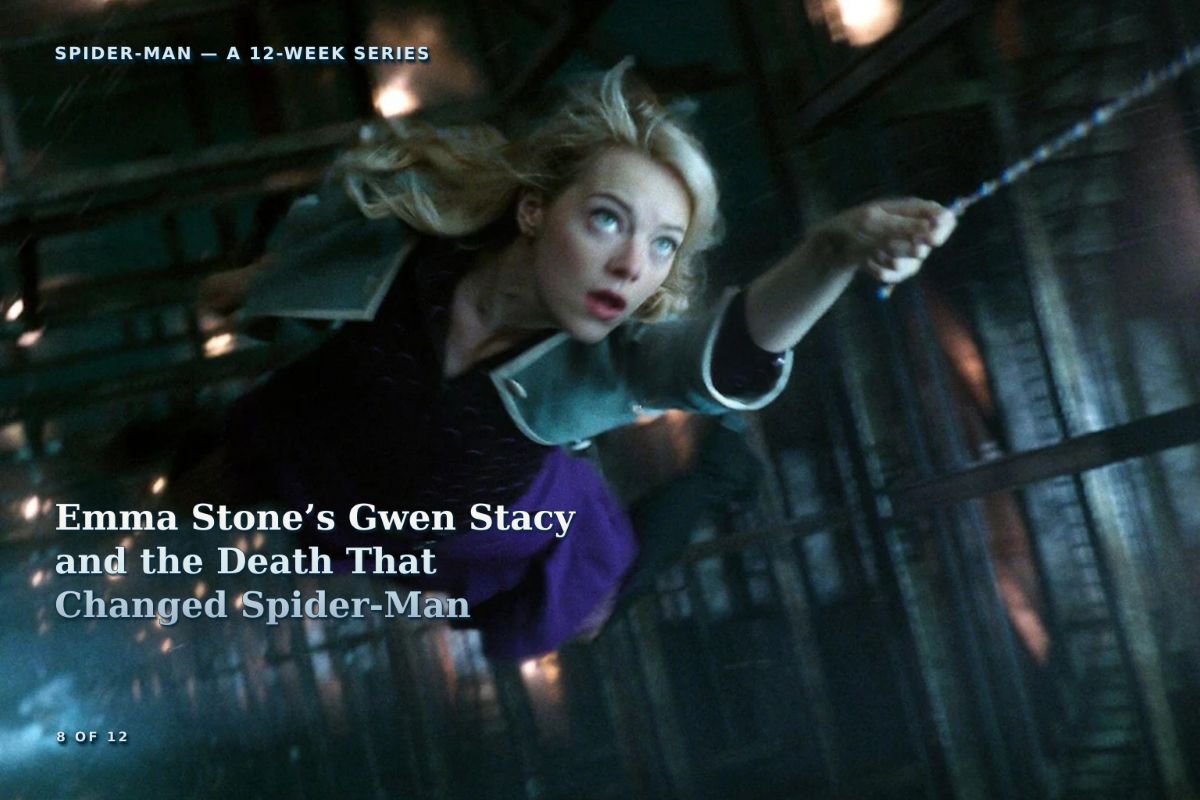
When Emma Stone’s Gwen Stacy fell through the collapsing clock tower during the final act of The Amazing Spider-Man 2, the moment carried a burden far greater than the conventional death of a superhero’s romantic partner. Audiences familiar with Marvel Comics knew that Gwen Stacy had occupied a singular place in Spider-Man history since her death in The Amazing Spider-Man No. 121 in 1973, an event widely regarded as one of the moments that ended the innocence of the Silver Age of comic books. Marc Webb’s 2014 film approached that legacy with deliberate visual forewarning: Gwen’s clothing recalled the comic-book imagery associated with her death, clocks repeatedly marked the fragility of borrowed time and Captain George Stacy’s spectral presence reminded Peter Parker that loving Gwen had become inseparable from the promise he made to stay away from her. Yet the power of the scene did not depend upon viewers recognizing those references, because Emma Stone and Andrew Garfield had created a relationship sufficiently intimate, intelligent and emotionally alive that Gwen’s death felt less like the fulfillment of mythology than the violent interruption of a future she had actively chosen.
Gwen Stacy was not important merely because Peter Parker loved her. She was a gifted scientist, an ambitious young woman preparing to leave New York for Oxford and one of the few people capable of understanding both the ordinary vulnerability of Peter and the extraordinary responsibility carried by Spider-Man. Her knowledge of his identity did not reduce her to a keeper of secrets; it allowed her to participate in the ethical and practical realities of his life, frequently recognizing solutions Peter could not reach alone. Where earlier superhero romances often positioned the woman as the protected civilian whose ignorance supposedly preserved her safety, Gwen challenged the paternalism concealed inside that protection. She understood the danger, refused to let Peter transform her father’s dying request into control over her future and insisted that accepting risk was part of her own moral agency. Her death is devastating precisely because the film gives her a meaningful life beyond Peter and then allows the dangers surrounding him to destroy a future that belonged to her.
The tragedy of Gwen Stacy therefore demands a deeper examination than the familiar question of whether Spider-Man’s web caught her too late. The analysis that follows explores how Emma Stone transformed Gwen into Peter Parker’s intellectual and emotional equal, why their romance felt unusually spontaneous within the superhero genre, how Captain Stacy’s final promise distorted Peter’s understanding of protection and why the clock tower became a visual machine of fate, time and impossible rescue. It also considers what happens psychologically when a hero’s greatest power cannot prevent the loss he has feared from the beginning, how Andrew Garfield’s performance converts physical stillness into unbearable grief and why his later rescue of another universe’s MJ in Spider-Man: No Way Home offers healing without rewriting the death that permanently altered his Peter Parker.

Unlock the Entire Empowering Entertainment Library
This article is only the beginning.
Become a member and enjoy unlimited access to every premium magazine article, expert interviews, in-depth features, practical guides, and a growing digital library of hundreds of books covering business, entrepreneurship, film production, personal growth, health, relationships, AI, ADHD, and much more.
One membership. Hundreds of resources. New content added every week.