




The U.S. Through the Movies: 13 Iconic Filming Locations You Can Actually Visit
Week 5 of 12
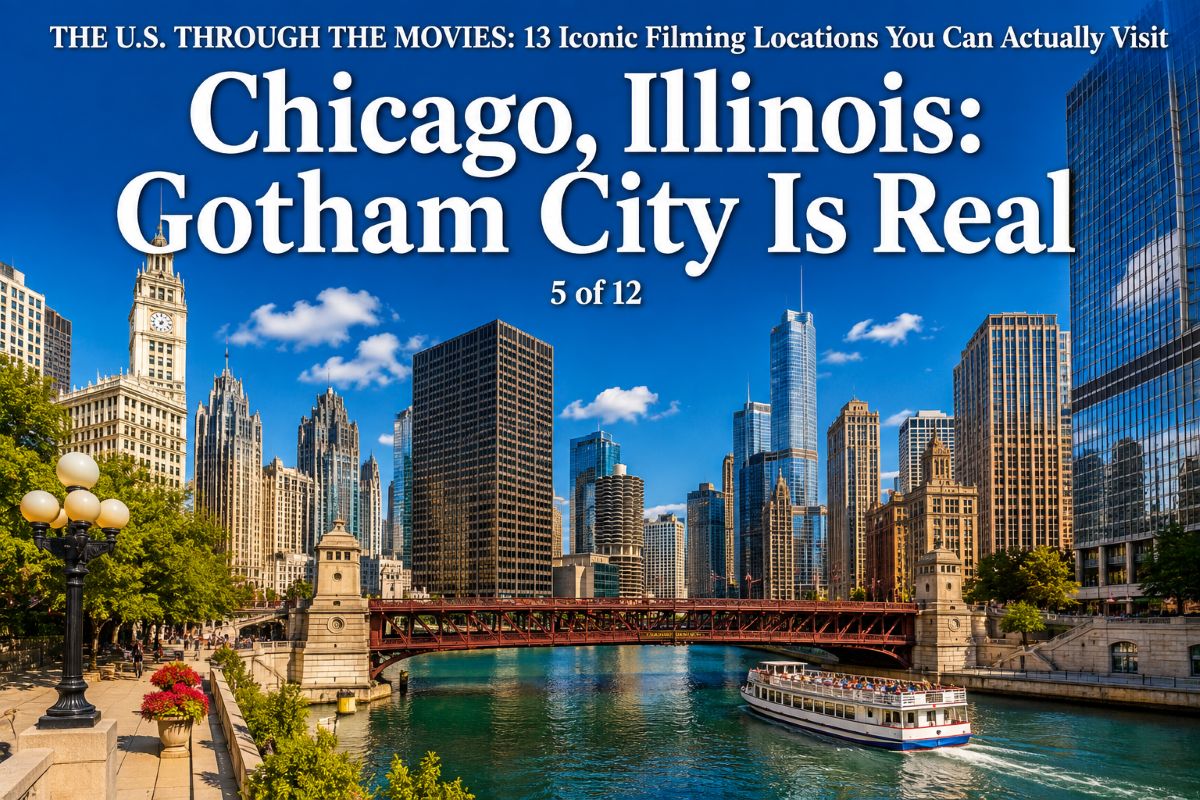
Chicago — When a Real City Became Gotham
Chicago possesses something that cannot be manufactured convincingly on a soundstage: architectural authority, the accumulated visual weight of a city whose towers, bridges, elevated railways, financial buildings, river corridors, monumental interiors and severe urban canyons appear to have been designed for stories about power long before cinema arrived to photograph them. That quality has allowed Chicago filming locations to inhabit remarkably different cinematic worlds without becoming anonymous scenery, from Christopher Nolan’s The Dark Knight, which transformed downtown Chicago into perhaps the most physically credible Gotham City ever placed on screen, to The Blues Brothers, which converted the city’s streets and highways into an enormous arena of musical rebellion and comic destruction; from Ferris Bueller’s Day Off, where Chicago becomes the landscape of adolescent freedom, to The Untouchables, where Union Station and the architecture of the city become instruments of moral confrontation and suspense; and finally to Home Alone, which moved beyond downtown into Chicago’s North Shore suburbs and turned an affluent family house into one of the most recognizable domestic spaces in modern movie history. Across these radically different films, Chicago does not merely accommodate storytelling but gives stories a physical structure against which characters can struggle, rebel, escape, protect, destroy or attempt to restore order.
The deeper reason Chicago has become one of the most important filming cities in American cinema lies in the unusual tension between permanence and instability embedded within its visual identity, because the architecture communicates order even when the narrative reveals disorder beneath it. Christopher Nolan understood that Gotham would become more disturbing if it looked like a city whose institutions ought to function, allowing the Joker’s assault on The Dark Knight’s social order to unfold among real banks, streets, tunnels and civic structures rather than within an obviously fantastical metropolis; John Hughes understood that Ferris Bueller’s escape from suburban routine would feel larger if he could temporarily possess the museums, stadiums, restaurants and streets of a sophisticated adult city; Brian De Palma understood that the monumental staircase of Chicago Union Station could transform a few seconds of physical movement into unbearable suspense; and John Landis understood that Jake and Elwood Blues would become funnier when their escalating contempt for authority collided with infrastructure designed to embody precisely the opposite principle. Chicago cinema repeatedly returns to the same fundamental relationship between the individual and the system, yet every film asks a different question about what happens when one human being confronts structures that appear larger, older and more powerful than themselves.
Following these iconic Chicago movie locations therefore becomes something considerably more revealing than locating where Batman drove, where Ferris spent his extraordinary day away from school, where Eliot Ness confronted violence, where the Blues Brothers unleashed chaos or where Kevin McCallister defended his home, because the real journey lies in understanding why Chicago made each of those stories stronger. We will descend beneath the visible city into Lower Wacker Drive and the urban underworld that helped Nolan make Gotham believable, examine how LaSalle Street and Chicago’s financial architecture gave The Dark Knight a language of institutional power, enter the Art Institute of Chicago to discover why one of Ferris Bueller’s Day Off’s quietest scenes contains the emotional center of the film, revisit the magnificent staircase of Union Station through De Palma’s construction of suspense, and travel north toward the suburban world of Home Alone, where the apparent security of the American family home becomes the foundation for a surprisingly sophisticated story about childhood independence, fear and belonging. What emerges is not simply a tour through Chicago film history, but a deeper examination of how architecture shapes psychology, how real places make fictional danger believable, and why a city capable of becoming Gotham never had to stop being Chicago in order to do it.
JOIN FOR FREE
Sign up to Hundreds of resources. New content added every week.
PLUS access to our MOVIE CHANNEL
One free account. Unlimited articles and movies. No credit card required.

Already a member? LOGIN HERE
