
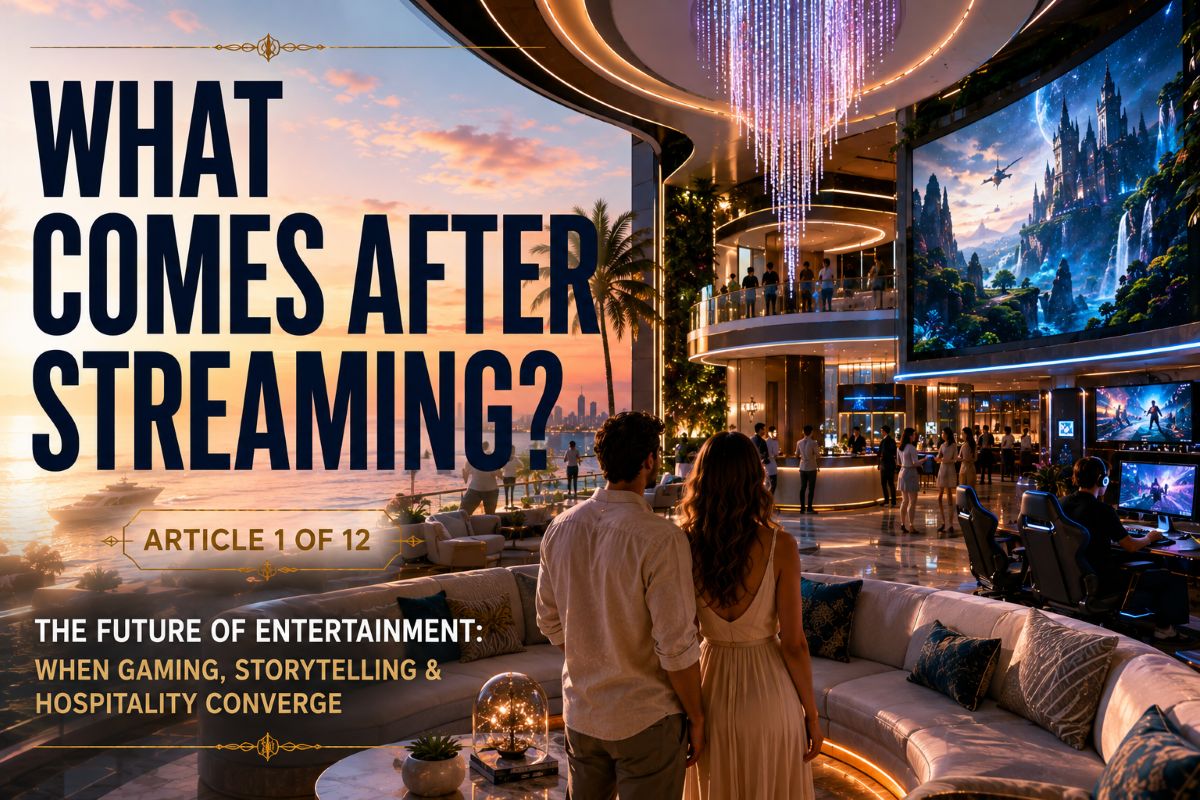
Why the Next Entertainment Platform May Be a Place
For decades, the word platform has increasingly referred to technological infrastructure: a television network capable of distributing programming into millions of homes, a streaming service capable of delivering enormous libraries on demand, a game console capable of supporting thousands of interactive worlds, or a social network capable of turning billions of individuals into simultaneous creators and consumers. This technological definition has become so dominant that the entertainment industry tends to assume the next major platform must also be digital, faster, more personalized and more sophisticated than whatever preceded it, yet there is no fundamental reason the next transformation of entertainment must happen primarily on another screen. A physical destination can also become a platform when it is capable of supporting multiple stories, characters, experiences, levels of participation and intellectual properties through a common infrastructure, particularly when that destination possesses something digital entertainment can simulate but never completely reproduce: the sensation of a human body actually occupying the world in which the story takes place.
Hotels and resorts become especially interesting when considered from this perspective because they already possess much of the infrastructure necessary for sustained participation rather than momentary entertainment. They have reservation systems capable of identifying individual guests, bedrooms that create private environments, restaurants and bars that provide social spaces, corridors and elevators that move people through architecture, event spaces capable of accommodating collective experiences, loyalty programs capable of remembering customers across visits, premium upgrades capable of monetizing exclusivity, and, perhaps most importantly, unusually long periods of access to the guest's attention. A cinema possesses an audience for approximately two hours, an escape room perhaps sixty minutes and many attractions for considerably less, whereas a hotel may possess the physical environment surrounding a guest for twenty-four hours a day across several consecutive days. What conventional hospitality generally lacks is not infrastructure but a narrative operating system capable of transforming those existing components from functional amenities into interconnected parts of an unfolding entertainment experience.
The opportunity becomes far more consequential when the strengths of entertainment industries that have traditionally developed separately are considered together, because film and television possess fictional universes but rarely provide permanent environments audiences can inhabit; gaming understands progression, choice, reward and consequence but usually confines those systems to digital worlds; role-playing understands identity and participatory storytelling but frequently operates at limited physical scale; and hospitality understands physical environments, service, guest movement and multi-day experiences but has historically treated entertainment as an amenity rather than the organizing principle of the stay. The convergence of these capabilities suggests something fundamentally different from a themed hotel or a resort containing games: a new entertainment platform in which movie IP provides mythology and world-building, gaming provides agency and progression, role-play provides identity, technology provides responsiveness, and hospitality provides physical reality, allowing the property itself to become the medium through which the story is experienced.

Unlock the Entire Empowering Entertainment Library
This article is only the beginning.
Become a member and enjoy unlimited access to every premium magazine article, expert interviews, in-depth features, practical guides, and a growing digital library of hundreds of books covering business, entrepreneurship, film production, personal growth, health, relationships, AI, ADHD, and much more.
One membership. Hundreds of resources. New content added every week.