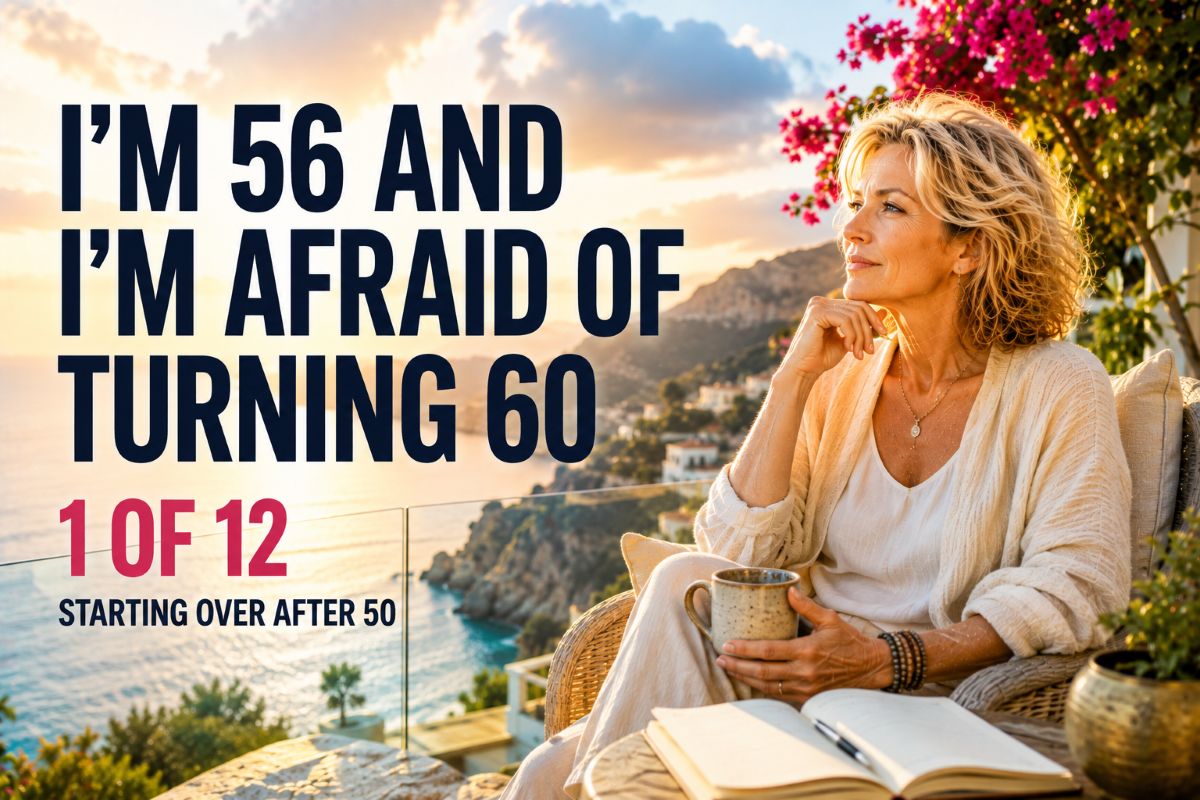
STARTING OVER AFTER 50
I'M 56 AND I'M AFRAID OF TURNING 60
When a Birthday Starts Feeling Like a Deadline
1 of 12
There is a particular kind of fear that can arrive in your fifties, and it has very little to do with vanity. It is not simply fear of wrinkles, grey hair, changing skin or the number printed on a birthday card; it is the unsettling realization that time has stopped feeling abstract. At 25, the future appears almost immeasurable, and even serious mistakes seem recoverable because there is an instinctive belief that life will offer another decade, another career, another relationship, another financial beginning. By 56, that same confidence can fracture. Turning 60 can begin to represent something much larger than entering a new decade: old age, physical decline, diminishing opportunity, the deaths of parents and grandparents, the memory of people we once considered elderly, and the frightening possibility that there may not be enough time left to build the life we still want. For anyone searching for how to start over at 50, how to reinvent yourself after 50, how to overcome fear of turning 60, or whether it is too late to change your life in your fifties, the deepest obstacle is often not practical at all. It is the private suspicion that the future may no longer be long enough to justify beginning again.
That fear becomes even more powerful when our personal history has quietly defined what 60 means. We do not encounter age as an objective number; we encounter it through memories. If the adults around us appeared old at 60, became ill in their early sixties, retired into increasingly narrow lives or died younger than we expected, those experiences can become an unconscious map of our own future. Long before we reach midlife, we may have absorbed an internal chronology in which 50 means the beginning of decline, 60 means old, 65 means danger, and everything beyond that feels almost theoretical. Then one day we discover that we are approaching the very ages that once seemed impossibly distant, and the arithmetic becomes mercilessly personal: if rebuilding a career takes five years, how old will I be when it succeeds; if I begin a business now, will I have enough years to enjoy what I create; if I finally become financially secure at 63, will I feel that I arrived too late; if I spend the next decade working toward a better life, will my body still be capable of living it? This is why starting over after 50 can feel so emotionally different from starting over earlier. The problem is not merely that time has passed; it is that we have become conscious of time passing.
Yet the question that matters most may not be whether 60 is old, whether 56 is too late to begin again, or even how many years remain, because none of those questions can offer the certainty we are really seeking. The more important question is what happens when we stop allowing an imagined future to consume the life that is already here. The rest of this article examines why the fear of turning 60 can become so psychologically powerful, how family history and cultural expectations distort our sense of what is still possible, why starting over in midlife triggers such brutal calculations about success, money, health and mortality, and how to replace the idea of 60 as an ending with a far more demanding perspective: that the years between now and then are not a waiting room, but part of the life we are afraid of losing.

Unlock the Entire Empowering Entertainment Library
This article is only the beginning.
Become a member and enjoy unlimited access to every premium magazine article, expert interviews, in-depth features, practical guides, and a growing digital library of hundreds of books covering business, entrepreneurship, film production, personal growth, health, relationships, AI, ADHD, and much more.
One membership. Hundreds of resources. New content added every week.