

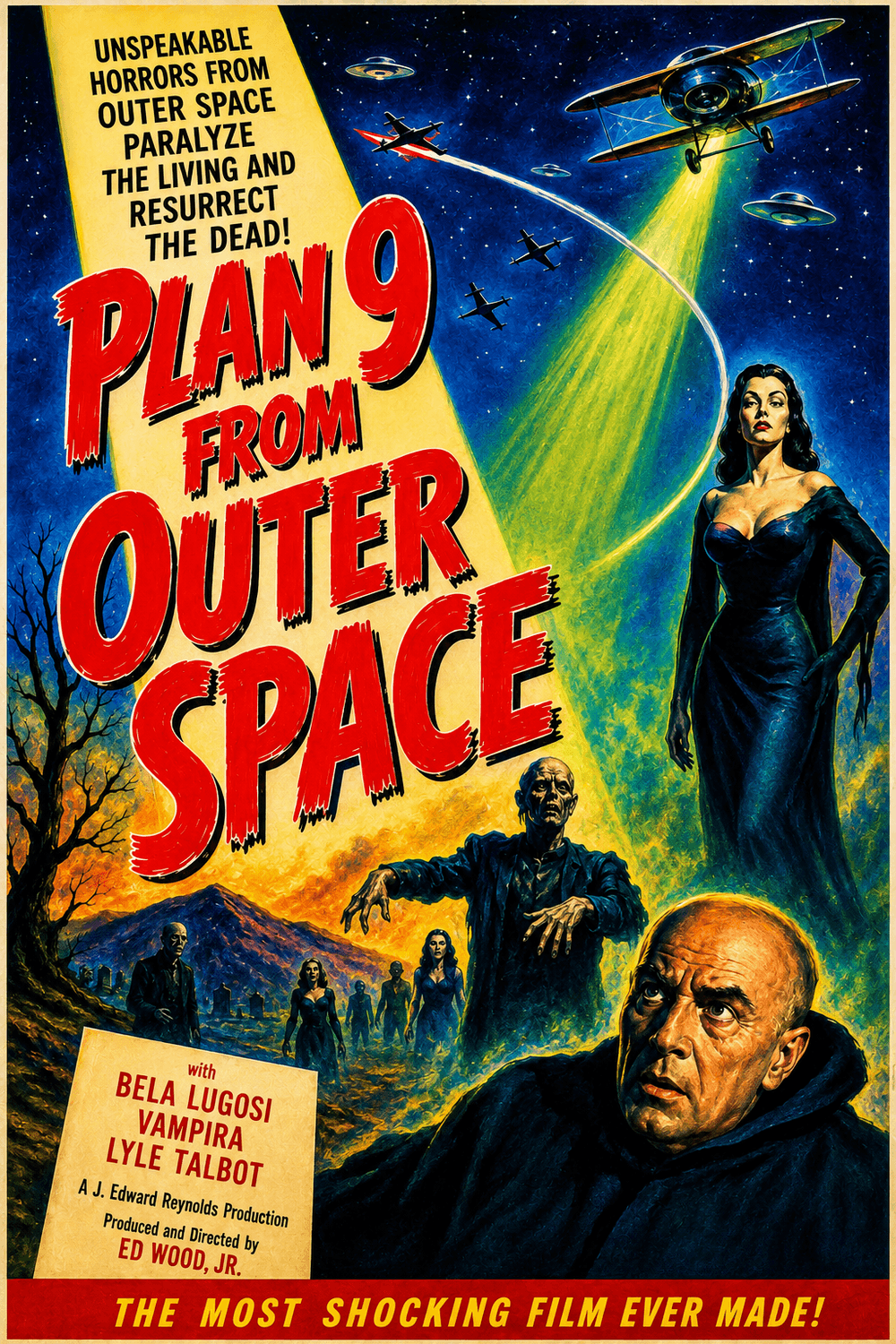
The Film That Refused to Disappear
Few movies have acquired a cultural identity as contradictory as Plan 9 from Outer Space. Released in 1959 after an earlier preview under the working title Grave Robbers from Outer Space, Ed Wood’s science-fiction horror film became famous not because it achieved technical perfection, critical prestige, or commercial dominance, but because its visible limitations eventually became inseparable from its charm. The unstable sets, shifting continuity, recycled footage, uncertain performances, artificial flying saucers, and solemn dialogue have been discussed so frequently that the film is often approached as a collection of mistakes before it is approached as a story. Yet its survival across generations cannot be explained by failure alone, because countless poorly made films have disappeared without leaving a trace. Plan 9 from Outer Space endured because beneath its awkward execution lies an unmistakable force of conviction: the film believes completely in its own warning about human arrogance, technological destruction, and the catastrophic consequences of refusing to listen. The American Film Institute identifies Edward D. Wood Jr. as the film’s writer, producer, and director, while also documenting the unusual production history that helped transform the movie into one of the most recognizable cult objects in American cinema. (AFI Catalog)
The movie’s reputation as one of the worst films ever made has become so dominant that it can obscure the deeper question of why audiences continue returning to it. Technical incompetence can provoke laughter, but laughter alone rarely generates lasting affection. Viewers remember Plan 9 because its flaws are not cynical. The film does not appear contemptuous of its audience, embarrassed by its subject, or detached from its own ambitions. It reaches earnestly toward cosmic tragedy, planetary danger, supernatural horror, military paranoia, and moral indictment, even when its resources cannot support the scale of those ambitions. That distance between intention and execution creates a peculiar emotional experience in which the audience sees both the film Wood wanted to make and the fragile production he was actually able to assemble.
The result is neither conventional success nor ordinary failure. It is a work whose limitations remain visible at every level, yet whose personality survives those limitations so completely that polished imitation could never reproduce it. The film’s immortality therefore begins with a paradox: it is remembered because it failed openly, but it is loved because it never stopped trying.
A Cosmic Warning Delivered Through a Cemetery
The story begins with the death of an elderly woman and the grief of her husband, setting the action within a cemetery before the arrival of extraterrestrial forces expands the crisis beyond ordinary mortality. Aliens have come to Earth after repeated attempts to contact humanity have been ignored, and they initiate Plan 9, a strategy involving the resurrection of recently deceased bodies. Their objective is not simply to conquer the planet through an army of the dead. They intend to force human authorities to acknowledge them before Earth scientists develop a weapon capable of destroying the universe.
This premise contains more seriousness than the film’s reputation often allows. The aliens are not invaders motivated primarily by greed, hunger, or territorial expansion. They consider themselves reluctant interventionists confronting a civilization whose scientific power has developed more rapidly than its wisdom. Humanity has acquired the ability to manipulate increasingly destructive forces while remaining politically divided, militarily aggressive, and dismissive of warnings that challenge its sense of superiority.
The resurrected dead therefore function as evidence rather than as the aliens’ ultimate objective. They are meant to create a phenomenon so undeniable that governments can no longer conceal extraterrestrial contact or dismiss alien communication. The plan is grotesque, but its underlying logic reflects desperation: if reasoned warnings fail, terror may succeed in forcing recognition.
The cemetery becomes the ideal location for this intervention because it already represents the boundary between human confidence and human limitation. Civilization can build cities, weapons, aircraft, institutions, and scientific theories, but every individual eventually enters the ground. By raising the dead, the aliens violate the one boundary humanity considers irreversible, transforming mortality into a demonstration of superior power.
Plan 9 and the Logic of Escalation
The title suggests that eight earlier plans have already failed, although the film provides little detail about them. This missing history unintentionally gives the aliens’ decision greater weight because Plan 9 appears to be the final stage of an escalating effort. They have attempted communication and received denial, secrecy, or hostility, leading them toward a method that cannot be ignored.
Escalation is central to the film’s moral structure. The aliens believe they are responding to human irresponsibility, yet their response involves controlling corpses, killing innocent people, and creating widespread fear. They condemn humanity for using destructive power without sufficient moral maturity while demonstrating the same willingness to justify violence through a supposedly superior objective.
This contradiction makes the extraterrestrials more interesting than simple messengers of wisdom. Their critique of humanity contains truth, but truth does not protect them from hypocrisy. They claim to defend the universe, yet they treat individual human lives as expendable. They object to Earth’s arrogance while speaking with absolute certainty about their own authority to intervene.
The film therefore creates an unstable conflict in which neither side possesses complete moral legitimacy. Humanity refuses to listen because its institutions are secretive, defensive, and convinced of their own importance, while the aliens abandon persuasion and embrace coercion because they believe their superior knowledge excuses their methods. The catastrophe emerges not from one purely evil force but from two systems certain that the other is incapable of reason.
Human Intelligence Without Human Wisdom
The aliens’ greatest fear is the development of a device described as the solaronite bomb, a weapon that could ignite sunlight particles and produce a chain reaction capable of destroying the universe. The scientific explanation is fantastical, but its symbolic meaning is clear. Humanity is approaching a threshold at which local aggression could create consequences far beyond the planet.
The idea reflects the anxieties of the atomic age. By the late 1950s, audiences were living under the reality of nuclear weapons, Cold War confrontation, military secrecy, and the possibility that scientific achievement might eliminate the civilization that produced it. Plan 9 from Outer Space translates those fears into exaggerated cosmic terms, imagining humanity not merely as a danger to itself but as a danger to existence.
The film repeatedly separates intelligence from wisdom. Human beings are capable of technological discovery, yet they remain emotionally immature, politically suspicious, and resistant to humiliation. The aliens do not fear that Earth scientists are unintelligent. They fear that intelligence has developed without an equivalent expansion of responsibility.
This distinction remains one of the film’s most valuable ideas. Knowledge can increase the range of possible action without improving the judgment governing that action. A civilization may become more powerful while remaining morally primitive, and the danger grows precisely because advanced tools amplify unresolved impulses toward domination, retaliation, and control.
The film expresses this argument awkwardly, but awkward expression does not erase conceptual importance. Beneath the flying saucers and resurrected corpses lies a warning that remains permanently relevant: technical progress cannot save a species whose emotional and political development fails to keep pace.
The Aliens and the Wound of Being Ignored
The alien commander Eros speaks with intense resentment about humanity’s refusal to acknowledge extraterrestrial contact. His anger is not merely strategic. It is personal. He experiences human disbelief as an insult and interprets Earth’s resistance as evidence of stupidity, arrogance, and moral inferiority.
This emotional dimension complicates his supposedly rational mission. Eros claims to act on behalf of universal safety, yet his speeches repeatedly reveal wounded pride. He does not simply want humanity to stop developing destructive weapons. He wants humanity to admit that he was right.
The need for recognition becomes increasingly dangerous when combined with superior power. A person or institution convinced of its own truth may initially seek understanding, but repeated dismissal can transform communication into punishment. The goal shifts from preventing harm to forcing acknowledgment, and the audience being addressed becomes less important than the speaker’s need to defeat resistance.
Eros therefore represents a familiar psychological pattern in exaggerated form. He possesses a legitimate concern, but his attachment to being recognized corrupts his ability to pursue that concern ethically. He becomes so invested in proving humanity foolish that he begins behaving in ways that confirm humanity’s fear of him.
The tragedy is that both sides participate in the same cycle. Earth authorities conceal and deny because they fear panic and loss of control, while the aliens escalate because concealment and denial make them feel powerless. Each side interprets the other’s defensive behavior as justification for greater aggression.
The Resurrected Dead as Instruments
The undead figures in Plan 9 from Outer Space differ significantly from the autonomous zombies who would later dominate horror cinema. They do not spread infection, act from hunger, or gather into uncontrolled hordes. They are remotely directed biological weapons, revived by alien technology and deployed to frighten, kill, and prove extraterrestrial superiority.
This arrangement places the film closer to the controlled zombies of White Zombie than to the later creatures of Night of the Living Dead. In both cases, the horror lies partly in the reduction of the human body to an instrument after personal will has disappeared. The dead no longer belong to themselves, their families, or even the natural process of decay. They belong to whoever possesses the power to activate them.
The aliens treat these bodies as strategic resources. Their previous identities matter only because recognizable corpses intensify fear among the living. A stranger raised from the grave would be disturbing, but a spouse, police inspector, or familiar community member returned as an obedient killer turns grief into vulnerability.
The revived bodies therefore weaponize memory. The living cannot confront them as anonymous monsters because their appearance preserves traces of relationship. Death has already inflicted loss, yet resurrection corrupts mourning by transforming the person remembered into a tool of violence.
The film never explores this emotional violation deeply, but the premise remains powerful. To control the dead is not merely to violate nature. It is to appropriate the emotional bonds that continue after death and use those bonds against the people who survive.
Bela Lugosi and the Presence of Absence
Bela Lugosi appears in Plan 9 from Outer Space through silent footage filmed before the main production, including images of him leaving a house, walking near a cemetery, and mourning beside a grave. Lugosi died in August 1956, before the movie was completed, and Ed Wood incorporated the existing material into the later production. AFI notes that footage shot of Lugosi in 1956 was ultimately used in the film, creating what became his final screen appearance in an Ed Wood project. (AFI Catalog)
The footage carries a strange emotional quality because Lugosi’s presence is both real and incomplete. He appears unmistakably as the legendary actor associated with Dracula, yet he never interacts directly with the principal cast or participates in the completed narrative as a continuous performer. His images belong to an earlier moment, inserted into a film constructed after his death.
This fragmentation unintentionally strengthens the movie’s themes. Lugosi appears as a man mourning the dead before becoming one of the dead, while the production itself resurrects his image and places it under another person’s control. In narrative terms, the aliens manipulate his corpse. In cinematic terms, Wood manipulates the remaining footage.
The parallel is uncomfortable but deeply fascinating. Film has always possessed the power to preserve appearances after death, allowing gestures, voices, and faces to continue moving before audiences long after the performer has disappeared. Plan 9 makes that power unusually visible because the seams cannot be hidden.
Lugosi’s screen presence becomes a ghost created by editing. He remains part of the movie, yet the viewer can feel the absence surrounding him. The film therefore preserves not simply a final performance but a record of Wood’s refusal to let his collaborator vanish completely.
The Double Who Cannot Become the Original
Because Lugosi’s footage was insufficient to complete the story, Wood hired Thomas R. Mason, a chiropractor and hypnotist, to serve as a double. Mason did not closely resemble Lugosi and concealed much of his face behind a cape while performing the resurrected character. TCM documents Mason’s unusual involvement and the production decision that allowed Wood to continue using the character after Lugosi’s death. (Turner Classic Movies)
The substitution has become one of the film’s most frequently mocked elements, yet it also produces an accidental meditation on identity. The audience is asked to accept two visibly different bodies as the same person because costume, posture, editing, and narrative instruction insist upon continuity.
Cinema regularly creates such illusions, but successful productions hide the mechanisms more effectively. Stunt performers, body doubles, stand-ins, and editing techniques frequently replace one physical presence with another. Plan 9 does not invent the substitution; it merely fails to conceal it.
That failure exposes the agreement between film and audience. Movies depend upon viewers accepting discontinuous fragments as continuous reality. A scene may be assembled across different days, locations, performances, and camera positions, yet editing asks the mind to transform those fragments into a single event.
Mason’s cape becomes an inadequate but sincere attempt to preserve that agreement. The concealment does not convince the viewer, yet the effort reveals Wood’s determination to finish the story he had imagined. The visible mismatch therefore becomes both technical weakness and evidence of loyalty to the original conception.
Tor Johnson and the Tragedy of Physical Transformation
Tor Johnson plays Inspector Daniel Clay, a police officer killed in the cemetery and later resurrected by the aliens. Johnson’s massive body, slow movements, and expressionless face give the character immediate visual power, turning him into one of the film’s most memorable figures.
Before his death, Clay represents ordinary authority. He investigates the cemetery disturbances through familiar police procedures, carrying a flashlight and weapon into a situation he cannot understand. After resurrection, those signs of institutional identity disappear. He becomes a body governed by external command.
The transformation is frightening because physical strength remains while judgment has vanished. Clay’s body once supported a social role, personal history, and responsibility to protect others. The aliens preserve the strength but remove everything that directed it ethically.
Tor Johnson’s performance is often reduced to lumbering movement, yet that movement serves the film’s concept effectively. The resurrected inspector appears heavy, mechanical, and disconnected from intention. His size, once associated with authority, becomes threatening because it has been emptied of restraint.
The character therefore illustrates a broader fear: power without consciousness. Strength becomes dangerous when separated from judgment, just as technology becomes dangerous when separated from wisdom. Clay’s resurrected body is a smaller version of the human civilization the aliens condemn—capable of force, deprived of moral direction, and controlled by whoever commands the mechanism.
Vampira and the Image of Silent Death
Maila Nurmi, known through her television persona Vampira, appears as the resurrected wife of Lugosi’s character. She moves silently through the cemetery in a black dress, extending her arms and approaching victims with a controlled, dreamlike rhythm.
Her lack of dialogue gives the performance a ceremonial quality. She is less a conventional character than an image of death given movement. The visual design draws upon Gothic femininity, the seductive vampire tradition, and the cultural power of the television horror hostess, yet the film removes the wit and personality associated with Nurmi’s public persona.
This reduction mirrors the condition of zombification. The recognizable image remains, but the individual voice has disappeared. Vampira is visually present while psychologically inaccessible, making her another figure through whom the film converts personality into surface.
Her scenes also demonstrate Wood’s instinct for iconic imagery. The production may lack convincing realism, but the image of a pale woman in black moving through a cemetery possesses immediate visual clarity. It can be understood at a glance, which helps explain why still photographs from the film remain so recognizable.
Wood’s strengths were not always located where conventional filmmaking demanded them. He struggled with continuity, pacing, dialogue, and technical polish, yet he understood the emotional power of a silhouette, a graveyard, a flying saucer, or a face emerging from darkness. The film survives partly because its images are stronger than its construction.
Criswell and the Authority of Prediction
The film opens with Criswell addressing the audience directly, inviting viewers to consider future events that may affect them. Known publicly for unusual predictions, Criswell brings a form of television authority into the film, presenting the story as though it were both entertainment and warning. AFI records Plan 9 from Outer Space as his feature-film debut and notes his established reputation for eccentric forecasting. (AFI Catalog)
His introduction immediately destabilizes the boundary between fiction and testimony. Rather than beginning within the story, the film begins with a man speaking directly to the audience about truth, future events, and the importance of belief. This framing attempts to give the movie the weight of a prophetic document.
The effect is theatrical and often unintentionally comic, yet the structure supports the film’s central theme. The entire plot concerns warnings ignored by people who believe themselves too sophisticated to listen. Criswell places the audience in the same position as the governments within the story: confronted by an extraordinary claim and asked whether disbelief is rational skepticism or dangerous arrogance.
His presence also reflects Ed Wood’s attraction to marginal performers, television personalities, wrestlers, nightclub figures, and people existing outside the conventional Hollywood system. Wood assembled a cast from the cultural edges, allowing personalities with their own public histories to enter his fictional world.
This approach contributes to the film’s unusual texture. The actors do not disappear completely into their characters because many carry visible identities from other forms of entertainment. The movie becomes a meeting place for fragments of mid-century popular culture, assembled through Wood’s conviction that they belonged together.
Dialogue That Reaches Beyond Its Capacity
The dialogue in Plan 9 from Outer Space is famous for its circular reasoning, unusual phrasing, solemn repetition, and attempts to explain ideas that become less clear as the explanations continue. Characters speak with absolute seriousness about flying saucers, government secrecy, universal destruction, and humanity’s inability to admit its own stupidity.
These speeches frequently provoke laughter because their emotional weight exceeds the language’s precision. The actors appear to be announcing profound truths, yet the sentences often twist awkwardly around the ideas they are meant to express. The gap between delivery and meaning becomes comic.
Yet the dialogue also reveals Wood’s extraordinary ambition. He was not trying to create a minimal creature feature in which monsters attack and heroes respond. He wanted characters to debate the moral purpose of science, the danger of pride, the failure of government, and the responsibility of intelligent life.
The writing fails conventional standards of naturalism, but naturalism may not have been Wood’s primary objective. His characters speak like participants in a cosmic morality play, where every conversation must carry the weight of universal consequence. The result resembles pulp philosophy delivered with theatrical gravity.
This explains why the dialogue remains memorable. Perfectly functional lines often disappear from memory because they perform their purpose without revealing the person who wrote them. Wood’s lines remain visible because they bear the pressure of his intention. They are flawed, but they are unmistakably his.
The Flying Saucers and the Beauty of Visible Artifice
The film’s flying saucers have become symbols of inexpensive special effects, often described as small models suspended against artificial backgrounds. AFI notes that the visibly crude spacecraft and other production limitations contributed significantly to the movie’s later reputation. (AFI Catalog)
Modern viewers can easily see the illusion. The movement lacks realistic weight, the scale remains uncertain, and the surrounding images do not create a convincing sense of physical integration. Yet the saucers possess a directness that highly polished effects sometimes lose.
They are immediately legible as symbols. The viewer sees the circular shape, understands the intended movement, and enters the story without needing to believe the image is photographically real. The effect resembles a child holding a model above a painted landscape while narrating an invasion with complete conviction.
This visible artifice creates a different relationship between film and audience. Instead of hiding the act of construction, the movie places imagination and material limitation side by side. The viewer must contribute more actively, supplying scale, danger, movement, and cosmic significance that the image cannot fully provide.
The pleasure comes not from being deceived but from participating in the attempt. The saucers become charming because they preserve the handmade quality of independent filmmaking, where objects are asked to become more than their materials should allow.
Day Becoming Night and the Collapse of Continuity
Among the film’s most obvious technical inconsistencies are scenes that shift between daylight and darkness even though the action is supposedly continuous. Characters may enter a cemetery at night and appear moments later in visibly different lighting, while interiors and exteriors seem to belong to incompatible times and locations.
Continuity ordinarily protects the audience’s sense that events occupy a stable world. Lighting, geography, costume, performance, and screen direction work together to conceal production fragmentation. When those elements fail, the viewer becomes aware that the scene has been assembled from separate pieces.
In Plan 9, this awareness becomes part of the experience. The film constantly reveals its own construction, making the audience alternate between following the story and observing how the story was manufactured.
This should weaken immersion, yet it creates another form of engagement. Viewers begin anticipating inconsistencies, noticing recycled footage, studying sets, and participating in the movie as an object rather than simply as a narrative.
The film therefore produces a communal style of viewing. Audiences laugh, comment, point, quote, and compare discoveries because the exposed construction invites collective attention. The movie becomes social not despite its flaws but through them.
The Cemetery as a Theater Set
The cemetery contains artificial graves, sparse vegetation, theatrical fog, and backgrounds that rarely create the impression of an expansive outdoor location. Yet this artificiality gives the film a dreamlike visual unity.
The graves do not resemble real stone monuments embedded in earth. They resemble symbols of graves arranged for immediate recognition. The trees, shadows, and fog perform the idea of a cemetery rather than reproducing one naturalistically.
This stylization connects the film to stage melodrama and early cinematic horror, where atmosphere often depended upon painted scenery, exaggerated lighting, and iconic objects. The viewer is not asked to believe that the cemetery exists geographically. The viewer is asked to accept it as the domain of death.
The set therefore succeeds symbolically even when it fails realistically. It provides a space where mourning, resurrection, alien control, police investigation, and supernatural threat can converge.
Wood’s cinema repeatedly operates through such symbolic compression. A few chairs become a military office, a curtain becomes a spacecraft interior, and a small section of ground becomes a cemetery containing multiple deaths. His filmmaking depends upon the audience recognizing intention before examining execution.
Government Secrecy and the Fear of Public Knowledge
Military and government officials within the film are aware of flying-saucer activity but attempt to limit public understanding. Their secrecy reflects a familiar assumption that institutions must control information in order to prevent panic, preserve authority, or maintain strategic advantage.
The aliens interpret this concealment as another example of human arrogance. They have attempted contact, yet governments convert contact into classified information rather than shared planetary knowledge. This ensures that humanity cannot respond collectively because most people are denied the facts required to understand the danger.
The film’s suspicion of secrecy reflects the broader atmosphere of the 1950s, when Cold War politics, military technology, atomic research, and reported UFO sightings contributed to public anxiety about what governments knew and refused to disclose. Plan 9 turns that anxiety into a cosmic accusation: authorities may be concealing not only evidence of extraterrestrial life but warnings essential to survival.
The institutional problem is not merely dishonesty. It is the belief that public knowledge belongs to those in power rather than to the people affected by it. Officials assume that control of information produces safety, yet secrecy prevents scrutiny, delays cooperation, and strengthens mistrust.
The aliens exploit this weakness by designing a plan whose effects can no longer be contained. The resurrected dead are not only weapons. They are publicity. Their purpose is to create visible consequences that secrecy cannot absorb.
The Impossible Moral Superiority of Eros
Eros delivers the film’s central condemnation of humanity, accusing Earth’s inhabitants of developing dangerous weapons while lacking the wisdom to use them responsibly. His argument contains the movie’s clearest moral truth, yet his behavior repeatedly undermines it.
He insults the humans, kills those who interfere, manipulates the dead, and threatens the planet in the name of preventing greater destruction. His certainty that the end justifies the means places him within the same logic he condemns.
This contradiction may not have been fully intentional, but it enriches the film. Eros becomes an example of how moral certainty can reproduce the behavior it claims to oppose. He believes his superior knowledge exempts him from the rules he applies to humanity.
The human characters respond defensively because his contempt makes listening almost impossible. Even a valid warning can fail when delivered through humiliation. Eros wants humanity to become wiser, yet he communicates in a way designed to establish inferiority rather than invite transformation.
The conflict therefore demonstrates that truth and persuasion are not identical. Possessing the stronger argument does not guarantee the ability to reach another person, particularly when the argument has become entangled with contempt.
Eros fails because he wants submission more than understanding. Humanity fails because it interprets challenge as attack. Between them, the possibility of dialogue collapses.
The Solaronite Bomb as a Symbol of Ultimate Consequence
The solaronite bomb is described as a weapon capable of exploding sunlight particles and triggering universal destruction. Its pseudo-scientific explanation may be implausible, but the concept gives the film enormous symbolic scale.
Human beings are imagined as children playing with forces whose consequences they cannot comprehend. The danger does not arise because scientists deliberately want to destroy the universe. It arises because discovery can outrun foresight.
The weapon represents the final stage of technological disconnection. A tool originally developed within national competition could create effects beyond borders, planets, and species. Local motives become cosmically irrelevant once the chain reaction begins.
This idea transforms the aliens’ concern from self-interest into existential fear. They are not simply protecting themselves from invasion. They believe Earth’s scientific recklessness could eliminate every civilization.
The film therefore asks whether technological sovereignty can remain legitimate when consequences become universal. Does one species possess the right to experiment with forces capable of destroying others who had no role in the decision?
The question remains serious even though the fictional mechanism is absurd. Modern technology repeatedly creates consequences that cross national boundaries, generations, ecosystems, and populations. Plan 9 expresses this problem through pulp science fiction, but the underlying ethical challenge is real.
Ed Wood and the Courage of Unprotected Ambition
Ed Wood’s reputation has often been constructed around incompetence, yet that description is incomplete. He possessed very limited financial resources, worked outside the major studio system, assembled unconventional performers, and attempted stories whose scale exceeded almost every practical element available to him.
What distinguishes Wood is not that he failed to recognize ambition. It is that he refused to protect himself from it. Many filmmakers reduce their ideas to fit their means, conceal weakness through minimalism, or avoid subjects requiring effects they cannot afford. Wood attempted alien spacecraft, global military response, resurrection, cosmic philosophy, and planetary catastrophe anyway.
This refusal created obvious flaws, but it also created personality. The film never feels like a calculated product designed through market research or institutional caution. It feels like the direct projection of one person’s imaginative world through materials too fragile to contain it.
Wood’s courage was therefore inseparable from his lack of restraint. The same conviction that allowed him to complete the film prevented him from recognizing where revision, reduction, or technical compromise might have improved it.
The result invites a complicated form of admiration. One need not pretend that the movie is conventionally well made in order to recognize the persistence required to make it. Technical judgment and emotional appreciation can coexist.
Sincerity as the Film’s Hidden Special Effect
The most convincing element in Plan 9 from Outer Space is not the saucer, cemetery, spacecraft, or resurrected corpse. It is sincerity. Every artificial object is held together by the film’s refusal to acknowledge that it might be inadequate.
Sincerity cannot repair continuity or transform cardboard into architecture, yet it changes the audience’s relationship to failure. Cynical failure feels disposable because nothing meaningful appears to have been risked. Sincere failure can become moving because the audience sees the distance between aspiration and capacity.
This is why ridicule gradually becomes affection for many viewers. The laughter remains, but it is joined by recognition of the human desire to create something larger than available circumstances permit.
Wood’s film exposes the vulnerability hidden inside every ambitious act. To make a movie is to risk discovering that imagination cannot be translated perfectly into sound, image, performance, and structure. Most productions conceal that vulnerability through professional skill. Plan 9 leaves it visible.
The film therefore becomes an accidental monument to creative exposure. It asks to be judged while lacking the defenses that usually protect artistic intention from public embarrassment. Its endurance suggests that audiences can respond not only to mastery but also to visible belief.
From Ridicule to Cult Canonization
Plan 9 from Outer Space did not immediately emerge as a celebrated cult film. Its later reputation developed gradually, particularly after writers and audiences began classifying it among cinema’s most notorious failures. TCM explains that its identity as the supposed “worst film ever” was amplified through later books, fan culture, television exhibition, and rediscovery rather than through its original release alone. (Turner Classic Movies)
This retrospective reputation changed the conditions under which the movie was watched. Audiences no longer encountered it simply as a science-fiction horror film. They approached it expecting mistakes, absurdity, and entertainment created through failure.
Expectation became part of the text. Every visible string, continuity lapse, awkward pause, and artificial set acquired meaning because viewers had been trained to search for evidence supporting the legend.
Yet canonization through ridicule eventually produced genuine historical interest. Viewers wanted to understand Ed Wood, Bela Lugosi’s final footage, Vampira’s participation, Tor Johnson’s screen presence, and the independent production culture surrounding the movie.
The film therefore escaped the category meant to contain it. Calling it the worst film ever should have reduced it to a joke, but the label gave it visibility, identity, and permanence. Many technically superior films from the same period disappeared while Plan 9 continued circulating.
Failure became branding, branding became community, and community became preservation.
Why Bad Films Usually Vanish
The survival of Plan 9 from Outer Space becomes more remarkable when compared with the enormous number of forgotten low-budget films. Technical weakness alone cannot explain cult status because mediocrity is common and rarely memorable.
A film must offer something distinctive enough for failure itself to become recognizable. Plan 9 possesses a unique combination of extreme ambition, visible limitation, unusual personalities, memorable imagery, philosophical dialogue, genre collision, and complete sincerity.
It is not dull in the ordinary sense. Even when scenes move awkwardly, the viewer remains engaged by the unpredictability of the construction. The movie constantly generates new points of attention because almost every choice appears slightly displaced from conventional expectation.
Its flaws are also accessible. Audiences do not need specialist knowledge to notice the changing light, mismatched double, unconvincing sets, or artificial saucers. The act of criticism becomes participatory and pleasurable.
At the same time, the film offers enough genuine imagination to prevent mockery from becoming empty. There is always another idea beneath the mistake: humanity threatening the universe, governments concealing contact, aliens weaponizing the dead, grief becoming invasion, and scientific achievement becoming cosmic danger.
The movie survives because there is something to discover after the laughter.
The Difference Between Failure and Fraud
Plan 9 from Outer Space is frequently described as bad, but it does not feel fraudulent. It does not appear to have been made by people who believed audiences were foolish or who intentionally withheld effort while demanding admiration.
The film offers everything it has. The sets, performances, effects, speeches, and editing may be inadequate, but they are presented without contempt. Wood appears to believe that the cumulative force of these elements will produce the experience he imagined.
This distinction matters because audiences often forgive incapacity more readily than indifference. Failure can become endearing when effort remains visible, while technically competent work can feel empty when no conviction appears beneath it.
The film’s sincerity therefore protects it from complete dismissal. The viewer may reject the execution while remaining responsive to the intention.
Wood’s vulnerability also changes the ethics of ridicule. Laughing at the film can feel communal and affectionate when the laughter recognizes his persistence, but it can become cruel when it reduces a human life to a list of mistakes.
The strongest appreciation of Plan 9 allows both realities to remain present. The movie is deeply flawed, and the person who made it believed in cinema with unusual intensity. Neither truth requires the removal of the other.
A Film About Not Being Believed
Beneath the extraterrestrial plot lies a theme that may have carried personal significance for Ed Wood: the desperation of possessing a message no one respects. The aliens repeatedly insist that they have tried to warn humanity, only to be ignored, dismissed, or attacked.
Wood himself worked within an industry that rarely granted him authority, resources, or recognition. He wanted to be taken seriously as a filmmaker while producing work that encouraged others to dismiss him. The more intensely he reached for importance, the more visible his limitations became.
The aliens’ frustration can therefore be read as an accidental reflection of the director’s own artistic condition. They believe they possess knowledge capable of saving the universe, yet their methods make them appear ridiculous or dangerous to the people they are trying to convince.
The emotional structure is painfully circular. The person who feels ignored may speak more forcefully, but increased force can make the message less persuasive. Failure to persuade then confirms the belief that others are incapable of understanding.
Plan 9 itself entered a similar cycle. It attempted a serious warning, audiences laughed, and the laughter became the principal reason the warning continued to be heard.
The film was not believed in the way Wood intended, but it was not forgotten.
The Destruction of the Saucer
The final confrontation aboard the alien spacecraft brings human officers face to face with Eros and Tanna. The argument escalates into violence, the equipment is damaged, and the saucer catches fire before exploding.
The destruction occurs not because either side successfully resolves the central conflict but because communication has failed completely. The aliens cannot present their warning without contempt, and the humans cannot receive it without defensiveness.
The spacecraft becomes the physical casualty of this collapse. A vehicle capable of crossing space is destroyed through a close-range struggle among individuals who cannot manage anger, pride, and fear.
This ending reinforces the film’s separation between technical advancement and emotional maturity. The aliens possess extraordinary transportation and resurrection technology, yet they remain vulnerable to rage. The humans possess courage and practical intelligence, yet they remain incapable of sustained dialogue with a threatening other.
Both civilizations have advanced beyond the psychological capacities governing them.
The saucer’s destruction therefore does not resolve the danger of the solaronite bomb. The warning may die with the messengers, leaving humanity victorious in the immediate conflict but still moving toward the catastrophe the aliens feared.
Victory becomes another form of ignorance.
Why the Film Still Matters
Plan 9 from Outer Space remains culturally significant because it occupies a place few films can reach. It is watched as comedy, horror, science fiction, historical artifact, production lesson, cult ritual, and portrait of creative obsession.
Its technical failures reveal the invisible labor through which conventional cinema produces continuity and belief. By watching those mechanisms break, audiences learn how much coordination filmmaking normally requires.
Its philosophical ambitions reveal the persistence of atomic-age anxiety, particularly the fear that scientific progress may exceed moral judgment. Its production history preserves the final filmed presence of Bela Lugosi and the unusual network of personalities surrounding Ed Wood.
Most importantly, its survival challenges narrow definitions of cinematic value. A movie can matter because it is beautiful, influential, innovative, emotionally profound, historically important, or technically masterful. It can also matter because audiences form a durable relationship with its imperfections.
Plan 9 demonstrates that cultural life does not always reward the most accomplished object. Sometimes it rewards the object that creates the strongest community of attention.
The Film That Became Better Than Its Reputation
Calling Plan 9 from Outer Space the worst film ever made ultimately says very little about the movie and much more about the pleasure audiences have taken in the label. The phrase offers a simple hierarchy, but the film itself has become too culturally rich to remain at the bottom of one.
A truly worthless film would not inspire decades of screenings, restoration, quotation, scholarship, parody, affection, and debate. It would disappear because no one would find a reason to return.
Plan 9 returns because it is alive with contradiction. It is incompetent but imaginative, ridiculous but earnest, cheap but ambitious, incoherent but unmistakably personal. Its errors weaken the story while strengthening the legend.
The film’s greatest success was never the success Ed Wood originally sought. He wanted audiences to fear the resurrected dead, contemplate humanity’s destructive arrogance, and recognize a cosmic warning. Many viewers instead laughed at the saucers, noticed the changing light, and recognized the substitute hidden behind Lugosi’s cape.
Yet through that laughter, they kept watching. They remembered the title, repeated the dialogue, learned the names of the performers, and preserved the work.
The movie failed to create convincing life from its artificial materials, but history performed a form of resurrection on the movie itself. A production dismissed as disposable returned through television, cult screenings, home video, restoration, and collective affection until it became more durable than many films that had once appeared superior.
That may be the final and most appropriate irony of Plan 9 from Outer Space. It tells the story of dead bodies raised through strange technology and forced back into visibility, while the film itself was resurrected by audiences who refused to let it remain buried. Ed Wood could not control the form that resurrection would take, but his creation survived, proving that artistic immortality sometimes belongs not to the flawless work, but to the imperfect work whose belief remains impossible to kill.
