

A Comedy About the Hunger Beneath Success
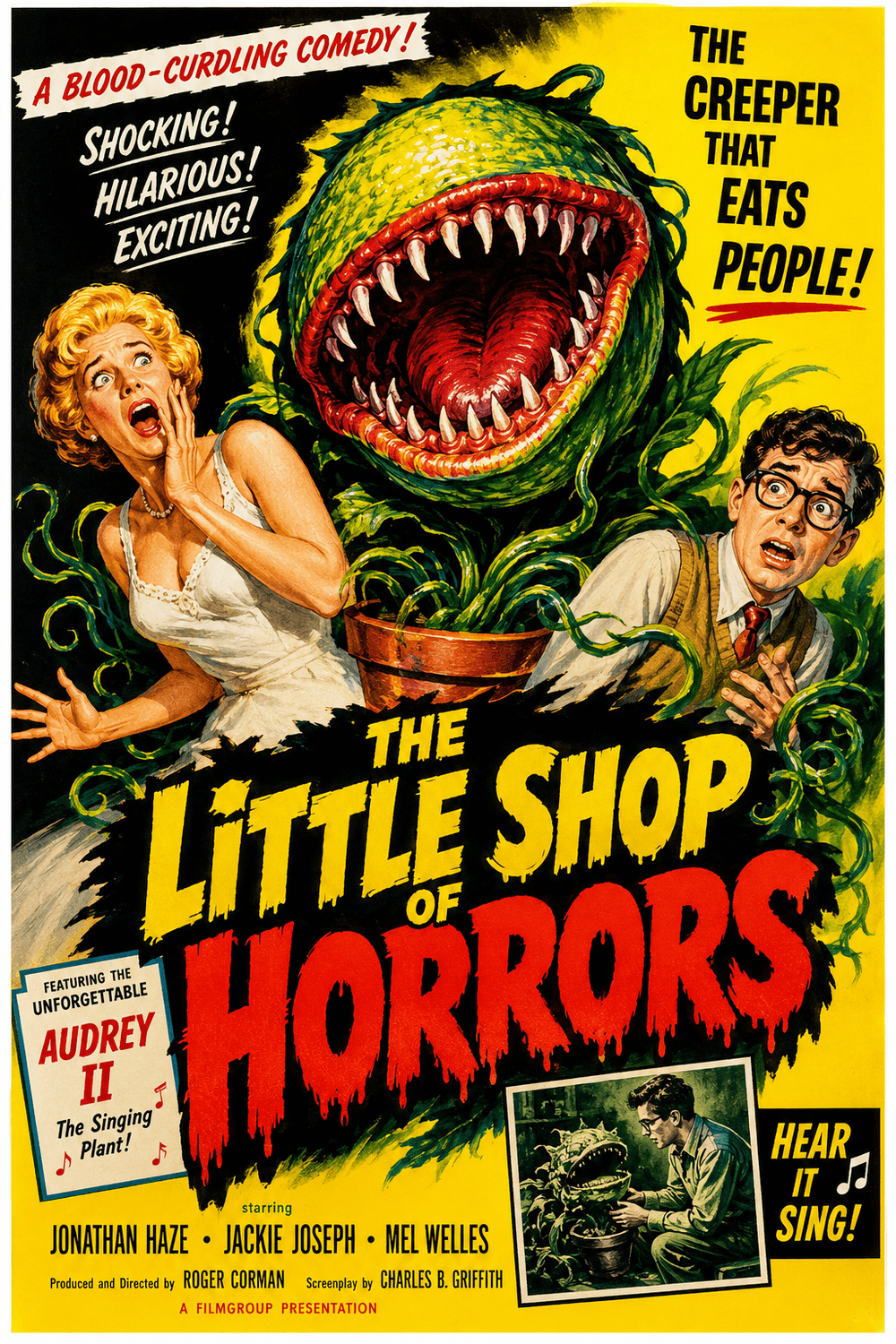
When The Little Shop of Horrors appeared in 1960, it presented audiences with an idea so simple that its deeper cruelty could easily hide beneath the laughter: an overlooked employee discovers something extraordinary, receives the attention he has always wanted, and gradually realizes that his success can survive only if he continues feeding it human beings. Directed and produced by Roger Corman from a screenplay by Charles B. Griffith, the film stars Jonathan Haze as Seymour Krelboyne, Jackie Joseph as Audrey Fulquard, and Mel Welles as flower-shop owner Gravis Mushnick, with Dick Miller and Jack Nicholson appearing in memorable supporting roles. The American Film Institute classifies the approximately seventy-minute production as a horror comedy released in 1960, while Turner Classic Movies describes its central premise as the story of an inept florist’s assistant who cultivates a carnivorous plant nourished by human blood. (AFI Catalog)
The film would later inspire the successful 1982 stage musical and its celebrated 1986 screen adaptation, but the original production remains a stranger, rougher, and more morally abrasive work. It contains no elaborate musical numbers, romantic grandeur, or technically sophisticated creature effects capable of distracting from the bleakness of Seymour’s transformation. Its comedy emerges through exaggerated characters, rapid dialogue, absurd misunderstandings, ethnic caricature, slapstick violence, and the increasing impossibility of the situation, yet beneath that comic surface lies a recognizable social nightmare: the person who has spent his life being ignored may become willing to pay almost any price once recognition finally arrives. (Taking Up Room)
The carnivorous plant is therefore more than an amusing monster. It is the physical expression of an appetite that expands whenever it is rewarded. Seymour initially wants only to preserve his job, impress Audrey, and prove that he is capable of producing something valuable, but each small success raises the stakes. The plant attracts customers, the shop prospers, Mushnick begins treating Seymour as an asset, and the man previously dismissed as incompetent becomes the center of public curiosity. What begins as a desperate attempt to matter gradually becomes a system in which attention, money, romance, and social legitimacy all depend upon continued violence.
Seymour Krelboyne and the Pain of Being Insignificant
Seymour is introduced as an awkward, poorly paid assistant working in a failing flower shop on Skid Row. He possesses enthusiasm but little confidence, and his mistakes repeatedly confirm the judgment others have already made about him. Mushnick treats him as a burden, customers rarely recognize his abilities, and Audrey’s kindness offers one of the few forms of emotional encouragement available to him. Jonathan Haze plays Seymour as a combination of innocence, nervous energy, childish confusion, and growing desperation, allowing the character to remain sympathetic even as his choices become increasingly indefensible.
His vulnerability originates in more than professional frustration. Seymour has built much of his identity around the experience of being underestimated, which means that success does not arrive merely as an external reward. It arrives as proof that his existence has finally acquired value. The plant becomes important because it allows him to escape the humiliating role assigned to him by everyone around him, transforming him from replaceable employee into inventor, expert, attraction, and possible romantic partner.
This is why Seymour cannot simply destroy the plant when its appetite becomes clear. Killing it would not mean losing only an unusual botanical specimen. It would mean returning to the life in which no one listened, admired, needed, or respected him. The plant has become the bridge between insignificance and visibility, and Seymour begins protecting that bridge even after discovering that it is constructed from death.
His emotional dependency reveals a dangerous feature of ambition. Success becomes especially difficult to relinquish when it repairs an old wound, because the person no longer experiences achievement as something possessed but as something holding the self together. Seymour does not merely want the benefits Audrey Jr. creates. He begins to believe that without those benefits he will become the person everyone previously assumed he was.
Audrey Jr. and the Demand Hidden Inside Opportunity
The plant begins as a strange botanical experiment Seymour has created through crossbreeding, yet it quickly demonstrates that ordinary soil, water, and sunlight cannot sustain it. After Seymour accidentally injures his finger, the plant responds to his blood, revealing the appetite that will govern the rest of the story. Its needs initially appear manageable because a few drops seem sufficient, allowing Seymour to pretend that the discovery remains within his control.
This first feeding establishes the psychological structure of dependency. Harm begins in a form small enough to rationalize. Seymour is not asked immediately to become a murderer; he is asked to tolerate a minor injury in exchange for preserving something potentially valuable. The cost appears temporary, private, and proportional to the reward.
The plant then grows, and growth transforms yesterday’s sacrifice into today’s insufficiency. What once sustained it no longer works because appetite expands alongside success. Seymour discovers that maintaining the result requires increasingly serious violations, but each escalation is connected to everything he has already invested. Destroying Audrey Jr. would force him to admit that the blood, secrecy, and effort were wasted.
This progression resembles the structure of many destructive ambitions. The first compromise feels exceptional, the second feels necessary to protect the first, and later compromises become part of an established system. The person does not experience himself as choosing evil anew each time because every choice appears to preserve something already built.
Audrey Jr. therefore embodies appetite without moral limitation. It does not care how Seymour obtains food, who must suffer, or what he becomes while providing it. It rewards delivery and punishes delay, reducing every ethical question to the continuation of growth.
The Flower Shop as an Economy of Desperation
Mushnick’s shop is failing before Audrey Jr. becomes its central attraction. Customers are scarce, the products are ordinary, and Mushnick appears trapped between financial anxiety and resentment toward the employees he cannot afford to replace. The business does not initially operate as a place of abundance, beauty, or emotional celebration despite selling flowers. It operates as a site of scarcity where every mistake threatens survival.
This economic pressure explains why the plant’s popularity changes the moral atmosphere so quickly. Mushnick does not need to understand Audrey Jr.’s biology in order to recognize its commercial power. People enter the shop to see it, publicity increases, and the business begins receiving opportunities that seemed impossible before Seymour’s discovery.
The plant’s value therefore arises not from what it produces but from the attention it attracts. It becomes a spectacle capable of converting curiosity into revenue, and that conversion changes how everyone evaluates Seymour. The employee once regarded as incompetent becomes valuable because he controls access to the object customers want to see.
Mushnick’s newfound respect is consequently conditional. He does not suddenly discover Seymour’s humanity, loyalty, or intelligence. He discovers Seymour’s profitability. This distinction is central because it teaches Seymour that recognition depends upon continued performance. He is welcomed as long as the plant continues attracting interest, but the social elevation remains attached to something external that can disappear.
The shop becomes an economy in which appetite circulates through every relationship. Audrey Jr. demands bodies, Mushnick demands customers, Seymour demands recognition, Audrey desires emotional security, and the public demands novelty. Each appetite feeds another until the plant’s literal consumption begins to look less like an isolated horror than the most honest expression of the entire system.
Gravis Mushnick and Conditional Respect
Mel Welles gives Mushnick a frantic comic energy, portraying him as a business owner whose irritation, anxiety, self-interest, and theatrical exasperation dominate nearly every exchange. His treatment of Seymour shifts according to the shop’s fortunes, revealing that authority can become affectionate when affection is profitable.
Before Audrey Jr. attracts attention, Mushnick sees Seymour primarily through error. He notices broken pots, damaged arrangements, confused customers, and the financial costs associated with keeping him employed. Once the plant becomes successful, the same young man is reinterpreted as a botanical genius capable of rescuing the business.
This change is psychologically important because Seymour has long wanted approval from someone who controls his employment and therefore his immediate survival. Mushnick’s recognition feels like paternal validation even though it is grounded in economic calculation. Seymour receives the emotional reward without examining the conditions attached to it.
Conditional approval is especially powerful when given to a person deprived of stable self-worth. Because Seymour has not developed an internal standard independent of others’ reactions, Mushnick’s shifting judgment becomes evidence about who he is. When the shopkeeper condemns him, Seymour feels worthless; when the shopkeeper celebrates him, Seymour feels transformed.
The relationship therefore helps explain why Seymour continues serving the plant. Audrey Jr. does not merely feed the business. It feeds the approval system through which Seymour has learned to interpret himself. Each new customer strengthens the illusion that he has finally earned a permanent place in the world.
Audrey Fulquard and the Promise of Emotional Belonging
Audrey offers Seymour something different from Mushnick’s commercial approval. She treats him with warmth, patience, and genuine affection, making her the emotional future he hopes success will secure. The plant’s name, Audrey Jr., reflects how closely Seymour has connected his botanical experiment to his romantic longing.
His love for Audrey initially appears innocent, yet it becomes entangled with the same system of achievement governing the shop. Seymour does not trust that he can be loved as the awkward, unsuccessful person he already is. He imagines that recognition, status, and scientific importance will make him worthy of her.
This belief turns romance into another reward produced by the plant. The larger Audrey Jr. grows, the more Seymour’s social position improves, and the more plausible a future with Audrey appears. His emotional hope therefore becomes dependent upon the same violence sustaining his professional success.
The film’s comedy softens this connection, but the underlying mechanism is tragic. Seymour wants intimacy, yet he pursues it through a secret that makes intimacy impossible. Every body fed to Audrey Jr. creates another fact he cannot safely reveal, widening the distance between the man Audrey believes she loves and the person Seymour is becoming.
He is therefore trapped between exposure and concealment. If he confesses, he risks losing Audrey, his job, his freedom, and the identity the plant created. If he remains silent, the relationship rests upon a fraudulent version of himself. His success brings him closer to the life he wants while making genuine participation in that life increasingly impossible.
The First Death and the Convenience of Accident
Seymour’s first human victim dies through a sequence presented as accidental. Wandering near a railroad track, Seymour becomes involved in an incident that kills a man, after which panic and opportunity converge. He has not set out with a deliberate plan to murder, allowing him to interpret his actions as a response to circumstances rather than as a moral decision.
The accidental nature of the death becomes essential to his self-deception. Seymour can tell himself that he did not create the corpse and therefore bears less responsibility for what happens next. Feeding the body to Audrey Jr. appears to him as concealment, disposal, and plant maintenance rather than the beginning of a deliberate killing system.
Yet the moment he uses the body, his relationship to future violence changes. He has discovered that human flesh solves the plant’s problem, protects his success, and removes evidence of death. The practical benefit creates knowledge that cannot be forgotten.
Moral escalation often depends upon this transition from accidental involvement to intentional repetition. The first event may be unplanned, but it reveals an available method. Once the person learns that a forbidden action produces a desired result, future choices occur within a changed psychological landscape.
Seymour’s guilt is real, but guilt does not automatically produce correction. Instead, it becomes another pressure requiring management. He must hide evidence, maintain appearances, and continue feeding the plant so that the original death appears to have served a purpose. The attempt to escape consequence creates the conditions for greater consequence.
Appetite Learns to Speak
As Audrey Jr. grows, it develops the ability to communicate and demands food directly. The plant’s speech changes the nature of Seymour’s responsibility because appetite is no longer inferred from physical decline. It becomes a voice capable of commanding, pressuring, and interrupting him.
The demand to be fed gives external form to the internal logic already controlling Seymour. Even before the plant speaks, he understands that his social survival depends upon its growth. Once it develops a voice, that dependency becomes personified, allowing him to experience his own ambition as an authority acting upon him.
This division is psychologically convenient. Seymour can begin regarding himself as the victim of Audrey Jr.’s demands rather than as the person who continues choosing to obey them. The plant becomes the cruel master, while Seymour becomes the frightened servant.
Yet the plant cannot obtain bodies without him. It has appetite but limited mobility, making Seymour’s cooperation essential. Every command must pass through his judgment before it becomes action, even when he prefers to describe the outcome as inevitable.
The talking plant therefore dramatizes the process through which desire becomes compulsion. A person may say that success, addiction, debt, reputation, or obligation is forcing continued behavior, but the force often operates through consequences the person has become unwilling to face. Seymour feeds Audrey Jr. because refusal would threaten the identity built around it.
The voice is terrifying because it says aloud what ambition frequently communicates silently: continue supplying what growth requires, regardless of what must be sacrificed.
Fame as a Predator That Must Be Fed
Audrey Jr. attracts increasing public interest because it is unlike anything people have seen. The shop becomes a destination, Seymour receives admiration, and the plant appears capable of transforming a marginal business into a cultural sensation.
The attention seems beneficial because it creates opportunity without requiring the public to understand the hidden cost. Customers see novelty, reporters see a story, Mushnick sees profit, and Audrey sees Seymour’s growing confidence. Only Seymour knows that every visible sign of success rests upon concealed bodies.
The film therefore presents fame as a predator with an expanding appetite. Initial recognition creates the expectation of continued novelty, growth, and performance. Seymour cannot preserve his new position by maintaining the plant at its current size. The attraction must become larger, stranger, and more impressive.
This dynamic gives Audrey Jr. a distinctly modern quality. Public attention rarely remains satisfied with what first attracted it because repetition weakens novelty. The creator must produce more in order to preserve the same level of interest, leading to a cycle in which success increases rather than reduces pressure.
Seymour discovers that being noticed does not free him from insecurity. It makes him more afraid of becoming invisible again. Before the plant, he had little status to lose; after the plant, every decline threatens public humiliation.
The reward therefore contains its own form of captivity. Seymour appears to rise socially, yet his freedom narrows because more people now depend upon him to keep producing the spectacle. He becomes important, but the importance belongs to the system he must continuously feed.
The Plant as Seymour’s Hidden Self
Audrey Jr. can be understood as the external form of desires Seymour is unable to acknowledge directly. He presents himself as timid, harmless, and eager to please, yet beneath that passivity lies frustration, resentment, ambition, sexual longing, and a desperate wish to escape humiliation.
The plant expresses those desires without shame. It demands satisfaction, occupies more space, commands attention, and consumes obstacles without concern for social rules. Everything Seymour has been trained to suppress appears in exaggerated biological form.
This does not mean the plant is merely imaginary, because the film treats it as physically real. Symbolically, however, it operates as Seymour’s disowned appetite. He can blame Audrey Jr. for demanding what part of him already wants: continued success at any cost.
The division allows him to preserve an image of innocence. Seymour remains the nervous employee who apologizes and panics, while the plant becomes the openly monstrous force. Yet their interests remain aligned for most of the story. Audrey Jr. receives food, and Seymour receives recognition.
The relationship resembles a pact in which each participant enables the other. The plant cannot hunt independently, while Seymour cannot achieve status independently. Together they create a system more powerful than either could create alone.
The horror emerges when Seymour realizes that the part of himself he has been feeding can no longer be contained. Appetite strengthens through obedience, and every concession teaches it that greater demands will eventually be satisfied.
Wilbur Force and the Comedy of Voluntary Pain
Jack Nicholson appears briefly as Wilbur Force, an enthusiastic dental patient who experiences pleasure through pain and eagerly submits to the dentist’s procedures. The role is small, but Nicholson’s exaggerated grin, breathless anticipation, and unsettling delight make the scene one of the film’s most memorable comic episodes. Turner Classic Movies includes Nicholson among the supporting cast, and the performance is now frequently discussed as one of his earliest recognizable screen appearances. (Turner Classic Movies)
Wilbur’s presence initially appears unrelated to Seymour’s moral decline, yet the scene reinforces the film’s inversion of ordinary appetite. People throughout the story desire what should repel them. Customers are fascinated by a grotesque plant, Seymour desires the success produced by death, the dentist enjoys inflicting pain, and Wilbur enjoys receiving it.
The comedy emerges because expected categories have been reversed. The patient does not fear the drill; he demands more. The professional who should be restrained becomes increasingly aggressive, while the apparent victim transforms aggression into pleasure.
This reversal also makes the world around Seymour feel morally unstable. Audrey Jr. is extraordinary, but abnormal appetite is already present everywhere. The plant’s hunger for flesh becomes one expression among many distorted desires, differing in degree more than in structure.
Wilbur’s delight also complicates the relationship between victim and aggressor. He appears to consent enthusiastically, yet his appetite encourages the dentist’s cruelty and turns professional treatment into a shared performance. The scene suggests that destructive systems do not always survive through force alone; they may also be sustained by participants whose desires make the harm rewarding.
The Dentist and Seymour’s Movement Toward Intentional Violence
Seymour’s encounter with the sadistic dentist marks a significant stage in his transformation because the resulting death cannot be separated as easily from deliberate action. The dentist is cruel, threatening, and socially repellent, allowing Seymour to rationalize what happens through the victim’s unpleasantness.
This is another essential step in moral decline. Once killing has become useful, the mind begins sorting potential victims according to how much sympathy they deserve. A cruel person appears easier to sacrifice because his flaws make the killer’s motives feel less selfish.
The danger lies in allowing personal judgment to determine whether another life remains protected. Seymour is not acting as a legitimate authority responding to immediate necessity. He is choosing a body capable of feeding the plant and using the dentist’s behavior to reduce his guilt.
The film plays the sequence as broad farce, yet its moral mechanism is precise. Violence becomes easier when the victim can be transformed into a category rather than encountered as a complete person. The dentist is no longer simply a human being; he becomes a sadist, threat, inconvenience, and source of food.
Seymour’s increasingly active role also weakens his claim that Audrey Jr. controls him completely. He begins adapting circumstances to the plant’s needs, demonstrating that compulsion has become cooperation. The servant is learning to anticipate the master’s appetite.
Consumption Without Conscience
Plants ordinarily transform sunlight, water, and nutrients into growth, making them symbols of natural renewal. Audrey Jr. reverses that association by requiring human death as the condition of blooming. Beauty and horror become biologically inseparable.
The plant’s flowers appear impressive because the audience knows what they contain. Each new blossom represents a human life converted into spectacle, turning visible success into concealed evidence. The more beautiful the plant becomes, the more morally repulsive the process supporting it.
This relationship exposes how easily consumption hides its origins. Customers see the final object but not the suffering required to produce it. They admire growth while remaining separated from the bodies inside the system.
Seymour becomes the intermediary who preserves this separation. He acquires victims, conceals the process, and presents the resulting plant as a botanical achievement. His role resembles any system in which the person responsible for production protects consumers from knowing the real cost of what they enjoy.
The plant possesses no conscience because appetite alone cannot generate moral limitation. Conscience must enter through the human participant capable of choosing whether desire should be satisfied. Seymour’s failure lies in expecting the source of appetite to regulate itself.
Audrey Jr. will never declare that it has consumed enough, because growth creates the need for further growth. Only Seymour can interrupt the cycle, and every reward makes interruption more psychologically expensive.
Mushnick as Witness and Opportunist
Mushnick eventually discovers evidence connecting Seymour to the disappearances and begins to understand the plant’s true source of nourishment. His knowledge places him at a moral crossroads because he can expose the crimes, destroy Audrey Jr., or preserve the business benefiting from them.
His hesitation reveals the corrupting power of indirect profit. Mushnick has not personally acquired the bodies, yet the shop’s success depends upon Seymour’s actions. Acknowledging the truth would require him to recognize that his own prosperity has been built upon violence.
The temptation is therefore not merely financial. Exposure would destroy the story Mushnick has told himself about the business’s revival. Audrey Jr. appears to have rewarded entrepreneurial persistence and Seymour’s botanical talent, while the truth reveals that success arrived through exploitation and concealment.
People often resist knowledge that threatens benefits they have already accepted. The problem is not always that evidence remains unclear; it is that clarity would create obligations. Once Mushnick knows, he must either act or become complicit.
His eventual confrontation with the plant demonstrates the danger of believing one can observe a predatory system without becoming part of it. Audrey Jr. does not distinguish between those who actively feed it and those who merely profit from its existence. Appetite ultimately consumes everyone within reach.
The Faces Inside the Flowers
Near the conclusion, Audrey Jr.’s blossoms reveal the faces of the people it has consumed. This image transforms hidden victims into visible testimony and destroys Seymour’s ability to maintain the separation between success and cost.
Until that moment, the bodies have disappeared inside the plant, allowing the evidence of violence to be converted into growth. The emerging faces reverse the process. What was buried returns to the surface, making each flower an accusation.
The image is both grotesque and morally appropriate because the plant’s beauty can no longer conceal what produced it. The victims become part of the spectacle, forcing observers to see the human content inside the achievement.
For Seymour, the revelation represents the collapse of self-deception. He cannot continue imagining Audrey Jr. as an independent monster that merely happened to benefit him. The faces connect his social success directly to identifiable lives.
This is how concealed systems of harm often become intolerable: not when the abstract cost increases, but when abstraction fails. Statistics, resources, inputs, and necessary sacrifices become morally urgent when the people inside those categories regain names and faces.
The flowers therefore bloom into evidence. Audrey Jr. has preserved what Seymour tried to erase, demonstrating that consumption does not eliminate consequence. It incorporates consequence into the structure of success.
Recognition Arriving Too Late
By the time Seymour understands that Audrey Jr. must be destroyed, the plant has become far more powerful than the small specimen he first fed from his injured finger. His delay has allowed both the physical creature and the social system surrounding it to grow.
This timing is essential to the tragedy. Seymour is not entirely without conscience. He experiences fear, guilt, hesitation, and eventual horror at what he has become. Yet conscience without timely action becomes another form of observation.
He repeatedly waits for a future moment when the problem will be easier to solve. After one more feeding, one more public appearance, or one more step toward security, he imagines that he will regain control. Each postponement makes control less possible.
The pattern reflects a common structure of destructive behavior. People often recognize danger before they act because recognition competes with reward, uncertainty, shame, and the hope that circumstances will improve without requiring sacrifice. By the time action becomes unavoidable, the consequences have expanded beyond the person’s original capacity to manage them.
Seymour’s final resistance is therefore brave but belated. He confronts the plant only after it has consumed multiple victims, corrupted his relationships, and grown powerful enough to destroy him.
The film does not suggest that remorse is meaningless, but it refuses to treat remorse as equivalent to innocence. Seymour’s recognition matters because it reveals that some part of his moral identity survives, yet the timing cannot restore the lives already converted into flowers.
The Creator Consumed by the Creation
Seymour ultimately enters Audrey Jr.’s enormous mouth in an attempt to destroy it, only to be consumed by the organism he created and sustained. His death completes the system’s logic because the person who repeatedly supplied others eventually becomes the final source of nourishment.
The plant’s consumption of Seymour is not simple revenge. Audrey Jr. does not possess a moral framework through which revenge would make sense. It follows appetite to its natural conclusion, treating its creator according to the same principle applied to every previous victim.
Seymour believed his special relationship with the plant protected him. He named it, cultivated it, understood its needs, and built his identity around its success. Yet appetite does not recognize loyalty once loyalty ceases to be useful.
This is the ultimate danger of constructing value through a system that cannot love, remember, or reciprocate. Seymour serves Audrey Jr. because it provides status, but the relationship remains entirely transactional. When his usefulness changes, he becomes another available resource.
His death therefore reveals the emptiness of the power he thought he possessed. He appeared to control a phenomenon that made him important, while in reality his life had become organized around satisfying its demands. He was not the master of Audrey Jr. but its most mobile root.
The creator is consumed because creation without ethical boundaries eventually reorganizes the creator around its own needs.
Roger Corman and the Discipline of Extreme Economy
The production history of The Little Shop of Horrors has become nearly as famous as the film itself. Corman created the picture with remarkable speed and limited resources, using sets associated with his earlier black comedy A Bucket of Blood and relying upon a familiar group of collaborators. The frequently repeated claim that principal photography was completed in roughly two days and a night has become part of Corman’s legend, although later accounts have questioned how literally the story should be understood and suggest that additional filming complicated the simplified version. (Turner Classic Movies)
The exact timetable matters less than what the production demonstrates about Corman’s filmmaking method. He approached limitation not as an excuse for inactivity but as a structural condition around which creativity had to be organized. Available sets, actors, time, and money became the starting point for invention.
This economy is visible in the film’s compressed locations, rapid dialogue, limited creature effects, and episodic supporting characters. Rather than hiding every constraint, Corman converts speed into rhythm. The movie moves quickly enough that absurdity accumulates before the audience can demand realism from any single moment.
The approach also created space for experimentation. A more expensive production might have required greater tonal consistency, narrative caution, and institutional approval. Corman’s low-budget system allowed horror, Jewish comedy, slapstick, police parody, social satire, and grotesque fantasy to coexist within a film barely longer than an hour.
The result illustrates a central principle of independent cinema: resources determine scale, but they do not have to determine imagination. Corman could not create a convincing botanical monster according to major-studio standards, yet he could create a concept strong enough to survive far beyond the physical limitations of its first screen appearance.
Charles B. Griffith and Comedy Through Accumulated Absurdity
Charles B. Griffith’s screenplay builds humor through relentless escalation rather than carefully separated jokes. Characters misunderstand one another, repeat linguistic patterns, pursue private obsessions, and behave according to comic rules that make ordinary communication increasingly impossible.
The humor frequently emerges from appetite. One customer casually eats flowers, Mrs. Shiva repeatedly arrives to announce another relative’s death, the dentist enjoys inflicting pain, Wilbur Force enjoys receiving it, Mushnick hungers for business, and Audrey Jr. hungers for bodies. Nearly everyone is defined by a desire that has exceeded ordinary proportion.
This structure prevents the plant from appearing entirely foreign to the world around it. Audrey Jr. is the largest appetite in the story, but not the only one. The human characters already inhabit a society governed by consumption, self-interest, loneliness, and exaggerated need.
The screenplay’s rapid movement also limits emotional reflection, which strengthens the black comedy. Death occurs, characters panic briefly, and the narrative immediately generates another absurd complication. The speed prevents grief from stabilizing the moral world.
Yet beneath the comic rhythm, consequences continue accumulating. The film appears to move past each death, but Audrey Jr. physically preserves the evidence within its growing body. Comedy creates temporary distance while horror stores the cost.
This interaction between tone and consequence gives the film durability. The audience laughs at events whose ethical implications become increasingly serious, creating discomfort about how easily entertainment can convert suffering into spectacle.
The Film’s Caricatures and the Limits of Its Era
A serious contemporary reading of The Little Shop of Horrors must acknowledge that several of its performances and comic patterns rely upon ethnic caricature, exaggerated accents, gender conventions, and social stereotypes associated with mid-century American entertainment. Mushnick and members of Seymour’s family are written and performed through broad cultural markers that can feel reductive or uncomfortable to modern viewers.
These elements should not be ignored simply because the film is a fast-moving comedy or a product of its historical moment. Humor creates cultural memory, and repeated caricatures can shape public perception even when presented without explicit hostility.
At the same time, understanding the film historically requires recognizing the comic traditions from which Griffith and the performers were drawing. The dialogue contains elements of vaudeville, Yiddish-inflected comedy, urban farce, radio humor, and low-budget theatrical exaggeration. These traditions offered recognizable rhythms to contemporary audiences but also depended upon simplified identities.
The film’s importance therefore does not require treating every element as equally successful or acceptable. Cultural value and cultural limitation can coexist within the same work. Examining the discomfort reveals how comedy changes as the assumptions shared between performers and audiences change.
Classic cinema becomes more meaningful when it is allowed to remain historically specific rather than being either excused entirely or rejected without analysis. The Little Shop of Horrors preserves both the inventiveness and the blind spots of the entertainment culture that produced it.
Skid Row and the Geography of Limited Possibility
The film’s Skid Row setting is played broadly, yet it establishes an environment in which people possess few credible paths toward advancement. Mushnick’s business is failing, Seymour lacks professional status, Audrey has limited options, and customers appear trapped inside eccentric routines.
This social confinement gives Audrey Jr.’s success additional power. The plant does not merely improve an already stable life. It appears to offer escape from a world where effort has produced little change.
Opportunity becomes morally dangerous when people believe it may be the only opportunity they will ever receive. Seymour cannot evaluate Audrey Jr. calmly because the plant appears unique. Destroying it would not mean waiting for the next promising invention; it could mean surrendering the only path out of humiliation.
Scarcity therefore amplifies compromise. A person surrounded by alternatives can reject a corrupt opportunity more easily than someone who believes refusal will return him permanently to deprivation.
The film’s comedy repeatedly exaggerates poverty and commercial desperation, but the underlying pressure remains serious. Mushnick tolerates what he might otherwise question because the shop needs customers. Seymour protects what he fears because he needs significance. Both men allow immediate scarcity to determine long-term morality.
Audrey Jr. flourishes because it enters an environment prepared to overlook danger in exchange for possibility.
The Public That Wants the Spectacle but Not the Truth
The customers and observers surrounding Audrey Jr. participate in the system without knowing its source of nourishment. They want to see the unusual plant, benefit from its novelty, and celebrate Seymour’s discovery, but they do not ask what sustaining such extraordinary growth requires.
Their ignorance is understandable because the truth is almost impossible to imagine. Yet the film uses that ignorance to expose a broader relationship between audiences and spectacle. People often desire remarkable results while remaining indifferent to the hidden process producing them.
The public rewards Seymour for growth, indirectly increasing the pressure that leads him toward additional violence. No customer commands him to kill, but collective attention creates the conditions under which killing preserves value.
Responsibility is therefore distributed unevenly. Seymour remains accountable because he knows the cost and chooses to pay it with other people’s lives. Mushnick becomes complicit once he understands enough to suspect the truth. The public remains morally distant, yet its appetite for spectacle strengthens the system.
Audrey Jr. becomes successful because everyone wants the visible result while Seymour alone manages the invisible sacrifice. This separation protects consumers from guilt and producers from scrutiny until the hidden bodies finally appear inside the flowers.
The revelation is shocking because it eliminates the distance upon which enjoyment depended. The spectacle and the suffering become the same object.
From Disposable B-Movie to Cultural Institution
The original Little Shop of Horrors gradually achieved cult status and eventually provided the narrative foundation for the 1982 Off-Broadway musical created by Howard Ashman and Alan Menken. That stage work inspired the more elaborate 1986 film directed by Frank Oz, introducing the story to a much larger audience and transforming the carnivorous plant into one of popular culture’s most recognizable theatrical monsters. (Taking Up Room)
The evolution is remarkable because the source film was created within a production culture built around speed, economy, and short-term exhibition. It was not designed as the first installment of a carefully managed intellectual property franchise. Its longevity arose because the central concept proved adaptable.
Each version emphasizes different dimensions of the story. The original is rough, frantic, and morally chaotic, while the musical adaptations develop the romance, songs, spectacle, and seductive personality of the plant more fully. Yet the central structure remains intact: an insecure man discovers a route to success, feeds it in secret, and becomes increasingly unable to separate his desires from its appetite.
This adaptability reveals the strength of the original metaphor. The plant can represent ambition, capitalism, fame, addiction, exploitation, creative success, romantic insecurity, or any system that rewards growth while concealing cost.
The production may have been inexpensive, but the idea was rich enough to continue generating meaning across decades, media, styles, and audiences.
Public-Domain Circulation and Cinematic Survival
The film has circulated widely through television, home video, streaming collections, inexpensive horror compilations, and public-domain movie platforms. Its broad availability helped introduce generations of viewers to Corman’s early work and strengthened the cult reputation that eventually separated the movie from its original status as a modest exploitation release. Multiple film resources describe the 1960 picture as widely available in the public domain, although specific adaptation rights connected to later theatrical and musical versions remain distinct from the original film’s circulation. (Art of the Title)
Public-domain circulation can reduce a film’s commercial control while increasing its cultural visibility. Without one rights holder strictly limiting access, copies appear in many forms and levels of quality, allowing the work to survive through repetition even when preservation standards vary.
For The Little Shop of Horrors, this accessibility became part of its afterlife. Audiences encountered it unexpectedly on late-night television, budget discs, online archives, and classic-horror channels, often discovering that the famous musical originated in a much smaller and stranger black-and-white comedy.
The film’s survival therefore mirrors Audrey Jr.’s growth in an unexpectedly benign way. It spread beyond the conditions of its original production, taking root in new media environments and continually finding fresh audiences.
Unlike the plant, however, the movie’s circulation does not require hidden bodies. It requires curiosity, preservation, and viewers willing to look beyond technical limitations toward the imaginative structure underneath.
Success as a Bargain That Keeps Changing
Seymour’s central mistake is not that he wants success. His desire to be respected, secure, useful, and loved is entirely human. The tragedy begins when he accepts a form of success whose price cannot remain fixed.
Audrey Jr. never offers a complete bargain. It does not say that one sacrifice will produce permanent reward. Each feeding creates only temporary stability before hunger returns.
This changing price prevents Seymour from evaluating the exchange honestly. At every stage, he can imagine that one final concession will end the crisis. The plant needs food now, but perhaps growth will soon stabilize; the shop needs publicity now, but perhaps financial security will create alternatives; the secret must be protected now, but perhaps future success will make confession unnecessary.
The future becomes the location where morality will supposedly be restored. Seymour repeatedly borrows against that imagined future, committing harm in the present while promising himself that later circumstances will justify or repair it.
Yet systems built upon escalating appetite do not deliver the freedom they promise. They consume increasing resources in order to preserve what has already been gained. Seymour becomes more celebrated and less free at the same time.
The film’s warning is therefore not against ambition itself but against success that requires permanent surrender to an appetite incapable of declaring satisfaction.
The Horror of Becoming Valuable for the Wrong Reason
Before Audrey Jr., Seymour believes he has little value. After Audrey Jr., everyone suddenly needs him, but their need is attached to the plant rather than to the person he hoped they would finally recognize.
This distinction creates the emotional cruelty at the center of the story. Seymour receives the outward signs of belonging—attention, praise, opportunity, romantic possibility, and professional respect—while knowing that they depend upon something he cannot ethically sustain.
He has become valuable, but for the wrong reason. The recognition confirms his significance while simultaneously proving that his ordinary self was never enough for the people whose approval he wanted.
This creates an impossible psychological demand. To preserve social value, he must preserve the extraordinary object. To preserve the object, he must continue violating the values that would make recognition meaningful.
His success therefore cannot heal insecurity because it continually reminds him that acceptance is conditional. The more the world celebrates Audrey Jr., the more Seymour fears what will happen when it disappears.
He becomes trapped inside a public identity that cannot survive honesty. The person who wanted to be seen must now hide the most important truth about himself.
Appetite Does Not Love Its Provider
Audrey Jr.’s final consumption of Seymour reveals the central asymmetry of their relationship. Seymour has sacrificed strangers, protected the plant, endured fear, and organized his future around its continued growth, yet none of that history creates obligation within the creature.
Appetite cannot feel gratitude because gratitude requires recognition of another’s independent value. Audrey Jr. experiences Seymour only as the source through which hunger has been satisfied.
This is why systems based entirely upon usefulness eventually consume their most loyal participants. The person may believe years of service create safety, but a system without conscience evaluates only present utility. Once the provider becomes more valuable as material than as servant, prior loyalty becomes irrelevant.
Seymour’s death is therefore not an unpredictable betrayal. It is the final expression of the principle he accepted when he first allowed the plant’s appetite to determine another person’s value.
The plant treats him as food because he taught it, through repeated obedience, that every human body can be converted into growth.
Why the Film Remains So Entertaining
Despite its bleak implications, The Little Shop of Horrors remains enormously entertaining because its speed, eccentric performances, visual absurdity, and comic unpredictability prevent the moral darkness from becoming oppressive. Roger Corman’s direction keeps the story moving with the efficiency that defined much of his independent work, while Griffith’s screenplay fills even minor roles with distinctive appetites and linguistic rhythms. TCM describes the film as representative of Corman’s early independent house style before his later cycle of color Edgar Allan Poe adaptations, and its cast draws heavily from performers who appeared throughout his low-budget productions. (Turner Classic Movies)
The plant itself is charmingly artificial, yet its limitations encourage imagination rather than eliminating it. The audience understands what Audrey Jr. represents long before its physical construction becomes convincing.
The tonal instability also contributes to the pleasure. The movie can move from workplace comedy to murder, from romance to grotesque spectacle, and from police parody to existential punishment without pausing to stabilize itself.
This unpredictability gives the film a handmade energy. It does not feel refined, but it feels alive, which is especially appropriate for a story about a crude creation growing beyond anyone’s expectations.
The Little Shop Where Every Desire Has a Price
The title appears modest, directing attention toward a small business in an overlooked neighborhood rather than toward a laboratory, castle, or global catastrophe. Yet the shop becomes a complete moral universe in which human desire is exposed through commerce.
Mushnick wants customers, Seymour wants recognition, Audrey wants affection, the public wants novelty, and Audrey Jr. wants flesh. None of these desires is initially equal in moral seriousness, but the business connects them until ordinary longing begins supporting extraordinary violence.
The setting demonstrates that horror does not always require a distant supernatural realm. It can grow inside familiar systems when every participant focuses upon what he or she receives while refusing to examine what the system requires.
Flowers ordinarily communicate love, mourning, celebration, gratitude, and beauty. In Mushnick’s shop, they conceal consumption. The symbolic objects through which people express human feeling become the place where human bodies disappear.
The little shop therefore becomes frightening because it continues functioning. Customers enter, transactions occur, relationships develop, and business improves while the deepest violation remains hidden inside the attraction everyone admires.
The Man Who Fed His Future Until It Ate Him
Seymour’s story is ultimately the tragedy of a man who believes success will allow him to become himself, only to discover that maintaining success requires him to abandon himself completely. He begins with understandable desires and moves toward monstrous actions not through one sudden transformation but through a sequence of concessions, each connected to something he fears losing.
He feeds the plant because he wants to preserve possibility. He conceals death because he wants to preserve innocence. He continues feeding because he wants to preserve status, romance, employment, and hope. Every act of preservation destroys another part of the moral identity he originally hoped success would validate.
By the time he decides to resist, the life he wanted and the monster he created have become inseparable. Destroying Audrey Jr. means destroying the achievement through which the world learned his name, yet allowing it to live means accepting that his future will require an endless supply of victims.
His final attempt to kill the plant represents a return of conscience, but it cannot undo the structure he has helped build. Audrey Jr. has become larger than the original desire that created it because every reward taught Seymour to feed it again.
The Little Shop of Horrors remains enduringly funny because its characters are exaggerated, its world is absurd, and its production embraces theatrical invention without concern for realism. It remains enduringly disturbing because the mechanism beneath that absurdity is painfully recognizable. People often imagine that success will finally quiet insecurity, only to discover that success introduces new demands, dependencies, and fears of loss.
Audrey Jr. is frightening because it says openly what destructive ambition whispers: feed me, and I will make you visible; stop feeding me, and everything you have gained may disappear. Seymour accepts that bargain until he realizes that the appetite promising him a life has been consuming that life from the beginning.
