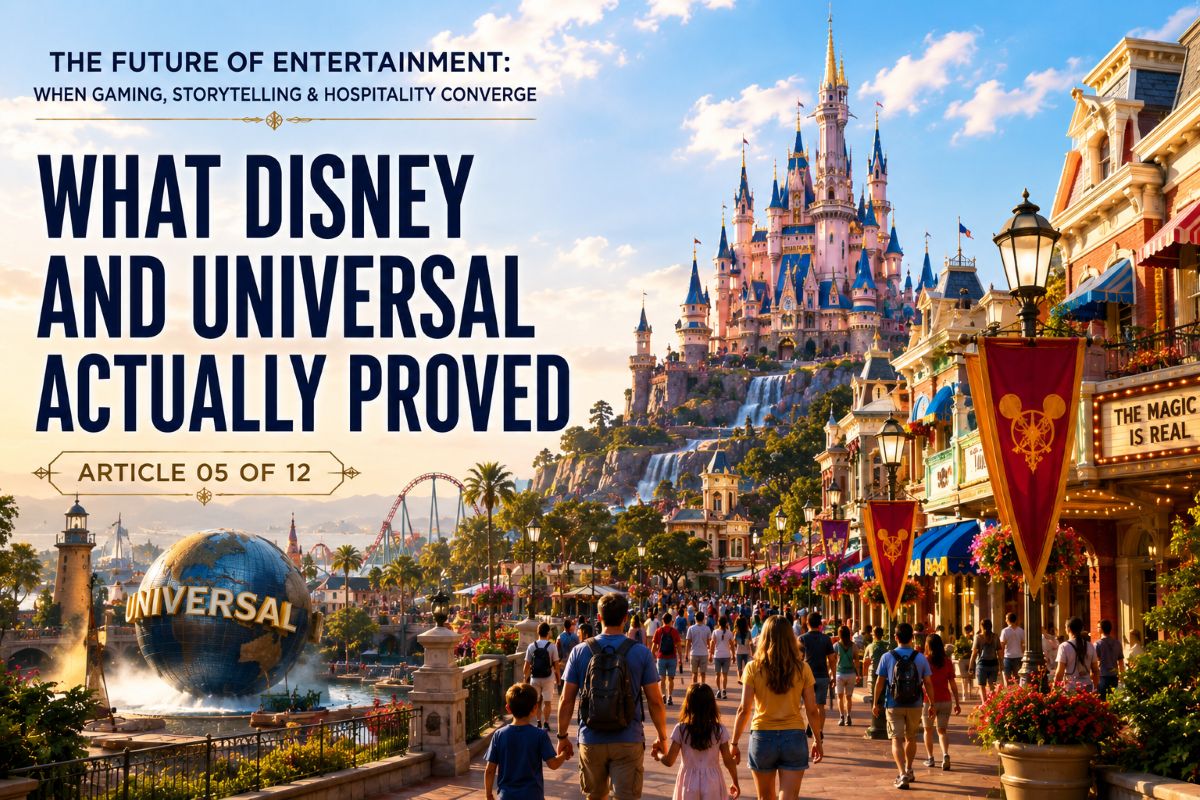
For decades, the extraordinary success of Disney and Universal theme parks has usually been interpreted through the language of attractions, tourism, family entertainment and intellectual-property licensing, yet their deeper significance to the future of entertainment may lie somewhere considerably more profound: they demonstrated that audiences will travel substantial distances, devote entire days or vacations, and spend far beyond the price of a cinema ticket for the privilege of physically entering environments connected to fictional worlds they already love. Disney theme parks, Universal theme parks, immersive entertainment, movie IP, themed hospitality and experiential travel collectively reveal an important transformation in the economics of storytelling because the commercial relationship between an audience and a successful entertainment property does not necessarily end when viewing ends. Once emotional attachment to a fictional universe becomes sufficiently powerful, geography itself can become part of the intellectual property experience, transforming stories from content distributed toward consumers into destinations toward which consumers willingly travel.
What makes this achievement particularly important is that the most successful themed environments do considerably more than reproduce recognizable imagery. They manipulate architecture, scale, sound, landscape, food, merchandise, performance, movement and carefully controlled transitions to create a temporary separation from ordinary surroundings, allowing visitors to experience fictional universes through their bodies rather than exclusively through imagination. The commercial lesson extends far beyond theme parks because it suggests that movie and television intellectual property can generate tourism, hospitality revenue, food and beverage spending, merchandise, premium experiences and repeat visitation when fictional worlds acquire convincing physical form. Gaming and role-play add another dimension to that proposition by suggesting that future audiences may want more than access to beautifully reconstructed worlds: they may increasingly expect agency, identity, progression and consequence within them.
Yet the success of Disney and Universal should not lead the entertainment industry to assume that the theme park represents the final form of physical storytelling, because the traditional attraction model still places important boundaries around participation. Visitors usually move through environments created for them, experience narratives whose essential outcomes remain fixed, and eventually leave the fictional world to return to accommodation that often operates according to conventional hospitality logic. The more consequential question is what happens when the principles proven by destination entertainment are combined with the psychological discoveries of gaming, the identity structures of role-play and the duration of hospitality, allowing the experience to continue beyond individual rides and attractions into the hotel room, restaurant, corridor and overnight stay. Examining what Disney and Universal actually proved therefore requires separating the enduring principles behind their success from the particular theme-park format through which those principles have historically been expressed.

Unlock the Entire Empowering Entertainment Library
This article is only the beginning.
Become a member and enjoy unlimited access to every premium magazine article, expert interviews, in-depth features, practical guides, and a growing digital library of hundreds of books covering business, entrepreneurship, film production, personal growth, health, relationships, AI, ADHD, and much more.
One membership. Hundreds of resources. New content added every week.