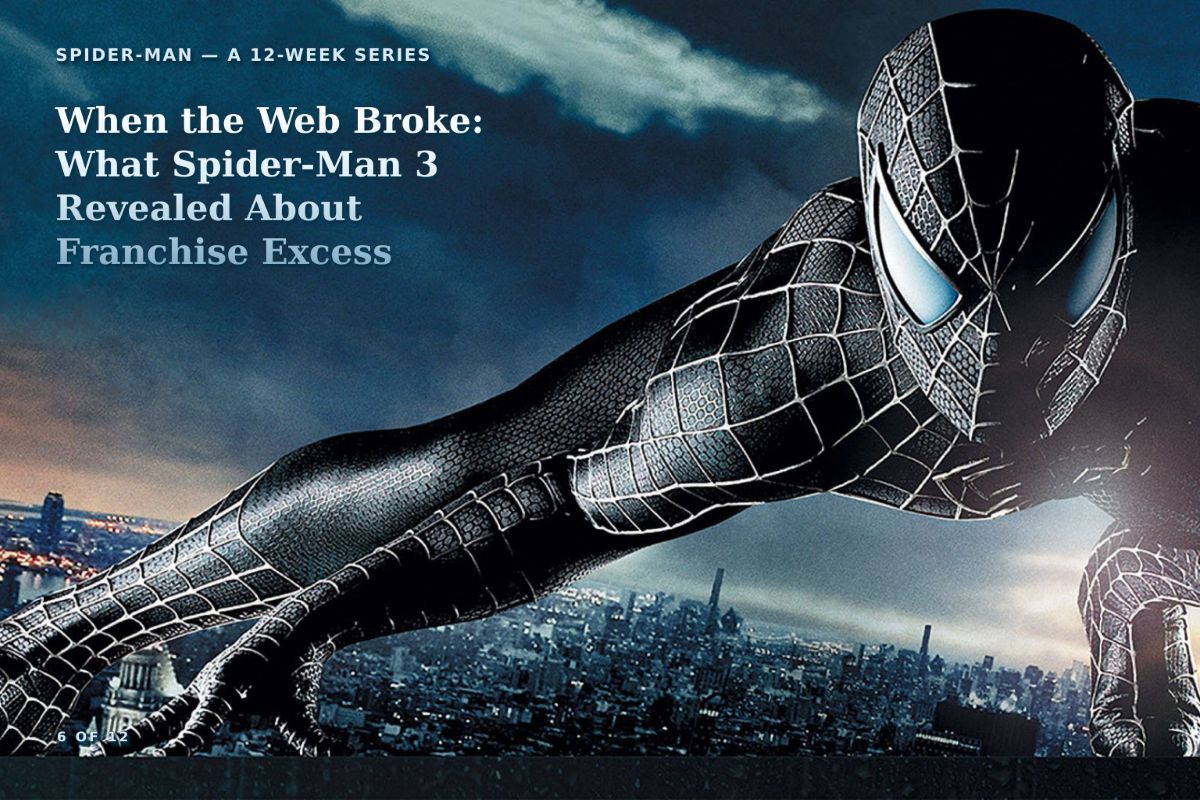
When Sam Raimi’s Spider-Man 3 opened in May 2007, it arrived with the commercial momentum of a franchise that appeared almost incapable of failure. Tobey Maguire’s Peter Parker had become one of the defining cinematic heroes of the new century, Spider-Man 2 had been acclaimed as a rare superhero sequel that deepened rather than merely enlarged its predecessor, and Sony positioned the third film as an event of unprecedented scale. The result earned approximately $890 million worldwide, making it the highest-grossing installment of Raimi’s original Spider-Man trilogy, while its global opening established a new box-office record at the time. Yet the film’s financial triumph concealed a profound creative instability: a story originally built around Peter’s pride, Harry Osborn’s grief and Sandman’s search for redemption had been expanded to accommodate Gwen Stacy, Eddie Brock, Venom, the alien symbiote and an increasingly crowded network of romantic, moral and commercial obligations.
The familiar criticism of Spider-Man 3 is that it contains too many villains, but numerical excess alone does not explain why the film feels so divided. The deeper problem is that its characters belong to different dramatic systems competing for the same emotional center. Thomas Haden Church’s Flint Marko and James Franco’s Harry Osborn inhabit Sam Raimi’s established world of guilt, family tragedy and morally compromised people whose destructive actions emerge from recognizable pain, while Topher Grace’s Eddie Brock and the Venom mythology introduce a darker form of comic-book rivalry that the film has insufficient time to develop. Peter’s black suit is intended to connect these stories by externalizing his arrogance and appetite for revenge, yet the symbiote must simultaneously function as science-fiction mythology, psychological metaphor, visual transformation and preparation for another major villain. Instead of concentrating the drama, it becomes the mechanism through which an already overextended film attempts to hold incompatible ambitions together.
A serious reconsideration of Spider-Man 3 must therefore move beyond ridicule of Peter Parker’s dancing, hairstyle and exaggerated confidence to examine the moral tragedy the film was trying to construct beneath its tonal disorder. This article explores how public admiration awakens Peter’s vanity, why Harry’s campaign of emotional revenge is more devastating than his physical attacks, how Sandman complicates the meaning of Uncle Ben’s death and why the symbiote does not create Peter’s darkness but grants theatrical permission to impulses already present within him. It also examines how pressure to enlarge a successful franchise fractured the relationship between theme and character, producing a film whose most revealing failure was not that it lacked ideas, but that it contained too many potentially powerful ideas to allow any one of them the depth it required.

Unlock the Entire Empowering Entertainment Library
This article is only the beginning.
Become a member and enjoy unlimited access to every premium magazine article, expert interviews, in-depth features, practical guides, and a growing digital library of hundreds of books covering business, entrepreneurship, film production, personal growth, health, relationships, AI, ADHD, and much more.
One membership. Hundreds of resources. New content added every week.