
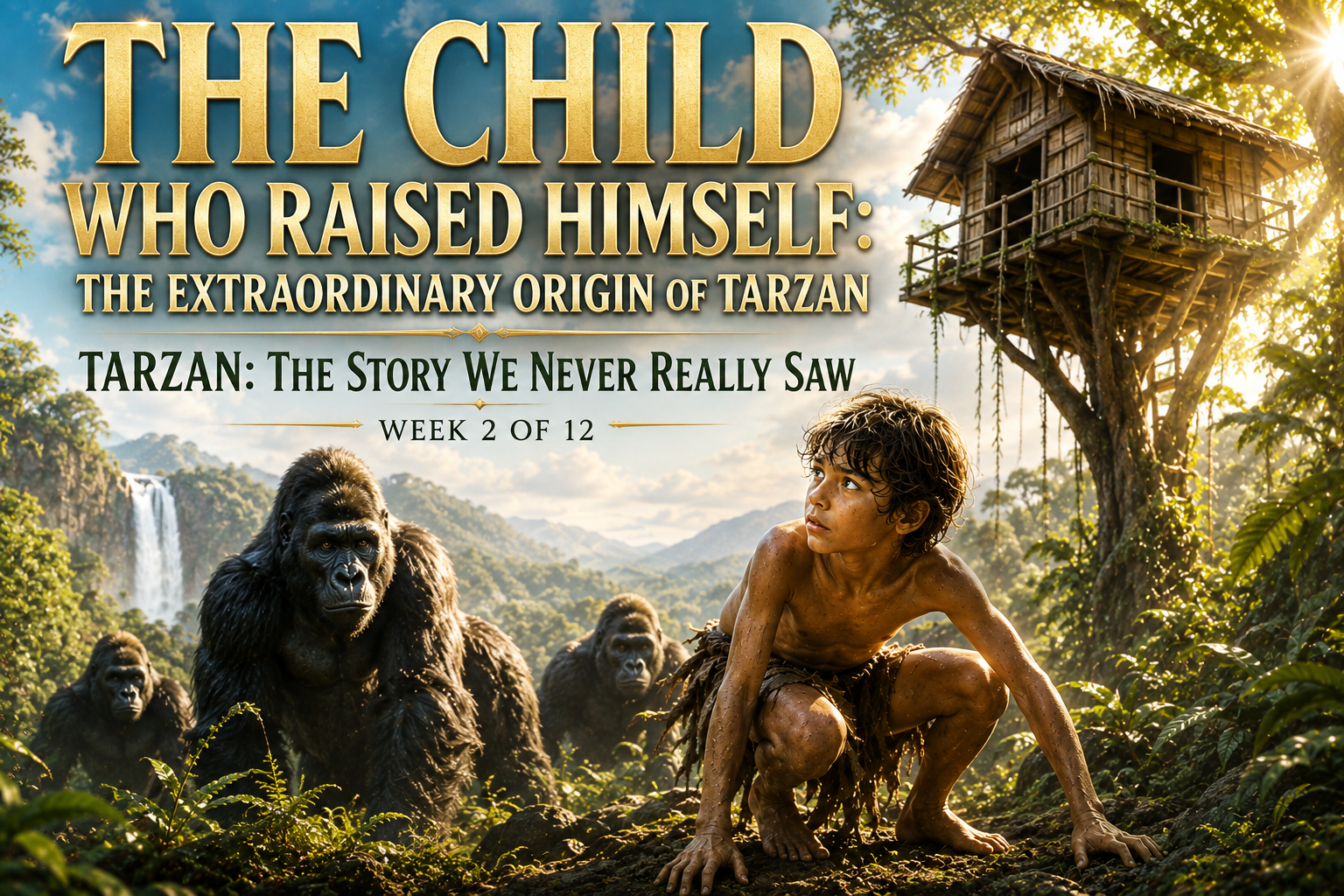
The origin of Tarzan in Edgar Rice Burroughs' Tarzan of the Apes is usually remembered as a piece of adventure mythology so familiar that its psychological strangeness has almost disappeared: an English infant is orphaned on the coast of equatorial Africa, adopted by Kala among the fictional great apes Burroughs called the Mangani, and grows into the extraordinary figure the world will know as Tarzan. Yet beneath that apparently simple premise lies one of the most radical identity experiments in popular literature, because John Clayton grows toward consciousness without knowing that John Clayton exists, without human parents capable of transmitting language or history, without a society telling him what a human being is supposed to become, and without even another human body nearby against which he can easily understand his own difference. Edgar Rice Burroughs, Inc. still describes the canonical Tarzan as John Clayton, Lord Greystoke, a human raised by Mangani whose earliest education comes from the jungle and from teaching himself through the library in his father's cabin, while Tarzan of the Apes establishes the orphaned child's intelligence as fundamental to his eventual rise among the creatures who initially possess enormous physical advantages over him.
Watch classic Tarzan movies and TV series by joining the EE Vault. Click here for more information.
What makes the childhood of Tarzan compelling is therefore not simply the fantasy that a human infant could survive among apes, but the much deeper question of what happens when identity must be constructed before society can supply an explanation for it. Tarzan grows within a community to which he belongs emotionally but not biologically, experiencing Kala as his mother and the Mangani as the structure of his world while his own body continually produces evidence that he is unlike them; he is comparatively hairless, physically vulnerable during childhood, differently proportioned, and increasingly capable of forms of observation, abstraction and tool use that change the balance between weakness and survival. His difference does not immediately tell him that he is human because the category "human" possesses no meaning until he gradually discovers evidence of another world, which means the first great mystery Tarzan encounters is not the jungle but himself. The cabin left by his dead parents then deepens that mystery almost unbearably, because inside it he finds objects, images and eventually written language created by beings who resemble him, transforming the remains of his biological family into a silent classroom in which a child begins excavating an identity he does not know is his own.
To understand the real story of Tarzan before Jane Porter, Lord Greystoke and Hollywood's jungle legend, we have to remain with that child long enough to see how profoundly his early development determines everything that follows. Kala does more than keep him alive because she establishes an emotional definition of family that bloodline will never completely replace; physical disadvantage does more than threaten him because it forces intelligence to become an instrument of survival; the discovery of books does more than teach him symbols because it introduces another civilization before anyone from that civilization can tell him how to interpret it; and the first recognition that other beings look like him creates a fracture between belonging and biological identity that the adult Tarzan will never fully resolve. Following that development from dependence to observation, from observation to knowledge, and from knowledge to the disturbing possibility that he may belong to two worlds at once reveals why the adult Tarzan is not merely a man who survived the jungle, but a man whose entire psychology was forged before civilization had the opportunity to define him.

Unlock the Entire Empowering Entertainment Library
This article is only the beginning.
Become a member and enjoy unlimited access to every premium magazine article, expert interviews, in-depth features, practical guides, and a growing digital library of hundreds of books covering business, entrepreneurship, film production, personal growth, health, relationships, AI, ADHD, and much more.
One membership. Hundreds of resources. New content added every week.