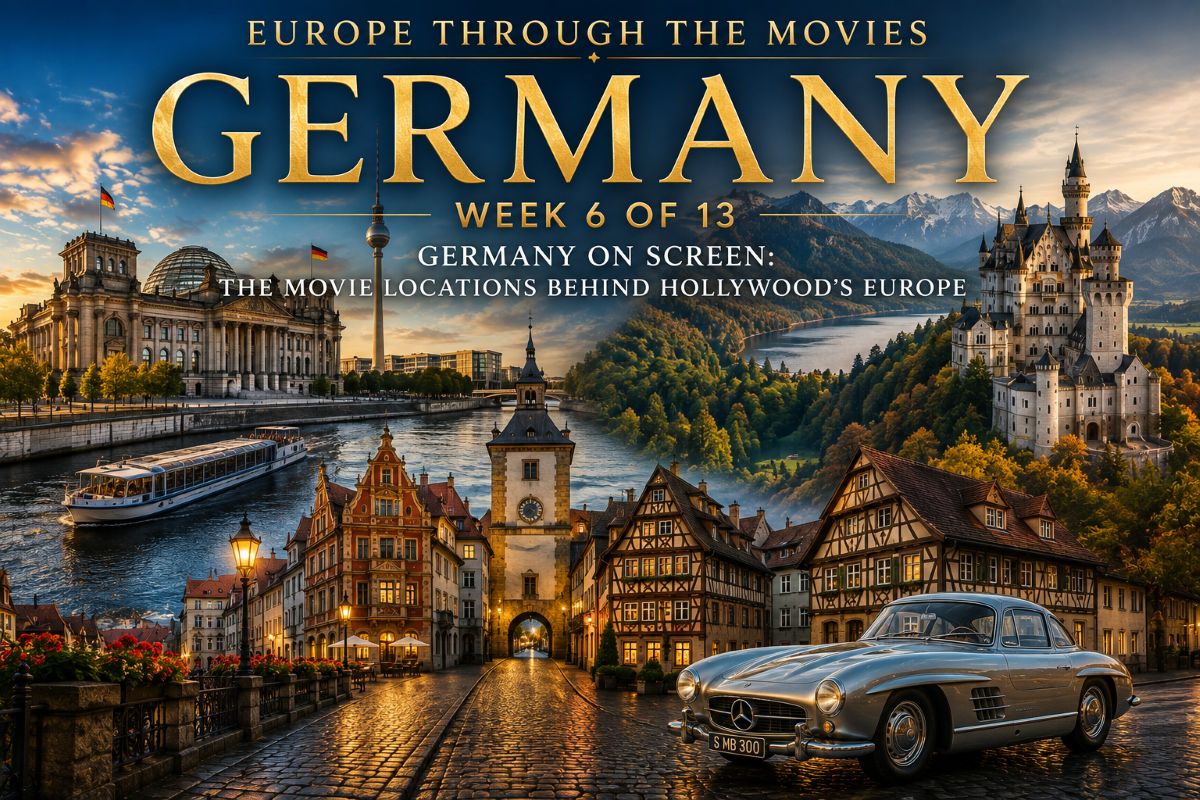
Germany presents filmmakers with a challenge fundamentally different from the cinematic seductions of Italy, France or Spain, because many of its most iconic filming locations cannot be separated easily from the historical events that occurred around them, the political systems that reshaped them or the extraordinary process of destruction and reconstruction through which the country entered the modern era. Berlin has become one of cinema’s great cities precisely because its streets can carry the visual memory of the Weimar Republic, Nazi Germany, wartime devastation, Cold War division and reunification within the same urban geography; Studio Babelsberg near Berlin, one of the world’s oldest large-scale film studio complexes, connects contemporary international productions with the very beginnings of European filmmaking; Görlitz has preserved such an extraordinary architectural range that it has repeatedly transformed into other European cities and historical periods, most famously becoming part of Wes Anderson’s fictional world in The Grand Budapest Hotel; while locations in Berlin and Potsdam have allowed films such as Bridge of Spies, Inglourious Basterds and Atomic Blonde to reconstruct political worlds whose histories remain physically embedded in Germany itself. To explore famous movie locations in Germany is therefore to enter a landscape where cinema is rarely dealing with architecture alone, because almost every significant location carries another layer of memory beneath whatever story the production has placed upon it.
This historical density has made Germany film tourism unusually fascinating, because the relationship between screen fiction and physical reality continually reverses itself: sometimes filmmakers travel to Germany because they need the authentic geography of events that actually occurred there, while at other times German streets and buildings are selected precisely because they can convincingly become somewhere else. Berlin can perform its own divided Cold War identity in one production and become another European capital in the next; Görlitz can disappear beneath fictional names while retaining architectural details accumulated through centuries of Central European history; Babelsberg can manufacture entire worlds inside studios situated only a short distance from locations where twentieth-century political history unfolded outside them. This constant movement between authenticity and transformation makes Germany one of Europe’s most intellectually compelling screen destinations, because the traveller is repeatedly confronted with the question of what exactly is being visited: the location represented by the movie, the historical place concealed beneath that representation, or the complicated point where the two have become impossible to separate.
Following the most iconic filming locations in Germany you can actually visit consequently becomes something deeper than a search for recognizable frames, beginning in Berlin, where Atomic Blonde and generations of Cold War cinema have transformed division itself into cinematic geography, before moving toward the Glienicke Bridge made internationally famous by real spy exchanges and later dramatized in Bridge of Spies, into Babelsberg and the extraordinary industrial history behind Germany’s contribution to world cinema, and eastward toward Görlitz, where surviving architecture helped Wes Anderson construct a fictional Central Europe more emotionally persuasive than literal geography might have allowed. Along the way, Germany forces us to confront one of the most difficult questions in screen travel: whether cinema preserves historical memory by returning audiences to the places where history occurred, or gradually overlays those places with new fictional memories until the movie becomes easier to remember than the reality underneath it.
Unlock the Entire Empowering Entertainment Library
This article is only the beginning.
Become a member and enjoy unlimited access to every premium magazine article, expert interviews, in-depth features, practical guides, and a growing digital library of hundreds of books covering business, entrepreneurship, film production, personal growth, health, relationships, AI, ADHD, and much more.
One membership. Hundreds of resources. New content added every week.